

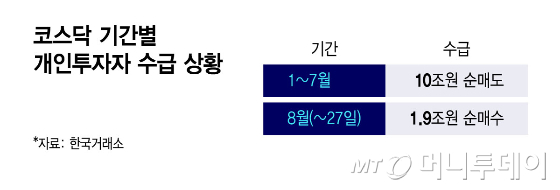
Analysts suggest that liquidity in KOSDAQ, which had been tightly constrained since the launch of single-stock leverage ETFs (exchange-traded funds), is gradually easing. Personal investors who had ignored KOSDAQ throughout this year have returned, net purchasing nearly 2 trillion won in August alone. Funds are also actively flowing into KOSDAQ ETFs, breathing new life into the market.
According to data from Korea Exchange (KRX) on the 27th, personal investors net purchased approximately 1.9 trillion won in KOSDAQ stocks during August alone. This contrasts sharply with the trend of net selling over 10 trillion won from the beginning of the year through the end of July.
Unlike KOSPI, which is heavily influenced by foreign investor inflows, KOSDAQ has traditionally been a market supported by domestic personal investors. Last year, individuals net purchased more than 7 trillion won exclusively in KOSDAQ stocks. In April as well, personal investors net purchased over 3 trillion won in KOSDAQ within a single month, pushing the index above 1,200.
However, following the launch of single-stock leverage ETFs at the end of May, liquidity concentrated only on KOSPI blue-chip stocks and single-stock leverage ETFs tracking them, causing the KOSDAQ index to fall to around 630, nearly half its peak level.
Fortunately, since financial authorities announced measures regarding single-stock leverage ETFs, the domestic stock market has shown signs of fund rotation (sequential movement of buying pressure) up to this day. The securities industry believes that KOSDAQ has also regained some vitality in terms of supply and demand.
In fact, the KOSDAQ ADR (Advance-Decline Ratio), which indicates the ratio of rising stocks to falling stocks, reached 130% today, entering an overbought zone beyond equilibrium. The ADR shows whether selling or buying pressure is concentrated among listed companies. An ADR of 100% indicates a balance between rising and falling stocks; above 120% signals an overbought condition, while below 70% indicates an oversold situation.
For about two months from the launch of single-stock leverage ETFs at the end of May until government measures were announced at the end of July, KOSDAQ ADR mostly remained in the oversold zone, fluctuating between 40 and 80, indicating poor supply and demand conditions. Considering this, analysts conclude that the market has breathed new life within just one month.
Funds are flowing not only into spot markets but also into KOSDAQ ETFs. Among KOSDAQ ETFs, KODEX KOSDAQ150, which has the largest net assets, saw 458.3 billion won in new inflows over the past month, ranking fifth among all ETFs. During the same period, similar products such as TIGER KOSDAQ150 received 35.8 billion won, and ACE KOSDAQ150 received 7.8 billion won.
The flow of funds into KOSDAQ active ETFs, which debuted in March this year, is also significant. Over the past month, KIWOOM KOSDAQ150 Covered Call Active received 27.1 billion won, KoAct KOSDAQ Active received 12.5 billion won, TIME KOSDAQ Active received 2.8 billion won, TIGER Technology Transfer Bio Active received 2.1 billion won, and DS KOSDAQ Active received 1.7 billion won.
The securities industry advises that while KOSDAQ's valuation is lower than KOSPI's, investors should focus on the differentiated performance momentum of information technology (IT) sectors centered on materials, components, and equipment (MCE) in semiconductors as a key investment point.
Ha Jae-seok, a researcher at NH Investment & Securities, stated, "Since August, the net asset value and trading volume of single-stock leverage products have decreased, and personal investors' concentration on semiconductors has eased." He added, "Due to institutional changes such as differentiated performance momentum, strengthened delisting rules, and the introduction of a tiered system, future supply and demand are expected to become polarized. Therefore, investing in KOSDAQ active ETFs will be effective."

 in STOCK
