

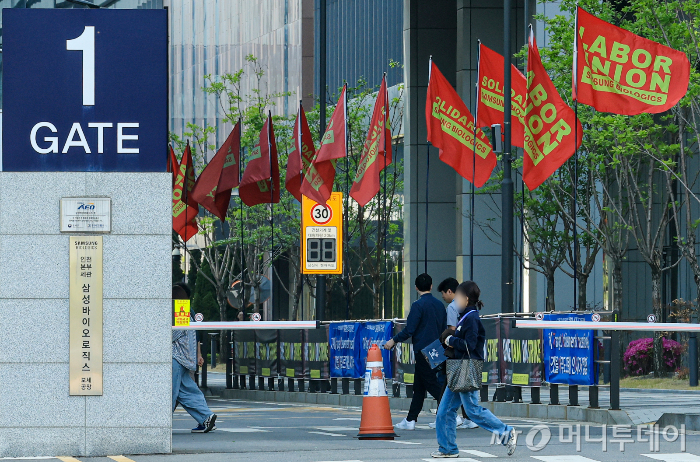
As the Samsung Biologics labor union has warned of a strike, concerns are emerging that the fundamental competitiveness of its biopharmaceutical CDMO (Contract Development and Manufacturing Organization) business could be undermined. This is because if the union proceeds with a strike despite the court issuing an injunction against it, the trust of global clients could plummet. Furthermore, there are indications that instability in the supply stability of biopharmaceuticals could ultimately lead to harm to patients.
According to industry sources on the 19th, the Samsung Biologics union is deliberating on its future plans, including whether to change the schedule for the general strike it had announced for the 26th. Previously, as the court effectively restricted the union’s strike, the possibility of changing the general strike schedule has emerged. The union maintains that there are no changes to its execution plan for collective action.
On the 16th, the First Civil Division of the Incheon District Court under the Seoul High Court ruled in favor of Samsung Biologics in an appeal regarding a preliminary injunction against labor disputes filed by the company, granting the injunction for all nine production lines requested by the company. Consequently, the Samsung Biologics union must ensure the normal operation of production equipment even during the period of labor dispute action.
The court’s ruling is interpreted as being influenced by the judgment that the supply stability of biopharmaceuticals produced by Samsung Biologics is critical. The tribunal stated, “Considering the social impact of supply disruptions for treatments such as cholangiocarcinoma and metastatic breast cancer, for which no alternative drugs exist, the necessity for preservation is recognized,” and noted, “The only way to prevent the deterioration of raw materials and products during the biopharmaceutical production process is to complete the (cultivation and purification) processes.”
Previously, the union announced that it would launch a second general strike for three weeks starting from the 26th. This period is more than four times longer than the five-day first general strike conducted in May. The estimated damage caused by production disruptions resulting from the union’s first general strike is approximately 150 billion won. This figure does not reflect intangible values such as a decline in client trust. There are significant concerns that if the second general strike materializes, it will cause greater direct damage, as well as issues regarding declining client trust and instability in biopharmaceutical supply.
In reality, biopharmaceutical production is a “continuous process” that suffers massive damage from even a single shutdown, unlike general manufacturing industries. Due to the nature of the process involving the cultivation of living cells, if operations stop once, all cells being cultivated must be discarded. Additionally, it takes several days and significant costs for cleaning and validation work required to restart the equipment.
In particular, in the biopharmaceutical CDMO business, trust in supply and delivery schedules, as well as safety, are core elements. If the risk of union strikes repeats, client trust will inevitably decline. Uncertainty in drug supply can act as a fatal disqualifying factor when global pharmaceutical companies select CDMO partners. In the fiercely competitive global biopharmaceutical CDMO market, the departure of major clients is an issue that can be directly linked to a decline in competitiveness.
Furthermore, if the union actually forces through a strike and causes disruptions in the production and supply of treatments for severe diseases such as anticancer drugs, it could lead to harm to patients. The court’s decision to grant the preliminary injunction against labor disputes can also be interpreted as being supported by the judgment that processes involving the quality and safety of drugs delivered to patients must not be halted even during a strike. The reason the biopharmaceutical industry views the Samsung Biologics union’s strike more seriously is that it requires considering not only the value of labor rights but also an ethical approach regarding patients’ right to life.
An industry official said, “While legitimate discussions regarding workers’ working conditions should be respected, strategies that use methods which could affect the supply stability of biopharmaceuticals and, further, the continuity of patient treatment as negotiation cards require greater caution.” They added, “Considering the particularities of the biopharmaceutical CDMO business, the union’s general strike can be seen as an action that shakes the foundation of the company.” The official continued, “If the Samsung Biologics union’s strike materializes, it could negatively affect not only the trust of CDMO clients but also the global perception of K-Bio as a whole.”

 in THEBIO
