

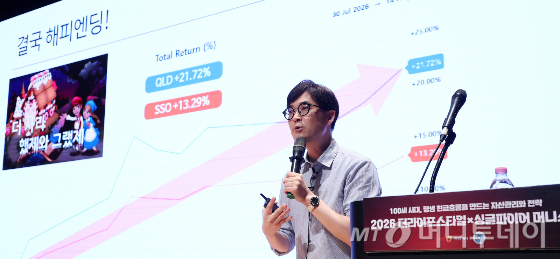
"From mid-May for about four months, the most stable stock that showed slow but steady upward growth was the U.S. S&P 500 Index, which rose by 2.87%. Other well-known stocks experienced extreme volatility. The QQQ, which tracks the U.S. NASDAQ-100 Index, Nvidia, and KOSPI all declined."
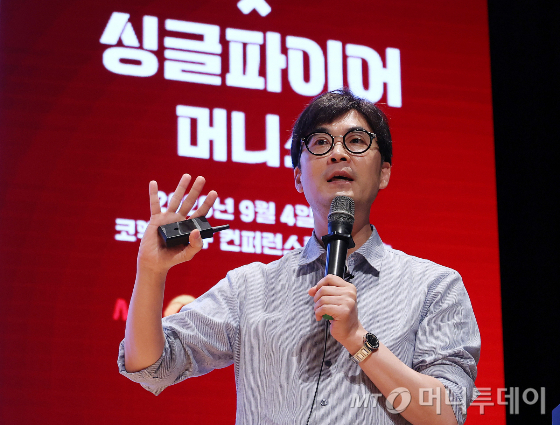
Pompo Kko, author of 'Retire with Just Three U.S. ETFs' and an economic writer who achieved early retirement through U.S. index ETF investing, presented on 'How Individual Investors Can Survive in a Highly Volatile Stock Market' at the MoneyToday '2026 The Lifestyle X Single Fire Money Show' held on the 4th at COEX in Seoul Gangnam-gu. He emphasized that investors should consistently accumulate small amounts of the U.S. S&P 500 Index, which has low volatility and a long-term upward trend, believing that time will ultimately prevail.
At the end of July, the KOSPI and KOSDAQ markets experienced record-breaking declines, with circuit breakers—a market stabilization measure—triggered for two consecutive trading days. Pompo Kko pointed out that while past volatility was often caused by national disasters, recent market fluctuations have become highly sensitive to relatively minor issues such as Chinese company listings and supply-demand dynamics. This volatility is a natural phenomenon in the KOSPI due to the significant weight of Samsung Electronics and SK Hynix within the index.
"The KOSPI market does not reflect the characteristics of a national index but rather shows volatility driven by individual companies like Samsung Electronics and SK Hynix," he said. "For AI (artificial intelligence) and semiconductor-related stocks, it is natural for prices to rise more than 10% when earnings are good or fall by 10% when earnings are poor."
According to Pompo Kko, the 100th-year average return of the U.S. S&P 500 Index stands at 10%. While investment products have occasionally outperformed the S&P 500 over certain periods, he explained that no product has surpassed it over such a long timeframe as 100 years.
"Investment products validated by historical data are U.S. indices," Pompo Kko stated. "Ultimately, the winning investment is one where you can buy and accumulate without worrying about when to sell." He himself has accumulated assets in U.S. indices totaling between 1.5 billion won and 2 billion won without selling.
He stressed the importance of distinguishing between 'core assets' and 'satellite assets' and allocating them appropriately. Core assets are those that can be accumulated indefinitely without needing to sell, such as the U.S. S&P 500, NASDAQ, and SCHD, a representative U.S. dividend stock ETF. Satellite assets follow short-term themes and require careful consideration of selling timing. Examples include semiconductors that led the first half of this year, as well as past themes like nuclear power, secondary batteries, and biotechnology.
He also recommended accumulating dollar-denominated assets steadily. Pompo Kko noted, "As the won-dollar exchange rate continues to rise, most Koreans have their assets tied up in the won, including real estate." He added, "In an environment where the value of the won is declining, it is crucial to accumulate dollar assets, which serve as the world's reserve currency."
He explained the importance of investing in dollar assets by comparing Korea's minimum hourly wage with the won-dollar exchange rate appreciation. This year, Korea's minimum hourly wage reached 10,130 won, a rise of approximately 37% compared to 2018. However, during the same period, due to the depreciation of the won, the equivalent value in dollars increased only slightly from $6.84 (using an average annual exchange rate of 1,100 won) to $6.88 (at 1,500 won).
Pompo Kko advised, "The reason hard work and rising wages do not lead to improved living conditions or easier spending is that real nominal income is declining." He recommended converting salaries into dollars each time they are received, accumulating assets in dollars—particularly through U.S. indices rather than bank deposits—and using won for daily consumption.

 in STOCK

