

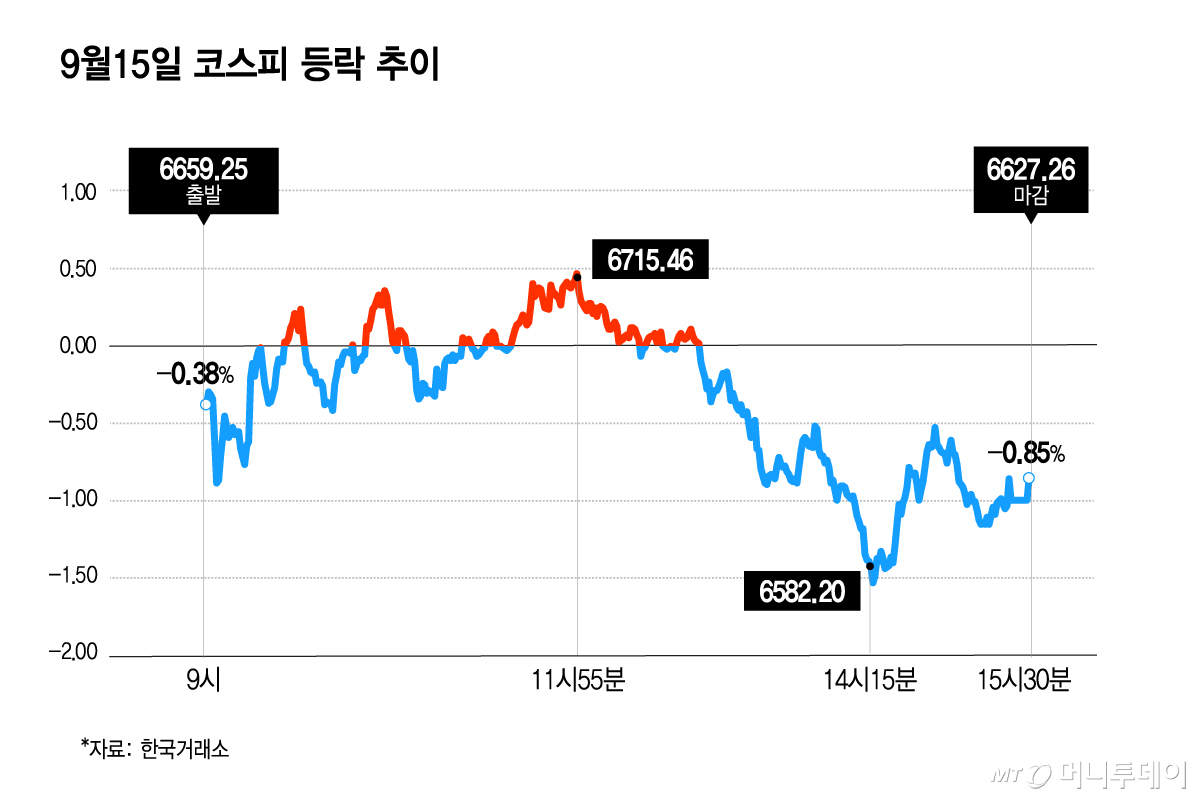
The KOSPI index closed slightly lower after a mixed session on Tuesday, standing at the 6,600 threshold. A wave of bargain buying that flowed in following the sharp drop the previous day scattered amid the fallout from rising U.S. interest rates. With market direction clouded by interest rate anxiety, securities firms are forecasting heightened short-term volatility until major countries decide on their base rates.
On this day, the KOSPI index closed at 6,627.26, down 57.11 points (0.85%) from the previous trading day. The intraday high-low spread was 133.26 points. In the Korea Exchange and Next Trade regular sessions, other corporations net-bought 1.6504 trillion won worth of stocks, individuals net-bought 1.1940 trillion won, while foreign investors net-sold 1.7055 trillion won and institutional investors net-sold 1.1432 trillion won.
Samsung Electronics closed down 500 won (0.20%) at 248,500 won, and SK Hynix closed down 7,000 won (0.41%) at 1.69 million won. Among the top 10 stocks by market capitalization, LG Energy Solution showed a solitary strong trend in the 3rd% range, while Samsung Life Insurance fell in the 4th% range, Samsung C&T and KB Financial Group fell in the 3rd% range, and Samsung Electro-Mechanics and Hyundai Motor closed weakly in the 1st% range. Samsung Biologics closed roughly flat, and SK Square recorded a flat close.
The index repeatedly flipped between gains and losses within ±1%, but expanded its decline after noon, falling to 6,582.20 (down 102.17 points or 1.53% from the previous day) around 2:15 p.m. before rebounding. This occurred just as U.S. 10-year Treasury prices traded in Asian markets fell again, pushing yields to break through 5%. The intraday high of 5.030% for yields marked a new peak since July 2007.
Lee Kyung-min, a researcher at Daishin Securities, stated, "Following the KOSPI's sharp drop of 225.54 points (3.26%) yesterday, there was a perception that bad news had already been priced in, leading to semiconductor rebound buying during the morning session." He added, "The reason for the reversal into an afternoon decline was macroeconomic deterioration, including rising U.S. 10-year yields and Brent crude futures prices, causing NASDAQ-100 futures and the Nikkei 225 index to give up their gains."
He further explained, "Although there were no new bad news items, additional rises in interest rates and oil prices led to a weakening of the perception that 'bad news had already been priced in' and reduced bargain buying. Amid an unstable external environment, sector-specific divergent trends emerged, and particularly under selling pressure from foreign investors and institutional investors, the burden on large-cap stocks expanded."
The approaching "Interest Rate Superweek" is fueling anxiety in the domestic stock market. In Korean time, the U.S. Federal Reserve (Fed) is scheduled to announce its base rate decision following the Federal Open Market Committee (FOMC) results early on the 17th. The Bank of England (BOE) will reveal its decision at 8 p.m. on the same day, and the Bank of Japan (BOJ) will announce its direction around noon the following day.
Im Jeong-eun and Tae Yun-seon, researchers at KB Securities, stated, "With monetary policy decisions looming in the U.S. and Japan, concerns over slowing artificial intelligence (AI) development speeds are compounding, increasing the likelihood of expanded short-term stock market volatility."
The KOSDAQ index closed up 5.62 points (0.70%) at 812.41 from the previous day. Institutional investors net-bought 113.4 billion won worth of stocks, foreign investors net-bought 69.2 billion won, while individuals net-sold 185.6 billion won.
Among top market-cap stocks, IOTech showed a strong trend in the 4th% range, EcoPro and Rainbow Robotics showed strength in the 3rd% range, and EcoPro BM showed strength in the 2nd% range. Simtek closed with a slightly strong flat trend. On the other hand, Juseong Engineering closed weakly in the 6th% range, while Wonik IPS and Rino Industrial closed weakly in the 1st% range. Altogen closed roughly flat.
By sector, KOSDAQ transportation equipment showed strength in the 4th% range, and finance and other manufacturing showed strength in the 1st% range. Electrical electronics, chemicals, manufacturing, pharmaceuticals, machinery equipment, publishing media, general services, IT services, entertainment culture, medical precision, and paper/wood sectors showed slightly strong flat trends. Telecommunications, metals, distribution, non-ferrous metals, food/beverages/tobacco, transportation/storage, construction, and textiles/apparel closed in the slightly weak flat range.
On this day, the won/dollar exchange rate closed at 1,359.4 won, down 12.1 won from the previous day, concluding Seoul's foreign exchange market weekly trading.

 in STOCK
