

The Federal Reserve System (Fed) has raised its base rate for the first time in over three years, triggering warning signs for the profitability of domestic securities firms. Rising market interest rates could lead to larger mark-to-market losses on held bonds, while the interest rates on funding products such as commercial paper—being expanded by major securities firms—are also likely to increase. This creates a structure where rising interest rates squeeze securities firms' earnings from both asset management and fund-raising sides.
According to the financial investment industry on the 17th, securities firms are primarily affected in their bond management divisions. When market interest rates rise, the prices of existing held bonds fall, potentially worsening mark-to-market gains or losses. Securities firms that manage large-scale bond positions using their own capital may face increased volatility in trading and product management earnings if interest rates spike sharply within a short period.
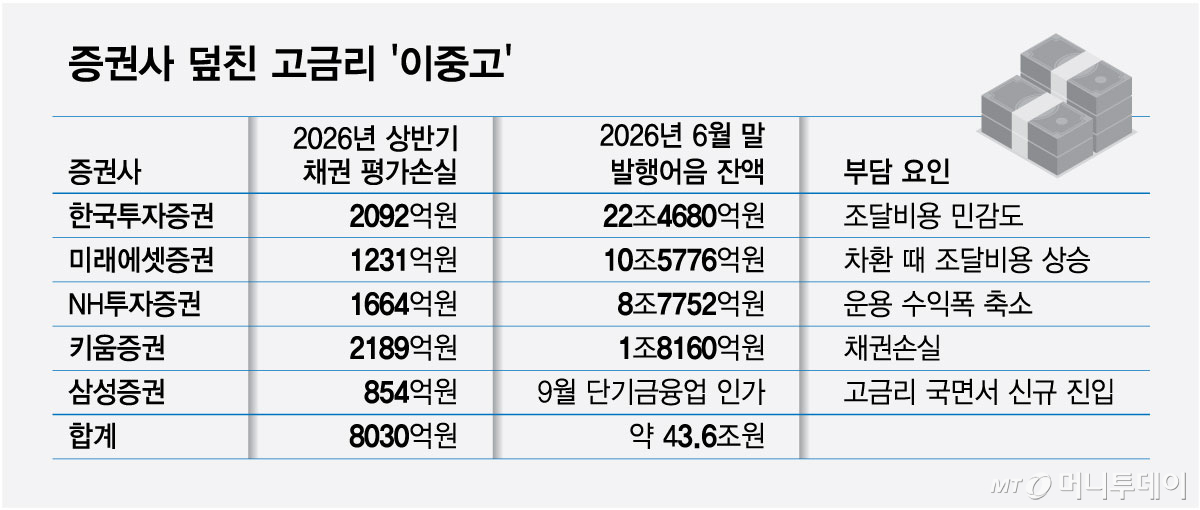
The six-month bond mark-to-market results for five major securities firms—Mirae Asset Securities, Korea Investment & Securities, NH Investment & Securities, Kiwoom Securities, and Samsung Securities—recorded a total loss of 803 billion won in the first half of this year, a deterioration of 1.1825 trillion won compared to a profit of 379.5 billion won in the same period last year. By company, Kiwoom reported a loss of 218.9 billion won, Korea Investment 209.2 billion won, NH Investment 166.4 billion won, Mirae Asset 123.1 billion won, and Samsung 85.4 billion won.
The Financial Supervisory Service (FSS) previously instructed major securities firms in June to prepare hedging measures against the possibility of rising interest rates. Securities firms maintain that rising interest rates will not immediately lead to additional losses. A securities industry official stated, "We are continuously hedging interest rate risks by adjusting bond maturities and durations and utilizing instruments such as Treasury futures and interest rate swaps," adding, "Bonds maturing soon can be replaced with new bonds at higher interest rates, potentially boosting interest income."
Rising interest rates are also expected to impact fund-raising activities. As of the end of June, the outstanding amount of commercial paper issued by Korea Investment, Mirae Asset, NH Investment, and Kiwoom totaled approximately 43.6 trillion won. With Samsung Securities receiving approval for short-term financial business this month, the number of comprehensive financial investment firms eligible to issue commercial paper has increased to eight.
Commercial paper refers to principal-and-interest-guaranteed notes maturing within one year. While not all existing outstanding amounts will see their costs rise at once, if market interest rates remain at high levels, funding rates could increase during the issuance of new paper and refinancing of maturing instruments. NH Investment & Securities' average funding rate for commercial paper in the first half of this year rose to 2.70%, higher than the annual average of 2.65% in 2025.
Interest rate competition due to new market entrants is also a variable. Samsung Securities internally analyzed that if interest rate competition on commercial paper becomes overheated, rising funding costs could squeeze operating margins. The firm also identified the ability to identify investment opportunities for raised funds as a key factor determining profitability.
If funding rates rise faster than the returns on existing managed assets, securities firms may need to raise their target return rates for new investments. In such cases, there are concerns that firms could be incentivized to expand operations into assets offering relatively higher returns, such as corporate lending, investments in unlisted companies, or bonds issued by low-credit corporations.
Due to U.S. interest rate hikes, securities firms now face the challenge of not only defending their bond portfolios but also securing investment returns that exceed rising funding costs. In an environment of rising interest rates, operational capabilities that ensure profitability while controlling risks are expected to become increasingly important.

 in STOCK
