

The Federal Reserve System (Federal Reserve·Fed) unanimously decided to raise the base rate for the first time in three years and two months, intensifying upward pressure on global government bond yields. Rising government bond yields lead to deteriorating returns for bond-type funds and make it difficult to issue new corporate bonds. Concerns are raised that corporate debt will increase.
According to the financial investment industry on the 17th, the U.S. Federal Reserve decided at its Federal Open Market Committee (FOMC) meeting on the 16th (local time) to raise the base rate by 25bp (1bp=0.01 percentage point), setting it at an annualized 3.75% to 4.00%. Kevin Warsh, Federal Reserve chairman, stated that while inflation concerns remain high, economic activity is robust and the focus is on price stability. He also assessed that the current interest rate level is still not sufficiently restrictive, lending weight to the possibility of additional rate hikes within the year.
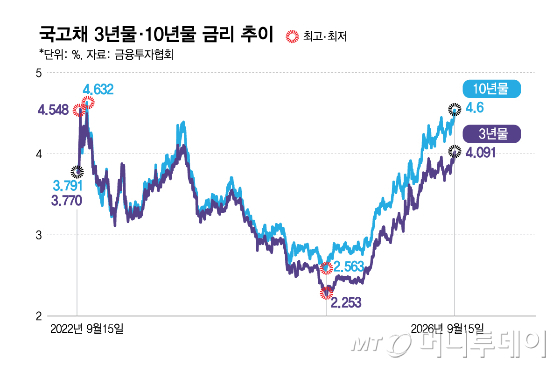
The U.S. base rate hike is expected to further fuel the upward trend in global government bond yields. According to the Korea Financial Investment Association's Bond Information Center on this day, the 3rd-year government bond yield closed up 1bp from the previous day at 4.063%. The 10-year yield fell by 4.1bp but recorded 4.506%, surpassing 4.5%. The U.S. 10-year Treasury yield also broke through the 5th% range again following the Federal Reserve's announcement of the base rate hike.
Im Jae-kyun, a researcher at KB Securities, stated, "With high oil prices persisting and the Federal Reserve raising the base rate, the dollar index has surpassed 100 points, increasing downward pressure on the won," and predicted that "rising international oil prices, combined with the Federal Reserve's tightening measures and a weakening won, will act as factors driving up Korean government bond yields."
As government bond yields continue to show instability, an emergency has been declared for domestic and foreign government bond fund management. Bond prices move in the opposite direction of bond yields; when yields rise, prices fall. Consequently, during periods of rate hikes, longer-term bonds tend to suffer worse returns. This is because they are locked into relatively lower rates for a longer period, so their prices must fall to avoid losing attractiveness compared to new bonds with higher yields. In fact, the recent six-month returns of U.S. and Korean long-term bond ETFs (exchange-traded funds) listed domestically were recorded at -10% and -4%, respectively. All periods from one month to one year showed negative returns.
A representative from an asset management company said, "We are responding conservatively by increasing the proportion of short-term bonds and reducing duration (price sensitivity) compared to benchmark indices," and added, "We are also focusing on including bonds with relatively high yield-to-maturity (YTM) to recover valuation losses through interest income."
The sparks from rising government bond yields have also splashed onto the corporate funding market. If investors can expect annual returns of 4% to 5% or more solely from safe-haven assets like government bonds, the incentive to invest in corporate bonds with relatively higher credit risk diminishes. From a corporate perspective, securing investment demand requires offering higher yields, so the burden of issuing corporate bonds is bound to increase.
In fact, according to the Korea Financial Investment Association, net issuance of corporate bonds from the beginning of the year until this day amounted to 4.8354 trillion won, a sharp 81% drop compared to 25.8037 trillion won during the same period last year. With demand contraction also occurring, companies have turned to short-term bank borrowing for funding instead of issuing corporate bonds, and debt burdens are expected to continue for some time.
Kim Sang-in, a researcher at Shinhan Investment Corp, stated, "Corporate borrowings and bonds increased significantly by 75.2 trillion won in the first half of this year, driven primarily by short-term borrowings," and added, "Companies appear to be aiming to increase long-term funding later by accepting shorter refinancing cycles now while interest rates are low or when rate volatility subsides."

 in STOCK
