

The financial authorities have launched a special initiative with the industry to prevent stock market volatility from expanding due to so-called margin investing (investing with debt) (investing with borrowed money). According to the Financial Supervisory Service on the 20th, at the 'Financial Consumer Protection Performance National Reporting Conference' held on the 17th, it was announced that improvement plans for credit lending and margin trading would be prepared. A financial authority official stated, "We are currently in discussions with the industry and expect to announce countermeasures soon."
Lee Eung-won, Chairman of the Financial Services Commission, also said in a congratulatory address at the 29th anniversary conference of the Korea Financial Investment Association held on the 18th that "we will closely manage stock market leverage such as credit lending and prepare more detailed volatility mitigation measures, including the introduction of market stability and emergency action powers by the Financial Services Commission during crisis situations."
The countermeasures are expected to focus on informing investors sufficiently and in a timely manner about the risks of margin investing (investing with debt) and the forced liquidation structure to prevent investor losses. Accordingly, measures under review include restricting margin trading for minors, requiring additional confirmation documents from elderly investors, providing prior simulations regarding conditions triggering forced liquidation and potential loss ranges, and improving procedures for prior notification of forced liquidation.
In addition, proposals have been raised to reduce securities firms' credit lending limits further below 100% of their own capital and to directly reduce scale through adjustments to credit lending collateral ratios and margin requirements. Since large securities firms previously took independent measures such as temporarily suspending credit transaction loan services or reducing limits due to a surge in margin investing (investing with debt) last March, it is expected that similar actions could be taken in emergency situations such as an expansion of stock market volatility.
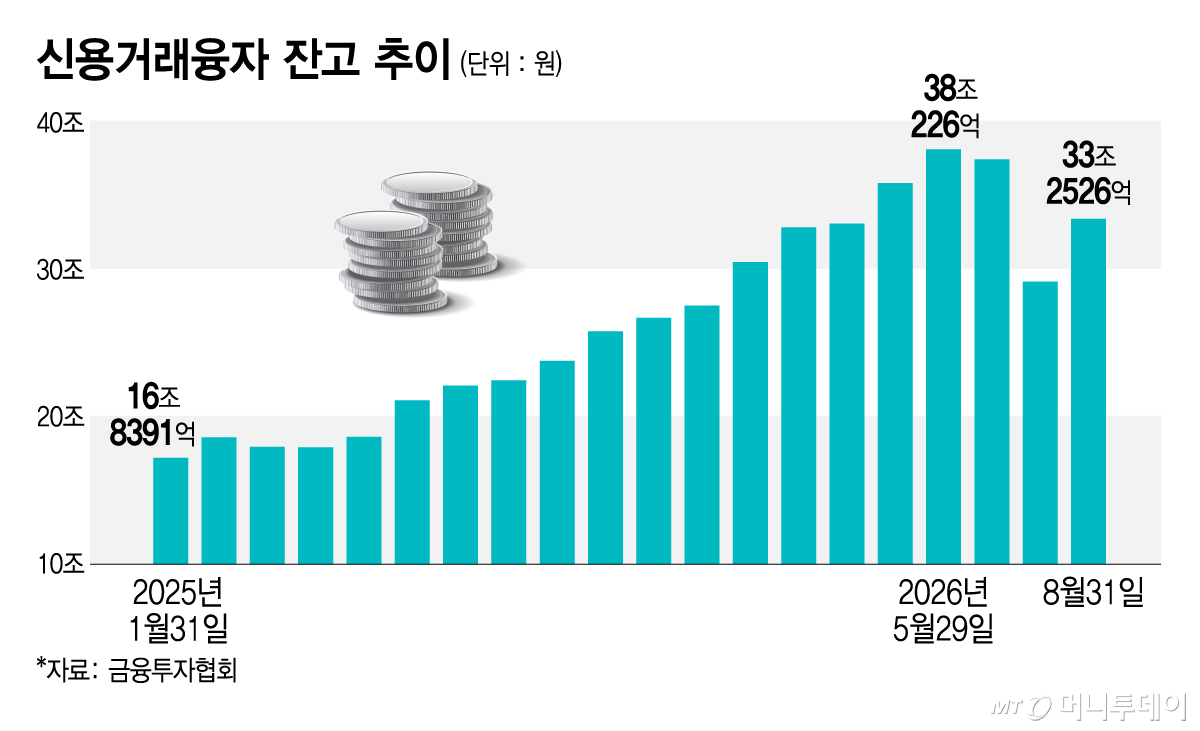
The financial authorities have launched countermeasures because they recently judged that there is a high correlation between recent stock market volatility and margin investing (investing with debt). The daily return volatility of the KOSPI rose from 1.4% last year to 3.6% in the first half of this year, a 2.5-fold increase. According to statistics from the Korea Financial Investment Association, as of the end of last month, the outstanding balance of credit transaction loans in the domestic stock market reached 33 trillion 252.6 billion won, nearly doubling compared to January last year (16 trillion 839.1 billion won). Credit transaction loans refer to the amount investors borrow from securities firms to purchase stocks.
The problem is that as margin investing (investing with debt) increases, the risk of losses for individual investors grows and market volatility can also expand. In credit transaction loans, if stock prices fall and the collateral ratio drops below a certain level, stocks are forcibly liquidated (forced selling). If large volumes of forced sales occur simultaneously, they can trigger further stock price declines, thereby expanding market volatility.

 in STOCK
