

It has been revealed that securities firms' funds are tied up in one out of four distressed real estate project financing (PF) sites where sales have repeatedly failed. Although the government plans to normalize distressed PF sites, even waiving capital adequacy regulations to ensure rapid housing supply, most of these sites are located outside Seoul, making normalization difficult, according to critics.
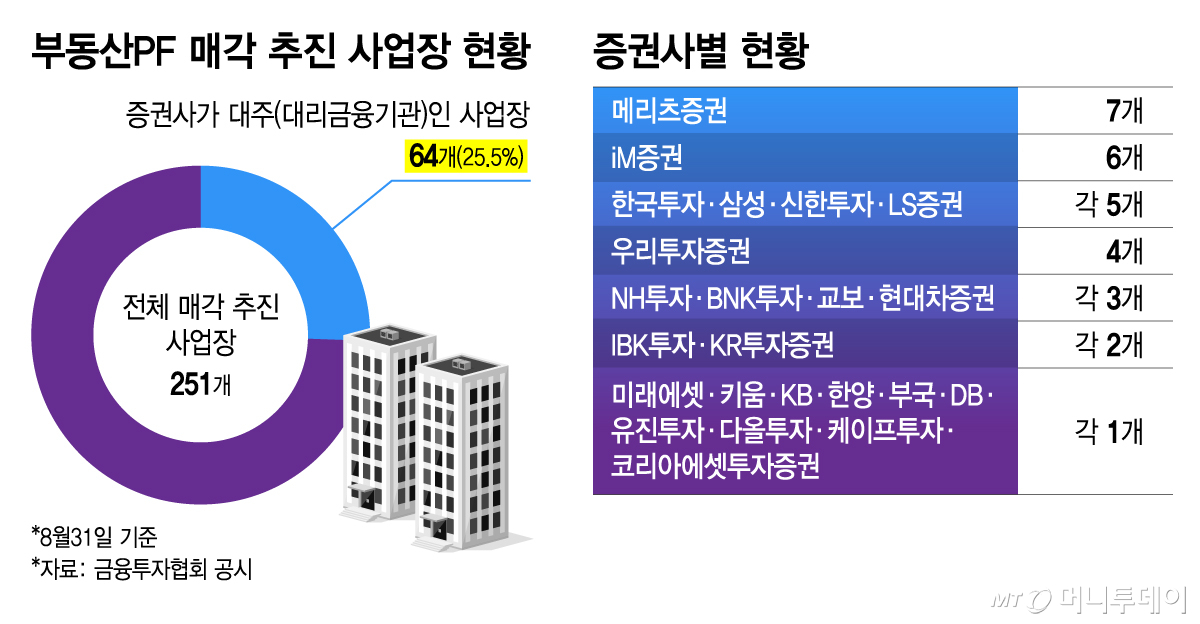
According to public disclosures by the Korea Financial Investment Association on the 21st regarding real estate auction PF site information, as of the end of August, a total of 251 sites remain without owners and are awaiting sale. These sites are categorized into: △pre-construction sites where only land has been secured but construction has not started; △sites where construction is underway but progress is slow; and △sites where construction is complete but have failed auction attempts multiple times.
Among these, 64 PF sites involve securities firms as proxy financial institutional investors (lender syndicates), accounting for 25.5%. By sector, securities firms hold the second-largest share after mutual financial institutions such as regional agricultural cooperatives and Saemaeul Credit Unions.
Looking at individual securities firms, Meritz Securities has the most with seven sites. iM Securities follows with six sites. Korea Investment & Trust, Samsung, Shinhan Investment, and LS Securities each have funds tied up in five sites that they could not recover. Woori Investment & Trust is involved in four sites, while NH Investment & Trust, BNK Investment, Kyobo, and Hyundai Motor Securities each have funds tied up in three sites under sale consideration.
The problem lies in the fact that while securities firms' real estate project financing soundness is deteriorating, the government is rushing to normalize these sites. As of the end of March, the risk exposure (exposure) of PF projects with caution or distress concerns in the securities industry totaled 3.7 trillion won, an increase of 200 billion won from the previous quarter. Non-performing loans where loan repayments are not being collected accounted for 14.57% of the total, also rising by 1.27 percentage points compared to the previous quarter.
The deterioration in securities firms' real estate project financing soundness is due to insufficient business viability and a lack of market demand. In fact, only five of the 64th sites are located in Seoul: △Gangnam-gu apartments (Samsung Securities), △two apartment complexes in Jungnang-gu (each by Bukuk Securities and Shinhan Investment Corp), △other residential facilities in Dobong-gu (Kyobo Securities), and △other residential facilities in Gwangjin-gu (Woori Investment & Trust).
Most are office apartments, mixed-use residential-commercial buildings, or logistics centers in Gyeonggi-do and Incheon, or non-metropolitan area apartments, mixed-use complexes, and office apartments. As housing demand concentrates in Seoul, the demand gap between Seoul and non-Seoul areas has widened, leaving many sites without owners despite multiple auctions.
In response, the financial investment industry expresses agreement with the government's intent to increase housing supply but urges caution regarding its effectiveness. A financial industry official stated, "PF sites funded by securities firms are relatively concentrated in non-Seoul areas or have a high proportion of office apartments and logistics centers rather than apartments. Unless there is fundamental demand support, there are limits to how much they can affect unsold projects in local regions."
There are also opinions that current policies alone are insufficient to save sites that have not yet been restructured, as their business viability has significantly declined, creating a large "price gap" between buyers and sellers. Another financial industry official noted, "The most problematic cases are those with EOD (end-of-day loss), which are mostly in non-Seoul areas. Restructuring requires cooperation between developers and contractors, but it remains uncertain whether government intervention can accelerate this process."
While the government has decided to waive capital adequacy regulations for PF projects related to housing for two years, critics argue that this will not be effective in either soundness management or speed improvement. With current delinquency rates failing to fully reflect actual risks, combining regulatory easing with such conditions makes qualitative improvement of real estate project financing difficult.
According to Korea Credit Rating's stress test on real estate project financing, if actual risks are reflected, non-performing PF would increase from 6 trillion won to 12.7 trillion won, requiring securities firms to additionally set aside 1.1 trillion won in reserves.
A financial industry official remarked, "It is difficult to expect rapid increases in new PF and housing supply solely through capital adequacy regulation waivers." They added, "To enhance policy effectiveness, expedited permitting procedures, credit enhancement through policy financing and institutional investors, and expanded supply from senior-ranking financial institutions must be implemented simultaneously."

 in STOCK
