

Financial authorities have opened the path for investors who subscribed to the first-tier National Participation Growth Fund (hereinafter "National Participation Fund") through banks to sell their holdings on the exchange. Although the fund was listed in the form of profit certificates on the 9th, trading was previously restricted to bank subscribers only; this measure addresses that limitation. The financial authorities have upgraded the system to allow investors to transfer their fund ownership to major securities firms.
According to financial authorities and the financial investment industry on the 22nd, the system has been adjusted to enable investors who subscribed to the National Participation Fund through banks and now wish to sell their holdings listed on Korea Exchange (KRX) KOSPI in the form of profit certificates to transfer those funds to Mirae Asset Securities, Samsung Securities, or KB Securities.
The National Participation Fund is part of the National Growth Fund established to foster advanced strategic industries such as growth companies. It is a five-year closed-end product that allows ordinary citizens to directly participate in raising investment capital. The first-tier National Participation Fund launched sales on May 22 with a target of 600 billion won and achieved commercial success, concluding within just five business days.
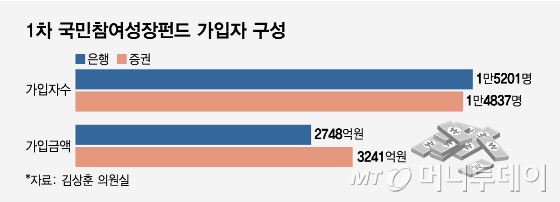
Banks sold the fund to 15,201 investors totaling 274.8 billion won, while securities firms sold it to 14,837 investors totaling 324.1 billion won. Although the fund was listed on KOSPI in the form of profit certificates on the 9th in compliance with laws and regulations, investors wishing to trade before maturity can now sell through the regular market.
However, controversy arose because only those who subscribed through securities firms could trade, even though they were part of the same National Participation Fund. Despite subscribing under identical conditions, investors who joined via banks—constituting more than half of all subscribers—were unable to trade with other investors.
The reason is that banks are prohibited from handling entrusted trading orders for products listed on stock exchanges. This is the same rationale behind why banks cannot sell stocks or ETFs (exchange-traded funds). Although some banks recently requested financial authorities to allow real-time management of ETFs, securities firms have opposed such moves, arguing that ETF trading falls under their core business as investment intermediaries, making it difficult under current laws.
Consequently, the financial authorities have exceptionally permitted a measure allowing investors who subscribed through banks to sell by transferring their funds to securities firms and then purchasing them on the exchange, aiming to ensure fairness.
Particularly, since establishing the necessary IT infrastructure for related systems may take considerable time, the authorities temporarily enabled investor-to-investor transfers through Mirae Asset Securities, Samsung Securities, and KB Securities, which already have the required fund adjustment infrastructure in place.
A financial authority official stated, "With sales of the second-tier National Participation Fund set to begin at the end of this month, we plan to further activate IT systems between banks and securities firms to ensure fairness when listing these products. We will also consider policy directions based on the trading volume of profit certificates from the first-tier National Participation Fund."
However, some segments of the securities industry argue that there is no urgent need to rush IT system development, as overall efforts to purchase the National Participation Fund on the exchange remain limited.
A securities industry official remarked, "We plan to expedite IT development alongside authorities for investor convenience," but added, "Since trading funds through stock market transactions would result in loss of tax benefits such as a 18 million won income deduction and separate taxation at 9.9% on dividend income, there will likely not be many investors attempting to sell on the exchange."

 in STOCK
