

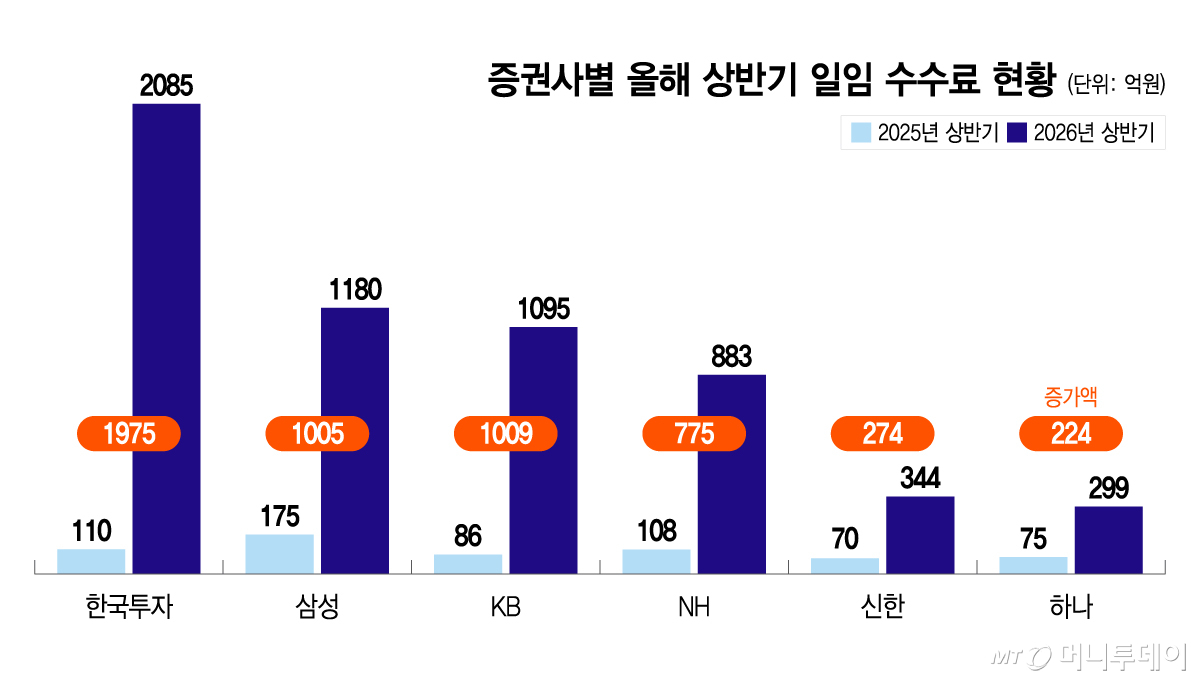
It has been confirmed that some brokerages' RAP account revenues have increased by dozens of times compared to the same period last year. Fees paid to advisory firms have also risen accordingly, which industry observers attribute to the massive sales of target-conversion RAPs. There are concerns that risk management is needed due to aggressive sales efforts.
According to electronic disclosures on the Financial Supervisory Service website on the 22nd, Korea Investment & Securities received 208.5 billion won in management fees from customers through RAP contracts in the first half of this year, an increase of 197.5 billion won (20 times) compared to the same period last year. A RAP is a comprehensive asset management (managed-type) service where brokerages operate and manage customer accounts on their behalf through investment management contracts.
Other major brokerages face similar situations. Samsung Securities collected 118 billion won in management fees, KB Securities 109.5 billion won, NH Investment & Securities 88.3 billion won, Shinhan Investment Corp 34.4 billion won, and Hana Securities 29.9 billion won in the first half of this year. Among these, Korea Investment & Securities and KB Securities recorded their highest-ever performance for the first half of the year thanks to management fees.
The increase in management fees compared to the same period last year was recorded as follows: Korea Investment & Securities (197.5 billion won), KB Securities (100.9 billion won), Samsung Securities (100.5 billion won), NH Investment & Securities (77.5 billion won), Shinhan Investment Corp (27.4 billion won), and Hana Securities (22.4 billion won).
The financial investment industry views the increase in fees for these companies as a result of aggressively selling target-conversion advisory RAP products. Target-conversion products are operated and sold based on advice from investment advisory firms such as Torus, Chesley, and Yed. Their feature is that once a target return rate of around 6% is achieved after deducting fees and various costs, the assets are converted into cash-like holdings.
Some brokerages have also seen increases in advisory fee expenses related to these products. Looking at the fee items for Korea Investment & Securities and KB Securities, which conducted the most aggressive sales, KB Securities' investment advisory fees (including investment counselor fees) for the first half of this year amounted to 9 billion won, an increase of 8.8 billion won compared to the same period last year. Korea Investment & Securities also saw other fee expenses, presumed to include investment advisory fees, rise from 54.8 billion won to 149.8 billion won during the same period.
However, target-conversion products have previously been sold in the trillions of won when first launched but repeatedly caused problems and were eventually discontinued. This was because they caused investor losses by raising concerns about incomplete sales, such as potential losses during the sales process or guaranteeing target return rates.
In particular, these products are well known for seeking high returns in a short period and being redeemed immediately upon achieving target return rates, thereby disrupting the stock market. Representative similar products include spot funds that were popular in the early to mid-1990s, Dongbu Delta Fund by Dongbu Asset Management in 2008, RCF Fund by Mirae Asset Asset Management in 2013, and Gauss Fund by Areumdari Investment Management in 2017.
The current situation is not easy either. Over the past three months, the KOSPI return rate has been -23%, showing no clear signs of recovery. Customer investments that failed to achieve target returns remain tied up without redemption. Some products have maturity dates, and if returns do not recover, they will be treated as losses.
A financial investment industry official stated, "While paying hundreds of billions of won in advisory fees to investment advisory firms and launching aggressive sales efforts, it is necessary to check whether incomplete sales are being prepared for at the front lines of sales operations." The official added, "If bank customers were introduced to products containing stocks, there would be grounds for concern."

 in STOCK
