

Financial authorities acknowledged that market volatility was amplified by the expansion of leverage in the stock market and announced a policy to rigorously manage margin investing (investing with debt).
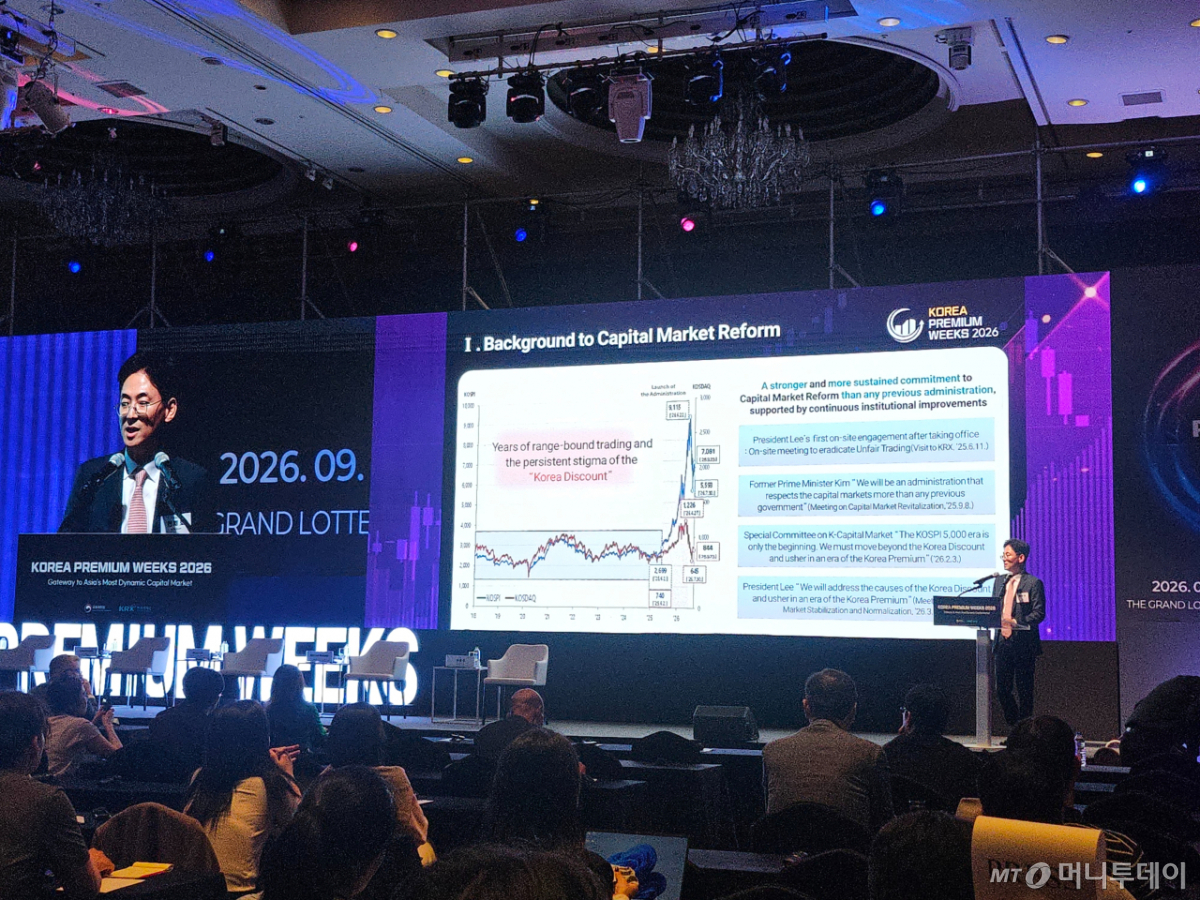
In a keynote speech at the integrated capital markets investor relations (IR) event ‘Korea Premium Week 2026’ held on the morning of the 28th in the Crystal Ballroom of The Grand Lotte Seoul in Jung-gu, Seoul, Byun Je-ho, Director of the Capital Markets Division at the Financial Services Commission, stated, “In June and July last year, the convergence of concentration in the semiconductor sector and the expansion of leverage led to increased market volatility, followed by an experience of sharp fluctuations.” He added, “We will thoroughly manage leveraged investment products, margin loans, and unsettled trades.”
Regarding the concentration in semiconductors and the expansion of leverage, Director Byun said, “It was a painful experience, but it also served as a time to learn one step ahead how to respond to crisis situations that can arise in the market environment.” He clearly stated, “Going forward, the market must grow not on the power of leverage, but on corporate performance and investors’ own funds.”
Taking the leveraged ETF incident as a lesson, the government plans to strengthen its market stabilization measures. Director Byun said, “We will reorganize the government’s contingency plan (emergency plan) for crisis preparedness to fit the new market environment,” adding, “We will also strengthen the government’s emergency market stabilization measures.”
He also hinted at strengthening regulations on high-frequency trading (HFT). Director Byun stated, “We are considering appropriate measures regarding high-frequency trading that expands market volatility,” and added, “We will actively respond to indiscriminate investment recommendations by influencers and market-disrupting activities.”
The Financial Services Commission expressed its determination to foster a ‘medium- to long-term investment culture’ in the stock market through policy tools. This includes launching the Our Children’s Independence Fund in the second half of next year, introducing a Productive Finance ISA (Individual Savings Account), and converting retirement pension funds into endowments to broaden the foundation for long-term investment demand.
Director Byun explained, “The Our Children’s Independence Fund is a system where parents and the state contribute investment funds for 19 years until a child reaches adulthood, and these funds are managed in the capital markets.” He added, “We plan to establish a separate Productive Finance ISA alongside existing ISAs and broaden channels for long-term funds to flow into the domestic stock market.”
Director Byun explained the government’s policy direction for improving the fundamental structure of the capital markets by dividing it into four areas: trust, shareholder protection, innovation, and market accessibility. Specifically, he stated that the response system for unfair trading is being strengthened through a joint task force on stock price manipulation to ensure investors can invest with confidence, and that the Commercial Act has been amended to mandate the board of directors’ duty of loyalty and the cancellation of treasury shares. Director Byun said, “Effects are gradually appearing, such as an increase in treasury share cancellations.” He added, “We introduced a separate taxation system for dividend income linked to the disclosure of corporate valuation enhancement plans, and boldly addressed the issue of duplicate listings, which has been cited as a cause of undervaluation in the stock market.”

 in STOCK
