

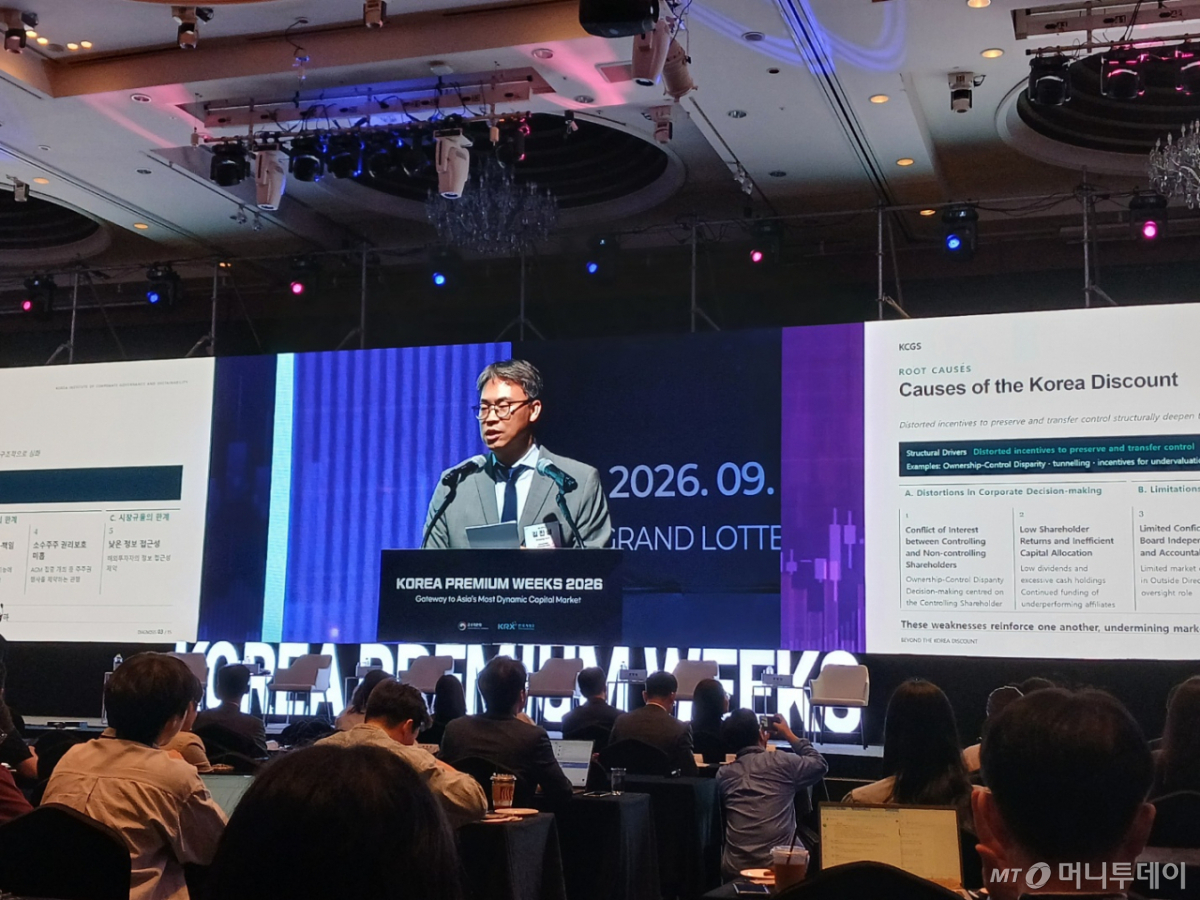
"It is difficult to find stewardship activities by Korean asset managers. I worry they are free-riding on the efforts of foreign investors and the National Pension Service."
Lee Hwa-shin, Director of Responsible Investment and Stewardship for APAC (Asia-Pacific) at Dutch pension fund APG Asset Management, made these remarks on the 28th at 'Korea Premium Week 2026' held at The Grand Lotte Seoul in Jung-gu, Seoul. He pointed out the lackluster stewardship activities of domestic institutional investors.
While the National Pension Service and foreign institutional investors engage in stewardship activities to improve corporate governance in Korean companies, such activities by domestic asset managers and other institutional investors are rarely seen.
Stewardship refers to investor activities aimed at enhancing long-term corporate value and the sustainability of the stock market. It consists of two pillars: engagement (dialogue with companies) and voting rights exercise. The director explained that asset managers should focus more on engagement activities that strengthen communication with invested companies, going beyond mere voting rights exercises.
Globally, there is a trend toward strengthening fiduciary duties for institutional investors. Recently, the UK revised regulations to require asset managers to consistently submit reports detailing their engagement processes and outcomes.
The director stated, "In the KOSPI market, foreign institutional investors, domestic institutional investors, and domestic retail investors each hold one-third of the shares. Even excluding the National Pension Service, domestic institutional investors account for over 20%." He added, "I wonder if only the National Pension Service and foreign institutional investors are raising their voices to improve corporate governance in Korean companies."
He continued, "Now we expect stewardship activities from domestic asset managers. If asset managers monitor whether companies' value-up programs function effectively through engagement activities, the entire system for developing corporate governance should operate smoothly."
The director emphasized that after government efforts to improve systems, it is now time for companies and investors to take action. He said, "Companies must disclose meaningful information to the market and establish independent boards of directors. Investors also need to engage in stewardship activities." He further noted, "If all market participants (government, companies, and investors) make efforts, investor trust in the market will grow, leading to an increase in corporate valuation."
Kim Jin-seong, Head of ESG Evaluation Division at Korea ESG Standards Institute, also highlighted that for the Korean capital market to move beyond discounting (undervaluation) toward premium pricing (overvaluation), policies on capital allocation, strengthening the role of independent directors, and comprehensive investor protection are necessary.
The division head stated, "Moving forward, discussions must expand from simply asking 'Did shareholder returns occur?' to 'How should capital be allocated?'" He added, "Independent directors must go beyond formal quantitative expansion; their actual independence and oversight functions need to be strengthened through measures such as activating nomination committees."

 in STOCK
