


Under government policies to expand commercial paper and Integrated Investment Accounts (IMA), the scale of brokerages' role as financial intermediaries and their risk-taking has grown. Amid this backdrop, with U.S. 10-year Treasury yields surging into the 5th% range, managing liquidity and soundness has become increasingly critical for domestic securities firms.
Although capital expansion has enhanced loss-absorption capacity, if high interest rates persist, funding costs, asset price volatility, and credit risks in corporate finance could all escalate simultaneously. Financial regulators are set to tighten liquidity regulations for brokerages starting next year and establish separate capital regulations for Comprehensive Investment Business Operators (CIBOs). However, experts point out that risk management systems must be refined further to match the expanded intermediation role and complex risks.
As rates soar, brokerages are 'growing bigger'
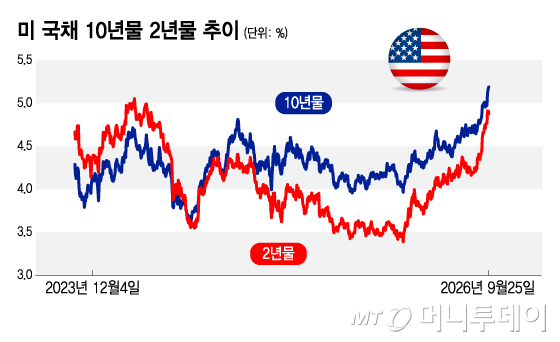
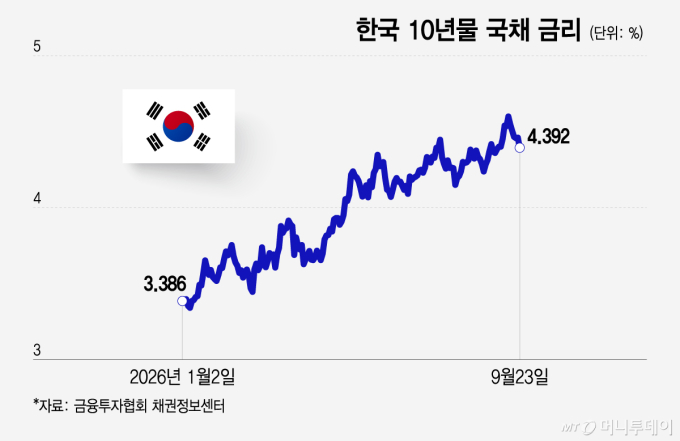
According to the financial investment industry on the 28th, the yield on U.S. 10-year Treasuries rose as high as 5.233% intraday on the 25th before closing at 5.167%. Reflecting the sharp rise in U.S. Treasury yields during the Chuseok (Mid-Autumn Festival) holiday, government bond yields also jumped significantly this morning. The yield on 3-year government bonds rose by 10.6 basis points (1bp = 0.01 percentage point) from the previous trading day to an annualized 4.112%, while the 10th-year yield increased by 15.0 basis points to an annualized 4.542%.
Analysts also argue that it is difficult to view the recent rate hikes merely as a temporary adjustment in the bond market. With inflationary pressures compounded by U.S. fiscal deficits and increased Treasury supply, there are even discussions about the possibility of 5%-range long-term rates becoming the 'new normal.'
At a time when the financial environment is becoming more turbulent, structural changes in the domestic securities industry are proceeding in a direction that actually increases risk. Financial regulators are expanding commercial paper and IMA to position brokerages as core pillars for supplying corporate finance and venture capital.
According to NICE Credit Rating, the scale of capital expansion in the securities industry from January to August this year reached 620 billion won, already surpassing last year's annual total (420 billion won). Rights offerings (paid-in capital increases) accounted for 460 billion won, while net issuance of new capital securities was 160 billion won. Capital expansion not only enhances loss-absorption capacity but also expands the room for CIBOs to broaden their business operations.
With Meritz Securities recently receiving approval, the number of commercial paper issuers has increased to nine. Commercial paper allows funding up to 200% of net assets, and when combined with IMA—which is available only to CIBOs with net assets of 8 trillion won or more—the total funding limit reaches 300%. The mandatory ratio for domestic venture capital supply relative to commercial paper and IMA funding amounts will also rise from 10% this year to 20% next year, and 25% in 2028.
A source in the securities industry said, "It is difficult to say that risks have decreased simply because capital has been increased to boost loss-absorption capacity." The source added, "In a situation where funding and corporate finance are expanding together through commercial paper and IMA, if high interest rates persist, funding costs, asset values, and corporate credit risks could deteriorate simultaneously, making it crucial to manage the linkages between these risks."
Bigger size, increased risk… Safety nets must also change
High interest rates are increasing burdens for brokerages in both operations and funding. The bond valuation gains/losses for five major securities firms—Mirae Asset Securities, Korea Investment & Securities, NH Investment & Securities, Kiwoom Securities, and Samsung Securities—in the first half of this year showed a loss of 803 billion won, worsening by 118.25 billion won compared to a profit of 379.5 billion won in the same period last year.
Funding costs have also risen. The interest rates on one-year commercial paper issued by major securities firms, which were in the high 2% to low 3% range at the beginning of the year, have recently climbed to around 4%. As funding scales expand through commercial paper and IMA, rising funding rates necessitate higher operational yields, thereby increasing the burden on asset management and risk management. If high interest rates increase corporate interest burdens and weaken repayment capacity, the credit risk of corporate finance assets held by brokerages could also rise.
Financial regulators are also strengthening safety nets. Starting next year, liquidity ratio regulations will be expanded to 49 securities firms, excluding foreign branches, and a new adjusted liquidity ratio reflecting asset price declines and contingent liabilities such as debt guarantees will be introduced. Plans to introduce differentiated capital regulations for CIBOs compared to general securities firms are also under review, with plans expected to be finalized within the year.
Another source in the financial investment industry stated, "The larger the role of brokerages becomes, the more important it is to manage how much actual cash flows out during a crisis and how long they can withstand it, rather than just maintaining liquidity ratios under normal conditions." The source added, "It is necessary to strengthen complex stress tests that simultaneously account for sharp rate hikes, refinancing squeezes, declines in collateral value, and corporate finance defaults, as well as to refine emergency funding plans for each CIBO."

 in STOCK


