

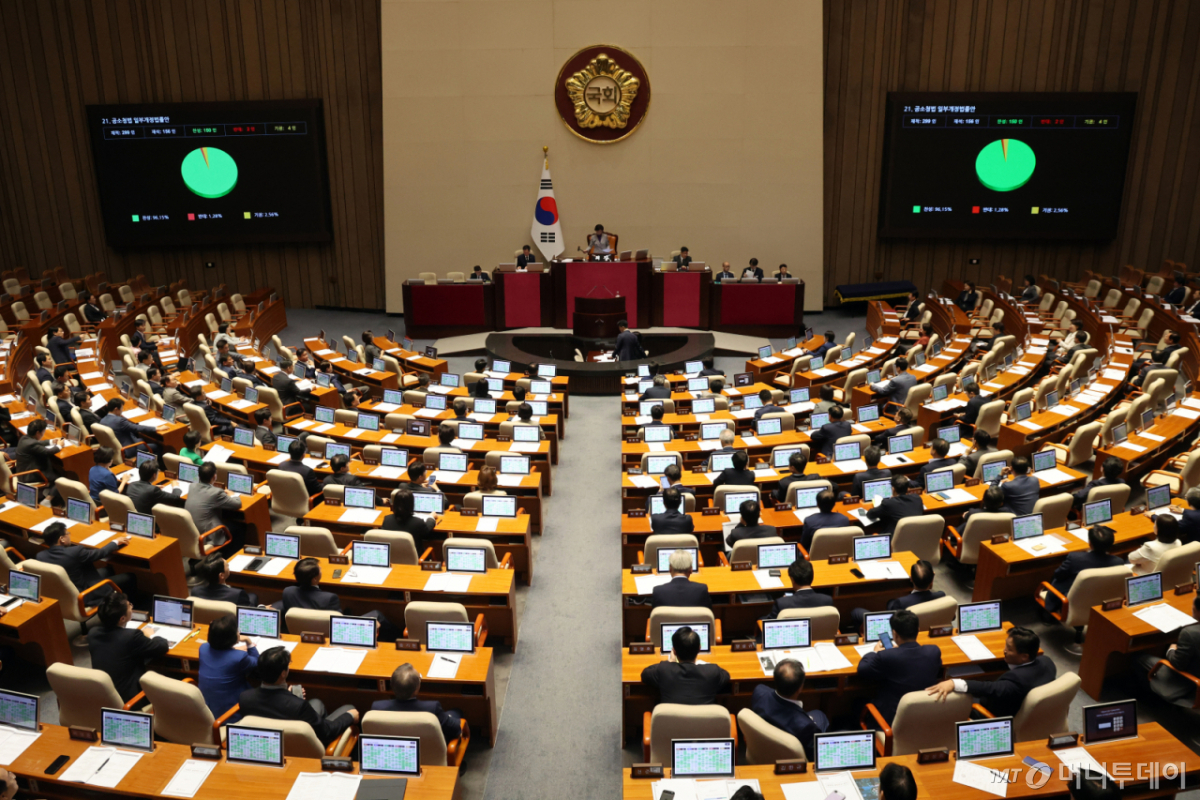
Eighteen domestic and foreign asset management firms issued an emergency joint statement on the 29th, urging that the processing of the mandatory tender offer system introduction bill by the National Assembly's Political Affairs Committee (hereinafter referred to as the Political Affairs Committee Bill), which is scheduled to be submitted to the National Assembly plenary session on the 1st of next month, be postponed.
This joint statement represents the largest-scale unified voice from domestic and foreign asset managers since the recent Commercial Act amendment. The combined assets under management of the participating firms reach 87 trillion won. They criticized the Political Affairs Committee Bill as running counter to the government's goal of creating "the most attractive capital market in Asia."
The Political Affairs Committee Bill is a bill that allows an acquirer to first purchase the controlling shareholder's stake and then conduct a tender offer only for the remaining amount needed to reach 50% plus one share. It passed the Legislation and Judiciary Committee on the 28th.
While supporting the introduction of the mandatory tender offer system, the asset managers argued that the structure allowing only the controlling shareholder to sell their entire holdings first must be corrected. This is because the intent of the system is to guarantee general shareholders an equal opportunity to sell under the same conditions as the controlling shareholder when control changes hands.
The asset managers stated, "Purchasing all remaining shares would be most desirable, but we respect the Political Affairs Committee's decision to set the threshold at 50% plus one share, considering the burden of acquisition funds and concerns about a slowdown in M&A (mergers and acquisitions)." However, they added, "Even if the 50th% plus one share method is maintained, that amount must be purchased from all shareholders at the same ratio."
If advance purchases are allowed, permitting the acquirer to buy the controlling shareholder's stake first during a mandatory tender offer, the controlling shareholder can sell all their held shares. In contrast, general shareholders can only sell a portion of their shares if there is a remaining amount needed to reach 50% plus one share.
For example, in a company where the controlling shareholder holds 40%, the acquirer would first buy this 40% off-market (advance purchase) and then only need to tender offer for the remaining 10% plus one share from general shareholders to reach a majority. Even if all 60% of general shareholders respond, each can sell only about one-sixth of their shares, and 80% of the total amount purchased by the acquirer would go to the controlling shareholder. In companies where the controlling shareholder's stake is already over half, there may be no remaining shares to buy via tender offer, meaning general shareholders might not even get a chance to sell.
The asset managers emphasized that being able to sell some shares at a price reflecting a control premium does not necessarily benefit general shareholders. If the acquirer holds a majority stake, it becomes difficult for general shareholders to check management, and the value of the remaining shares may decline. This means the loss from the unsold five-sixths could be greater than the gain from the sold one-sixth.
They argued that advance purchases should be excluded, and the controlling shareholder should also respond to the tender offer on the same terms as general shareholders, ensuring a "proportional tender offer" where shares are purchased at the same ratio from all shareholders. The asset managers emphasized, "The same price alone is not sufficient. The opportunity to sell at the same ratio must also be guaranteed."
The participating asset management firms requested the National Assembly not to process the Political Affairs Committee Bill in the plenary session on the 1st of next month. They stated that after public discussion, the system should be re-examined, and even if the 50th% plus one share method is maintained, advance purchases by the controlling shareholder should be excluded so that all shareholders, including the controlling shareholder, can sell at the same price and ratio.
They emphasized, "This is not an issue of a minor clause," adding, "It is a matter of determining what principles will govern the treatment of controlling and general shareholders in future Korean control transactions." They further stated, "Since this system is being reintroduced after about 30 years, principles must be clearly established from the start."
The participating asset management firms are scheduled to hold a joint press conference at 1 p.m. on the 30th.

 in STOCK
