

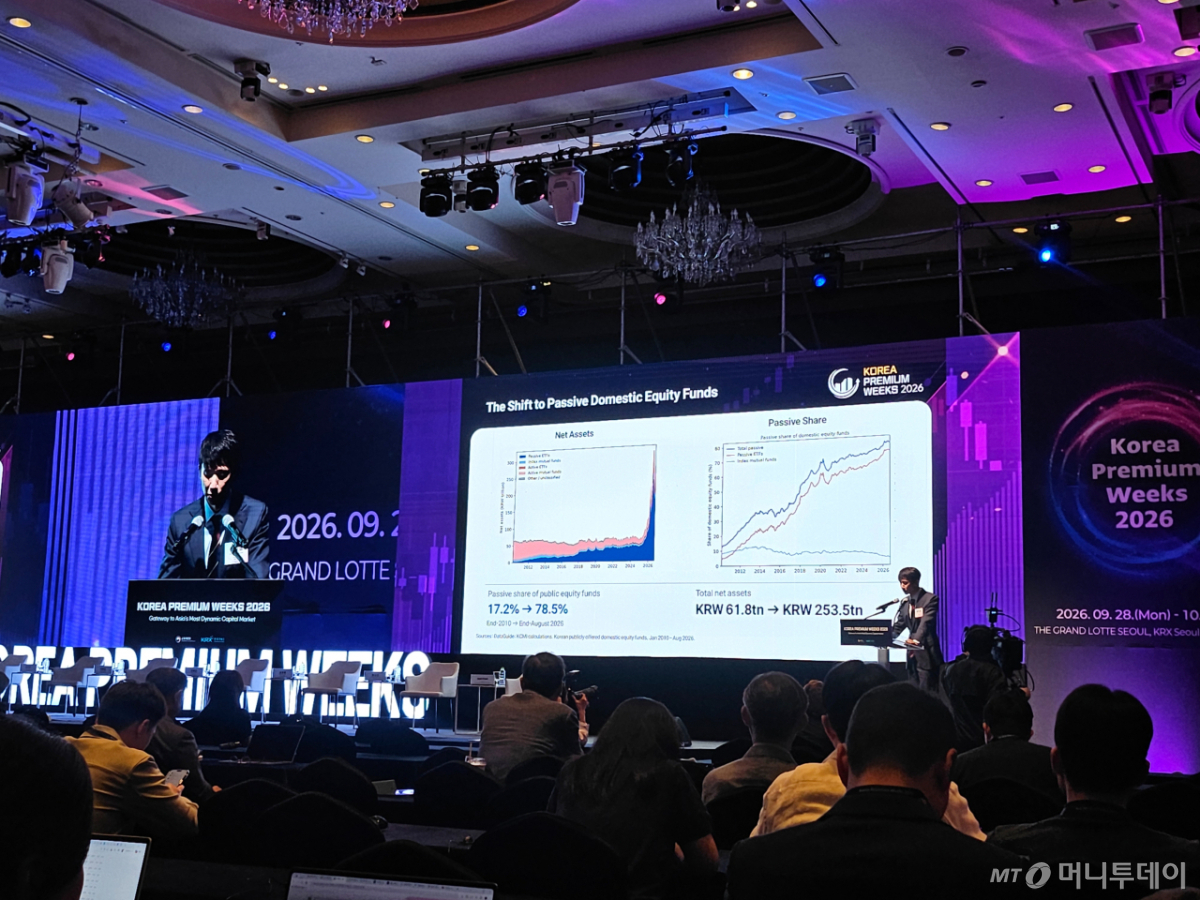
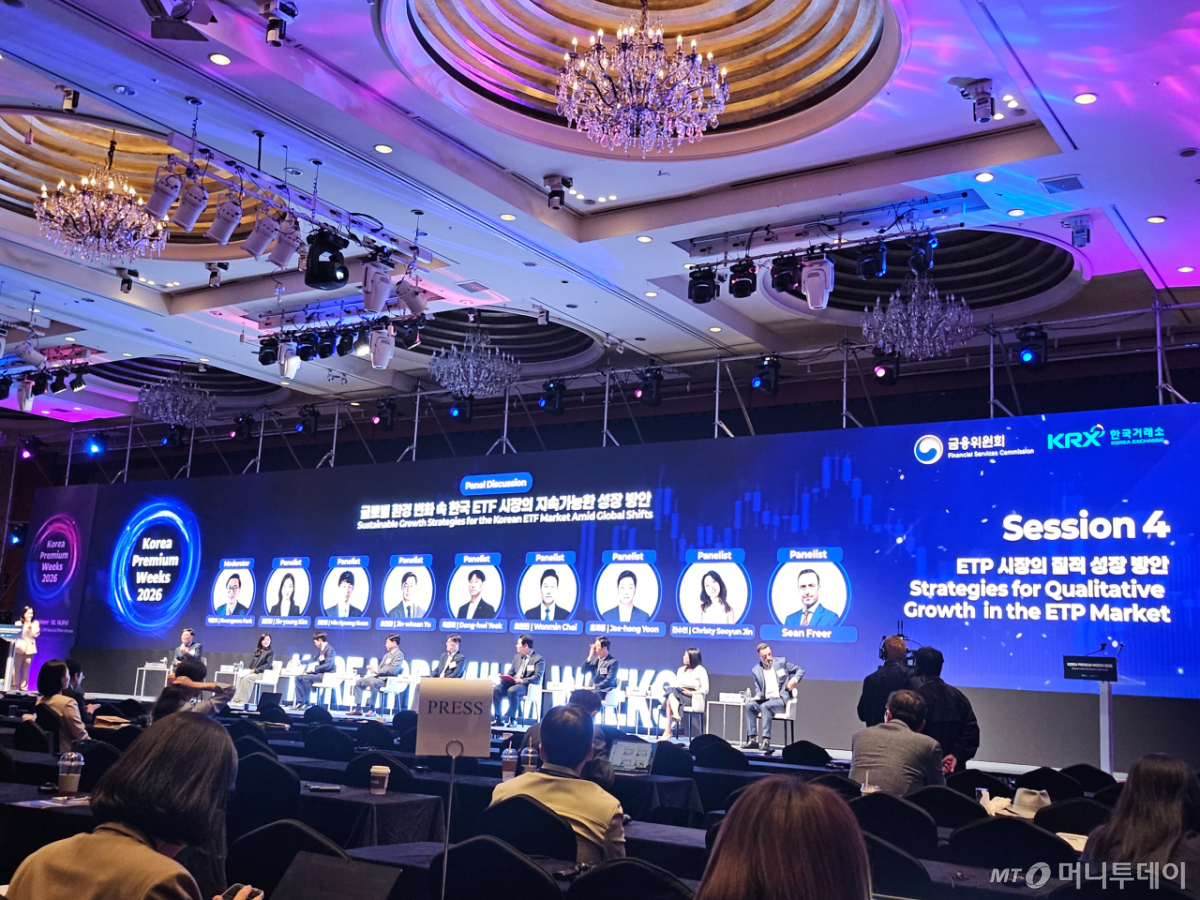
Experts have recommended institutional improvements, such as tax exemption on trading gains from exchange-traded funds (ETFs) within retirement pension accounts and the promotion of fully active ETFs, for the domestic ETF market, which surpassed 500 trillion won in assets under management (AUM) in the first half of this year, to develop qualitatively. It was also suggested that model portfolios (MPs) should be used to present asset allocation strategies so that ETFs can fulfill their role as a medium- to long-term asset management tool.
Experts stated this at the ETP (ETF) session of 'Korea Premium Weeks 2026,' held on the 29th at The Grand Lotte Seoul in Jung-gu, Seoul.
Opinions first emerged that tax equity must be improved for long-term funds to flow into the ETF market and for it to develop healthily. Yoo Jin-hwan, Product Jeon Ryak-dam-dang (SVP) at Samsung Asset Management, said during a panel discussion, "While overseas equity ETFs are structured to maximize tax deferral benefits when held in pension accounts, domestic equity funds or ETFs are exempt from trading gains taxes in general accounts but incur taxes and become subject to pension income tax in retirement pension accounts." He added, "Tax improvements are necessary from the perspective of revitalizing the stock market through the activation of retirement pensions."
Most experts agreed that 'fully active ETFs,' which do not have an obligation to track an index, should be permitted. Executive Yoo stated, "There is discussion on introducing fully active ETFs without obligations to follow a benchmark or index correlation coefficient, and it needs to be considered in connection with investor protection issues." He proposed, "It would be good if discussions on introduction proceed in a direction that sets guidelines, such as requiring about 80% of assets to be invested in the relevant field when an ETF's name indicates a specific sector or industry group, while also increasing discretion in individual stock investment."
Voices also emerged calling for further development of ETFs as a medium- to long-term portfolio investment tool. Choi Won-min, Vice President at BlackRock, emphasized, "There is still insufficient consideration on how to integrate and utilize ETFs in portfolios," adding, "The culture of ETF investing must gradually shift toward portfolio investing." In the United States, dozens of MPs are provided, allowing investors to choose a suitable portfolio and invest in ETFs; it was argued that such MP provision should also be activated domestically.
Vice President Choi said, "In the United States, the proportion of active ETFs among newly launched ETFs is very large. This means demand for active ETFs is high," adding, "It is also important how active ETFs are integrated within an investor's portfolio." He explained that ETFs should be appropriately allocated and managed within a portfolio according to investor tendencies, such as target-driven and alpha-seeking types.
In addition, improvement directions mentioned included: competition among asset management companies centered on long-term management indicators showing how long customer assets are held and managed, rather than the scale of AUM; improvements in ETF product naming issues; enhanced transparency in the disclosure process of ETF portfolios; and expanded inflow of pension assets into the ETF market.
Meanwhile, opinions emerged that single-stock leveraged ETFs should not be approached from a perspective of 'good or evil,' but rather that attention should be paid to 'concentration in specific sectors.'
Kwon Min-kyung, Senior Research Fellow at the Korea Capital Market Institute, diagnosed during a panel discussion, "There are studies and literature indicating that returns decrease in highly volatile market conditions." She stated, "Rather than saying it is unconditionally bad, considering the basic intent of leveraged or inverse products, returns may shine more in markets where 1.5x or 2x leverage is more advantageous, while they may not perform as well in high-volatility markets." Senior Research Fellow Kwon added, "However, theme-concentrated products can be risky if they tilt in one direction."
The asset management industry expressed the opinion that the side effects of single-stock leveraged ETFs could be mitigated through diversification of ETF products and allowing the renovation of ETF products premised on prior investor notification.

 in STOCK

