

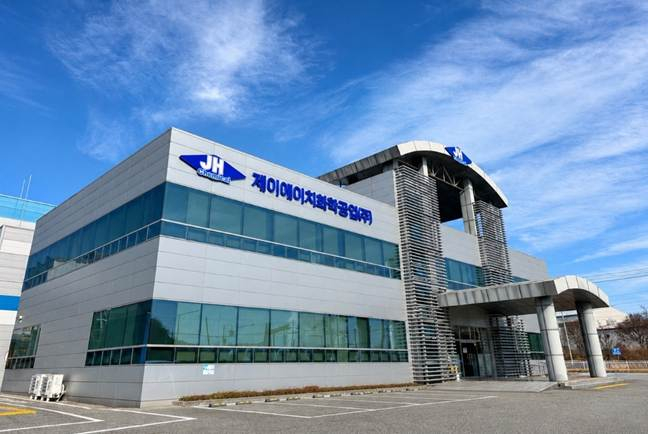
JHC, a subsidiary of L&F specializing in secondary battery materials and Lisa recycling, announced on the 14th that it will expand its circular economy business centered on pre-treatment of spent batteries and lithium recovery.
JHC currently has secured an annual capacity for pre-treating 15,000 tons of spent batteries. It possesses technological competitiveness to recover approximately 95% of the lithium from lithium-containing wastewater generated during the manufacturing process of secondary battery materials.
Based on the material manufacturing technology and process operation experience accumulated through the production of precursors (the stage prior to cathode materials), JHC is expanding its spent battery pre-treatment and lithium recovery business, broadening its role as a key hub in the circular value chain for cathode materials. Established in 2011, JHC has gradually built its precursor production foundation and has been producing secondary battery precursors for electric vehicles in Yangsan since 2014. Since then, it has enhanced its material manufacturing and production operation capabilities through processes such as lithium hydroxide (LiOH) crushing and smart logistics systems.
JHC produces black mass (BM) by subjecting spent cathode materials and used batteries to pre-treatment processes including discharge, disassembly, crushing, and grinding. In particular, it has established a business foundation capable of handling both designated waste and general waste based on its comprehensive waste recycling license.
In addition to spent battery pre-treatment, JHC is focusing on circular economy projects that convert lithium-containing wastewater generated during the manufacturing process of secondary battery materials into resources. Following the acquisition of a wastewater reuse license in 2024, it has established a process to evaporate and concentrate lithium-containing wastewater to resource it as lithium carbonate.
In particular, it has secured technological competitiveness to recover up to approximately 95% of the lithium contained in the wastewater. Through this, it is building a circular economy system that minimizes the loss of lithium that could be discharged as wastewater while converting the recovered lithium into lithium carbonate for use as a new raw material. Going forward, it plans to continuously strengthen its technological competitiveness to convert valuable resources contained in wastewater back into raw materials, going beyond the concept of wastewater treatment.
L&F plans to link waste, Busan water, and spent cathode materials generated within the group with Lisa recycling feedstocks, centered on JHC. It is building a circular value chain that recovers valuable metals by linking the black mass produced through JHC's pre-treatment with specialized post-treatment companies. Through this, the strategy is to increase the potential for reducing raw material procurement costs while lowering dependence on external raw materials and strengthening the stability of core raw material supply, as well as expanding the foundation for circular utilization of resources within the group.
Lee Byung-hee, CEO of JHC, stated, "We will not stop at spent battery pre-treatment but will expand our business scope to the entire circular economy value chain by linking lithium-containing wastewater resource conversion and lithium recovery technology." He added, "In particular, we will cultivate the circular economy business as a new growth pillar for JHC, growing it into a business that combines profitability and sustainability, and based on this, we will continue sustainable future growth."

 in INDUSTRY
