

Domestic asset management firms are continuously unveiling exchange-traded funds (ETFs) related to artificial intelligence (AI) and semiconductors, but investor funds are actually flowing into parking-type products such as money market funds (MMFs). While expectations for growth in the semiconductor industry remain high, stock market volatility has expanded again, leading investors to prioritize securing cash assets over aggressive investment.
According to the financial investment industry and ETF Check on the 14th, of the 29th new ETFs listed on the Korea Exchange (KRX) since August, 17 were related to AI and semiconductors, accounting for approximately 59%. This means that 6 out of every 10 newly listed products are related ETFs.
This month as well, three of the five newly listed products—KODEX US AI Agent Active, DS AI Semiconductor Active, and SOL Global DRAM Semiconductor Plus—were related to AI and semiconductors. Recently, products have emerged that focus on specific industries such as high-bandwidth memory (HBM), DRAM, and NAND flash, going beyond those investing in the semiconductor sector as a whole, diversifying product composition.
However, actual fund flows tell a different story. As stock market volatility has recently expanded, funds are pouring into parking-type ETFs that can manage short-term funds, rather than equity ETFs. Parking-type ETFs are products that invest in short-term bonds or financial instruments to pursue relatively stable returns, and are used to temporarily manage idle investment funds.
Over the past month, KODEX Money Market Active ranked first in net fund inflows with 252.78 trillion won entering the fund. This is more than three times that of the second-place KODEX US NASDAQ100 (74.39 billion won). Funds also flowed into ACE Money Market Active (51.78 billion won), KODEX Short-term Bonds (39.45 billion won), KODEX CD Rate Active (Synthetic) (26.72 billion won), and MIDAS Money Market Active (18.49 billion won).
On the other hand, when the reference period is expanded to six months, only one parking-type ETF, KODEX Money Market Active, appears among the top 20 products by net fund inflows. This indicates that interest in parking-type products has relatively increased recently.
This trend is not unrelated to recent uncertainty in the domestic stock market. Despite expectations for earnings growth from major semiconductor companies such as Samsung Electronics and SK Hynix, foreign selling pressure and global geopolitical risks are intertwining to increase market volatility. Analysts note that while investors agree on the medium- to long-term growth potential of the semiconductor industry, an increasing number are hesitant about immediate stock price gains.
Han Su-jin, a researcher at Samsung Securities, stated, "Five of the top 10 ETFs by increase in domestic assets under management over the past week were parking-type products," adding, "Uncertainty regarding the direction of the domestic stock market is continuing to drive fund inflows into parking-type ETFs."
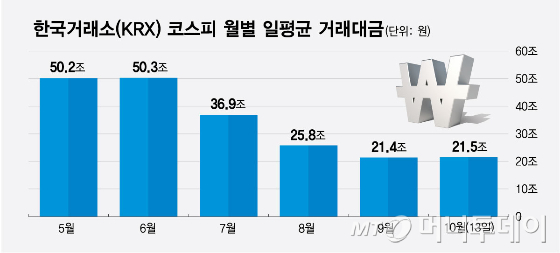
The key question is whether funds flowing into parking-type ETFs will move back into the stock market. The average daily trading volume for KOSPI this month is 21 trillion won, less than half of approximately 50 trillion won in April and May last year. Investor deposits, which serve as idle investment funds, once reached the high 130 trillion won range in the first half of the year but have recently remained around 100 trillion won.
An official from the securities industry said, "If market uncertainty persists for a long time, the phenomenon of funds staying in cash-type ETFs may continue regardless of new product launches."

 in STOCK
