

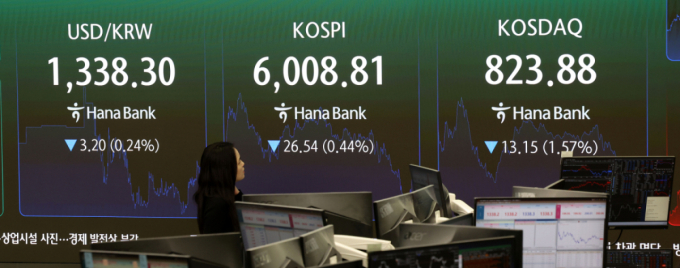
The KOSPI ended trading lower for the sixth consecutive business day, barely holding the 6,000-point line. On the 14th, it opened higher and surged by more than 2%, but as wait-and-see sentiment intensified ahead of the release of the U.S. September consumer price index (CPI), it dipped below the 6,000-point line during trading. Experts are paying close attention to the CPI results, which could influence the Federal Reserve System (Fed) decision on the October base rate.
On the 14th, the KOSPI closed at 6,008.81, down 26.54 points (0.44%) from the previous trading day. The index opened higher and rose to a high of around 6,190, but the upward momentum subsequently slowed. Before the close, it briefly fell below the 6,000-point line, dropping to the 5,940 range.
During intraday trading on the 14th, ASML announced earnings that exceeded market expectations, but "sell-on" (selling at highs) supply entered the market, causing after-hours stock prices to decline. As a result, analysis suggests that investor sentiment in the domestic semiconductor sector also weakened, acting as downward pressure on the index.
Lee Kyung-min, head of FICC at Daishin Securities, said, "The KOSPI shifted to a bullish trend due to inflows of rebound buying following the previous day's sharp drop, but the magnitude of the rebound was limited by rising international oil prices, sluggish AI (artificial intelligence) momentum, and caution ahead of the U.S. September consumer price index (CPI) release." He added, "Going forward, attention should be paid to the possibility of a reversal in the weakened AI momentum through TSMC's earnings release."
In the KOSPI market on the 14th (based on Korea Exchange data), retail investors and foreign investors made net sales of 314.2 billion won and 1,181.3 billion won, respectively. Foreign investors have continued a streak of net sales for seven consecutive business days, but the scale has decreased slightly. Foreign investors sold off 510 trillion won worth of shares on the previous day. Institutional investors made net purchases of 808.4 billion won. Other corporations, including SK Hynix's share buyback, bought 685.3 billion won worth of shares.
Among KOSPI sectors, insurance fell by more than 4%. Medical and precision equipment, and financials declined by the 3rd% range and the 2nd% range, respectively. Distribution, pharmaceuticals, machinery and equipment, and securities dropped by more than 1%. Electric and electronics, manufacturing, and construction ended slightly lower. Textiles and apparel, non-metals, real estate, and transportation equipment and parts showed slight gains. Metals rose by more than 1%.
Among top KOSPI market capitalization stocks, Samsung Life Insurance fell by more than 3%. SK Hynix, KB Financial Group, and Samsung Biologics dropped by the 1st% range. SK Square and Hyundai Motor ended slightly lower, while Samsung SDI closed with a slight gain. Samsung Electronics closed at 232,000 won, the same as the previous trading day's closing price on a regular session basis. Samsung Electronics and SK Hynix rose by more than 2-3% during intraday trading, but their upward momentum was halted due to the impact of ASML's earnings release.
Secondary battery theme stocks showed strength on the 14th. LG Energy Solution and Samsung SDI rose by more than 2% and more than 5%, respectively. Kim Ju-yeon, a researcher at Mirae Asset Securities, said, "Expectations have been formed that demand for ESS (energy storage system) batteries for AI data centers is surging and electric vehicle sales in Europe will show strength," adding, "Earnings improvements were confirmed for some stocks in the third quarter."
The KOSDAQ closed at 823.88, down 13.15 points (1.57%) from the previous trading day. The KOSDAQ index ended trading in the 820th range for the first time since the 18th of last month.
In the KOSDAQ market, foreign investors and institutional investors made net sales of 217.2 billion won and 181.1 billion won, respectively. Retail investors made net purchases of 385.3 billion won.
Among KOSDAQ sectors, machinery and equipment and non-metals fell by more than 4%. Manufacturing dropped by the 2nd% range. Medical and precision equipment, electric and electronics, distribution, telecommunications, and chemicals declined by more than 1%. Pharmaceuticals, textiles and apparel, food and tobacco, etc., remained slightly lower. IT (information and communications) services, paper and wood, etc., closed with slight gains. Construction, financials, metals, entertainment and culture, etc., rose by more than 1%. Transportation and warehousing jumped by the 3rd% range.
Among top KOSDAQ market capitalization stocks, weakness was prominent in semiconductor materials, components and equipment stocks. Jusung Engineering plunged by the 8th% range, dropping to the fourth place, one tier below its previous market capitalization rank. Wonik IPS and Simmtech showed weakness in the 6th% range, while Iotech showed weakness in the 5th% range. Rino Industrial and HLB fell by more than 4%. Rainbow Robotics ended slightly lower. Alteogen closed at 224,500 won, the same as the previous trading day's closing price. Ecopro and Ecopro BM rose by more than 3% and more than 2%, respectively. Ecopro BM regained the third place in market capitalization with its rise on the 14th.
The U.S. September CPI, an indicator the market is watching this week, was scheduled to be released overnight. If the September index confirms that price pressure is low, the probability of a Federal Reserve System (Fed) base rate hike in October will decrease, and concerns over funding for AI and infrastructure companies are likely to subside.
Lim Jeong-eun and Tae Yun-seon, researchers at KB Securities, said, "With the release of the U.S. September CPI and the entry into the full-fledged earnings season, it is necessary to watch for increased market volatility and differentiated trends by stock."
In the Seoul foreign exchange market on the 14th, the won/dollar exchange rate ended daily trading at 1,338.3 won, down 6.8 won from the previous trading day's closing price.

 in STOCK
