

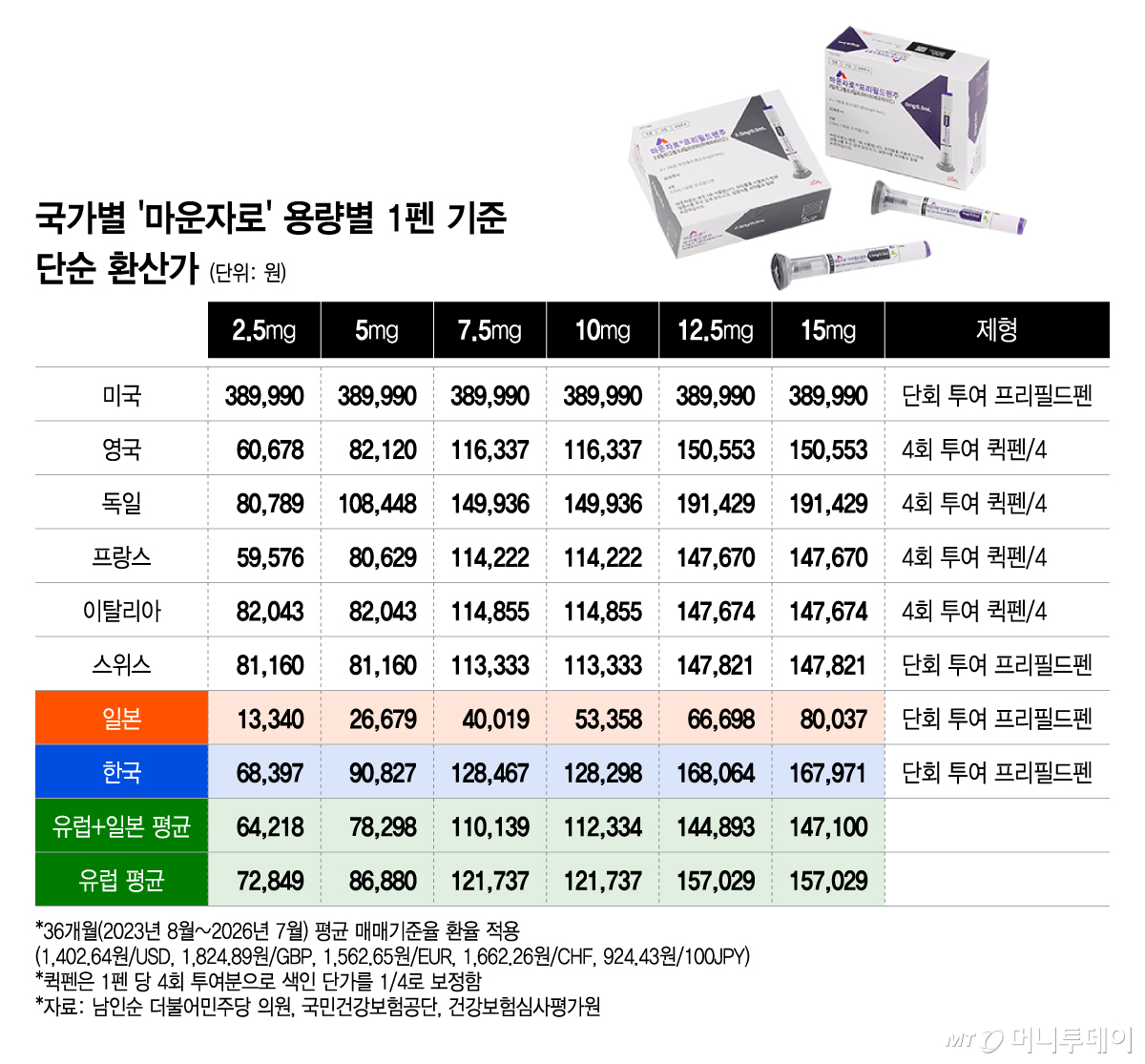
The domestic supply price of the lowest dosage of the obesity drug 'Mounjaro' was found to be more than five times higher than that in Japan. Prices for GLP-1 (glucagon-like peptide-1) class obesity drugs in South Korea were higher not only than those in neighboring countries such as Japan and China, but also than those in major European countries.
Korea's 'Mounjaro' supply price is 16% higher than the average of Japan and five European countries
According to obesity drug supply price data obtained by Nam In-soon, a Democratic Party of Korea lawmaker on the National Assembly Health and Welfare Committee, from the National Health Insurance Service and the Health Insurance Review & Assessment Service, the factory shipment price (wholesale supply price) for Mounjaro Prefilled Pen Injection 2.5 mg in Korea from January to June this year is 68,397 won. This is based on the shipment price before being supplied to medical institutional investors through distributors.
This is 5.1 times Japan's supply price of 13,340 won. It is also higher than France's supply price of 59,576 won and the United Kingdom's supply price of 60,678 won. Prices for Mounjaro by dosage in each country were compared using simple converted prices per pen. Calculations applied the average exchange rate over a 36-month period (August 2023 to July 2026).
When compared with seven major countries that serve as price references for Korea (United States, United Kingdom, Germany, France, Italy, Switzerland, and Japan), Korea's Mounjaro prices were on the higher side compared to all countries except the United States and Germany.
Compared with the average supply price of Europe and Japan, excluding the United States among the seven major countries, Korea's supply price was higher for all dosages except the lowest 2.5 mg. Based on 5 mg, Korea's supply price was 90,827 won, which was 16% more expensive than the European-Japanese average supply price of 78,298 won. For the highest dosage of 15 mg, Korea's supply price was 167,971 won, which was 14% higher.
Even when compared with the average price of five European countries, Korea's Mounjaro prices were more expensive for all dosages except 2.5 mg. The 5 mg dosage was 5% higher, the 7th mg dosage was 6% higher, and the 12.5 mg dosage was 7% higher, respectively.
In countries such as Japan, health insurance is applied, so the cost borne by patients at medical institutional investors is fixed. In contrast, in Korea, because it is a non-covered treatment, medical institutional investors or pharmacies can arbitrarily add additional profits and sell it, meaning the price paid by patients can be higher.

Medical tourism to Japan for treatment; government only cracks down on patients without managing prices... "Additional government action needed"
As a result, some patients travel abroad to places like Japan for medical treatment and obtain prescriptions for GLP-1 obesity drugs, but the government is cracking down on this as well, leading to growing dissatisfaction among patients.
Nam (Rep.) criticized, "GLP-1 class obesity treatments are in a blind spot of price management due to their non-covered status, and institutional means to control excessive or inappropriate use are also inadequate." They added, "If the structure blocks the import of obesity drugs from overseas while effectively leaving domestic high-price sales to the market, it is hard to avoid criticism that this protects the high-price sales of global pharmaceutical companies over the choices of citizens."
There are also calls for the government to intervene in managing obesity drug prices. Nam Nae-gyeong, Director of the Social Policy Division at the Korea Consumers' League, pointed out the lack of control mechanisms in the domestic non-covered market, stating, "In other countries, non-covered treatments cannot be used arbitrarily, and prices are largely set within a defined range." They continued, "Without any regulation, would pharmaceutical companies voluntarily lower prices? Rather than relying on corporate conscience and ethics, supporting management systems must be established."
A patient currently taking obesity medication stated, "The government shifts the responsibility only to patients purchasing obesity drugs," adding, "There is no separate investigation or plan addressing the domestic and international price gap, which is the direct cause of citizens turning to overseas purchases of obesity drugs."
They criticized, "Global pharmaceutical companies claim that Korean drug prices are too low to launch products, engaging in 'new drug Korea passing' while demanding higher new drug prices from the government, yet they display a double standard by charging high prices for non-covered treatments like obesity drugs." They emphasized, "The government should establish procedures to negotiate supply price reductions with relevant pharmaceutical companies regarding excessively high drug prices compared to overseas," adding, "Pharmaceutical companies with significant market power should have their potential unfair practices reviewed jointly with the Fair Trade Commission."

 in THEBIO

