

# A man in his 70s, identified as Mr. A, who resided in Incheon, missed the National Cancer Health Screening for that year in 2024 due to undergoing surgery. By the time he received the screening in the following year, 2025, he was already in a state of “late-stage lung cancer.” After enduring a year-long battle with the illness, he ultimately passed away in May of this year.
It has been revealed that more than 73,000 National Health Insurance subscribers were diagnosed with one of six major cancers after consecutively failing to undergo national cancer screening over the past three years. The medical expenses borne by the National Health Insurance Service for these individuals in the year following their cancer diagnosis reached 500 billion won over the recent two-and-a-half-year period. Critics point out that the state’s failure to manage consecutive non-participants in cancer screening has led to deteriorating public health and leakage of national health insurance funds.
73,130 individuals diagnosed with six types of cancer after consecutive non-participation in national cancer screening over the past three years
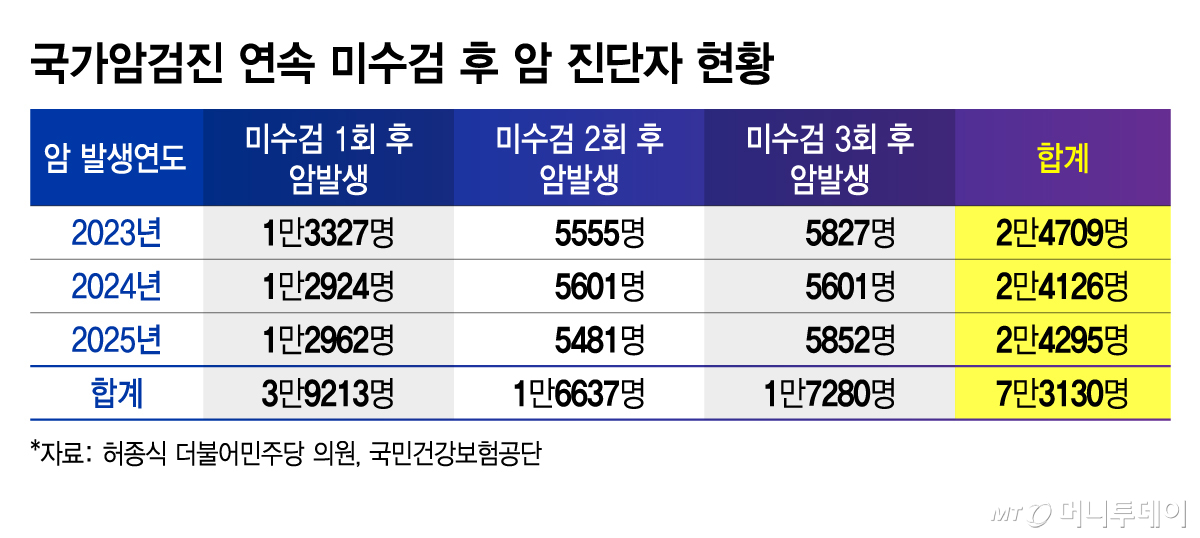
According to data obtained by Heo Jong-sik, a Democratic Party of Korea lawmaker on the National Assembly’s Health and Welfare Committee, from the National Health Insurance Service on the 15th, 73,130 people were diagnosed with “stomach cancer, colorectal cancer, breast cancer, cervical cancer, liver cancer, or lung cancer” after consecutively failing to undergo national cancer screening over the three-year period from 2023 to 2025.
By year, approximately 24,000 individuals received a cancer diagnosis after consecutive non-participation each year. The figures were △24,709 in 2023, △24,126 in 2024, and △24,295 in 2025.
By the number of consecutive non-participations, those who missed the screening once accounted for 39,213 individuals, or 53.6% of the total. Those who consecutively missed it twice numbered 16,637 (22.8%), while those who consecutively missed it three or more times numbered 17,280 (23.6%).
One in four individuals diagnosed with cancer after consecutive non-participation had failed to undergo national cancer screening three or more times consecutively. The number of individuals diagnosed with cancer after missing the screening three or more times consecutively was 5,827 in 2023, 5,601 in 2024, and 5,852 in 2025, recording figures in the 5,000 range each year.
Health insurance treatment costs for individuals diagnosed with six types of cancer after missing screenings reach 503 billion won over two and a half years
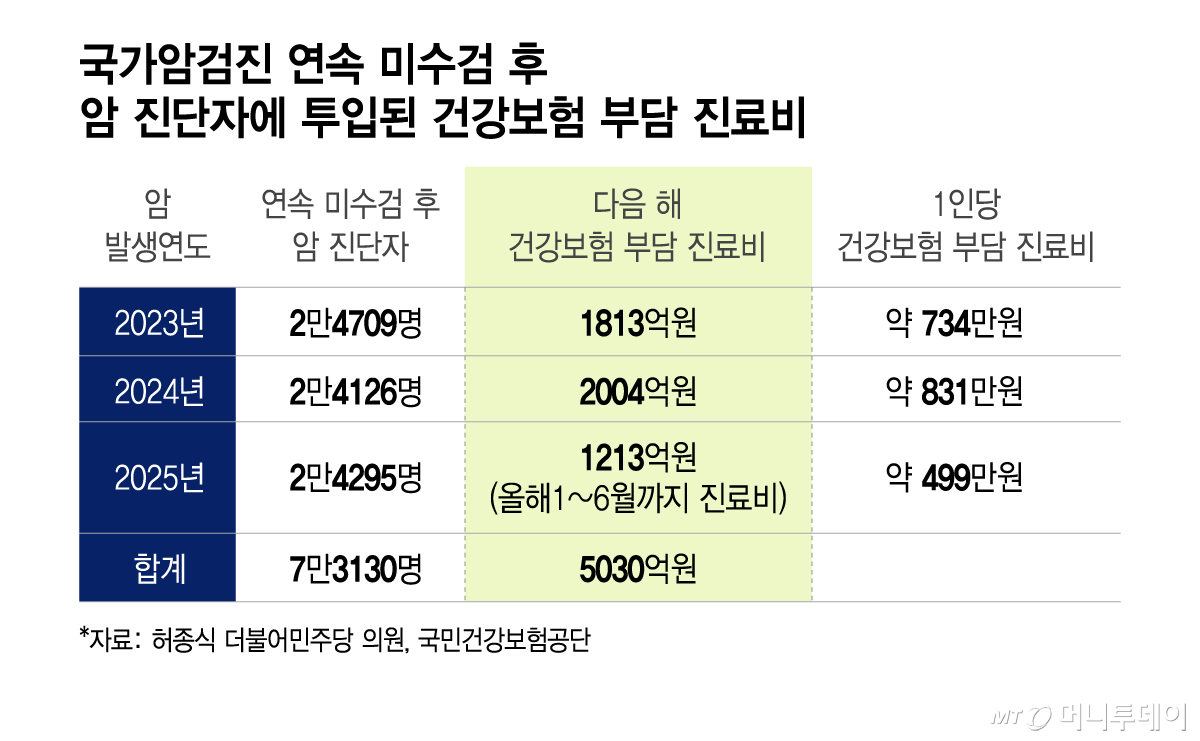
The medical expenses borne by the National Health Insurance Service for individuals who contracted cancer between 2023 and 2025 after missing national cancer screening reached 503 billion won over the two-and-a-half-year period through June of this year. By year, the service-borne medical expenses incurred in 2024 for the 24,709 individuals diagnosed with cancer in 2023 amounted to 181.288 billion won. For the 24,126 individuals diagnosed with cancer in 2024, 200.403 billion won was spent in 2025. Medical expenses for those diagnosed with cancer last year totaled 121.32 billion won from January to June of this year.
The per-capita medical burden borne by the service in 2024 was approximately 8.31 million won, an increase of 13.2% (970,000 won) compared to 7.34 million won in the previous year.
Looking at cancer diagnoses in 2024 by type, breast cancer had the highest total service-borne medical expenses in the following year at 76.559 billion won. This was followed by △colorectal cancer at 49.126 billion won, △stomach cancer at 37.671 billion won, △liver cancer at 26.951 billion won, △cervical cancer at 5.594 billion won, and △lung cancer at 4.502 billion won.
The per-capita service-borne amount was highest for lung cancer at 16.86 million won. This was followed by breast cancer at 12.62 million won, △liver cancer at 10.14 million won, △cervical cancer at 7.44 million won, △colorectal cancer at 6.08 million won, and △stomach cancer at 5.98 million won.
“Management system for consecutive non-participants in cancer screening must be reformed”
The National Health Insurance Service sends mail and electronic documents to national cancer screening targets at the beginning of the year and encourages participation through notification texts, phone calls, TV, radio, and digital signage. However, despite various notices and promotions, critics point out that the current management method is not leading to actual screening participation, as individuals diagnosed with cancer after consecutive non-participation continue to occur at similar levels each year.
Heo (Rep.) emphasized, “The fact that consecutive non-participants occur in the same scale every year is a clear signal that the current management system is not functioning,” adding, “We must immediately reform the management system so that lives and health are not threatened by missed early screening opportunities and national health insurance finances are not repeatedly wasted.”
He further stated, “A performance management system linked with relevant institutional investors is needed to evaluate whether national cancer screening leads to actual early detection and timely treatment,” adding, “We should review plans to establish performance indicators linking screening, early detection, and treatment in consultation with relevant institutional investors such as the Ministry of Health and Welfare and the National Cancer Center.”
In this regard, the National Health Insurance Service stated, “We have been conducting continuous encouragement for non-participants over the past four years to undergo screenings throughout the year,” adding, “While we do not separately manage the screening participation rate of consecutive non-participants, we will intensively manage consecutive non-participants in the future and strengthen direct guidance through phone calls and voice (AI) systems.”

 in THEBIO

