

Domestic bond yields fell across the board on the 15th, even as the U.S. September Consumer Price Index (CPI) growth rate exceeded market expectations. This is interpreted as demand shifting to safe-haven government bonds after the corporate bond yield of U.S. artificial intelligence (AI) company CoreWeave surged to 14.8%, raising concerns about its debt burden.
According to the Korea Financial Investment Association, as of the final closing price on the morning of the 15th, the yield on 3-year government bonds was 3.843%, down 4.0bp (1bp = 0.01 percentage points) from the previous day. The 10-year bond yield fell by 6.0bp to 4.201%. Since hitting their respective yearly highs on the 28th of last month (4.119% for 3-year) and the 15th of last month (4.600% for 10-year), yields have declined by 27.6bp and 39.9bp, respectively, through the 15th. The yield on AA-rated unsecured 3-year corporate bonds fell by 3.0bp to 4.540%, while BBB-rated corporate bond yields dropped by 2.6bp to 10.349%. These two corporate bond yields have also declined by 24.8bp and 24.2bp, respectively, since hitting their yearly highs on the 28th of last month. However, the yield on 91-day commercial paper (CP) rose by 2.0bp to 3.65%, marking its highest level this year.
![[Milpitas, California = AP/NEWSIS] The price of diesel is displayed at the bottom of a gas station price board in Milpitas, California, on the 10th (local time). U.S. diesel prices hit a new all-time high again on the 11th. This is because fuel supplies worldwide are being disrupted as the United States wages war with Iran. September 11, 2026. / Photo by Yoo Se-jin](https://thumb.mt.co.kr/cdn-cgi/image/f=avif/21/2026/10/2026101513504572979_2.jpg)
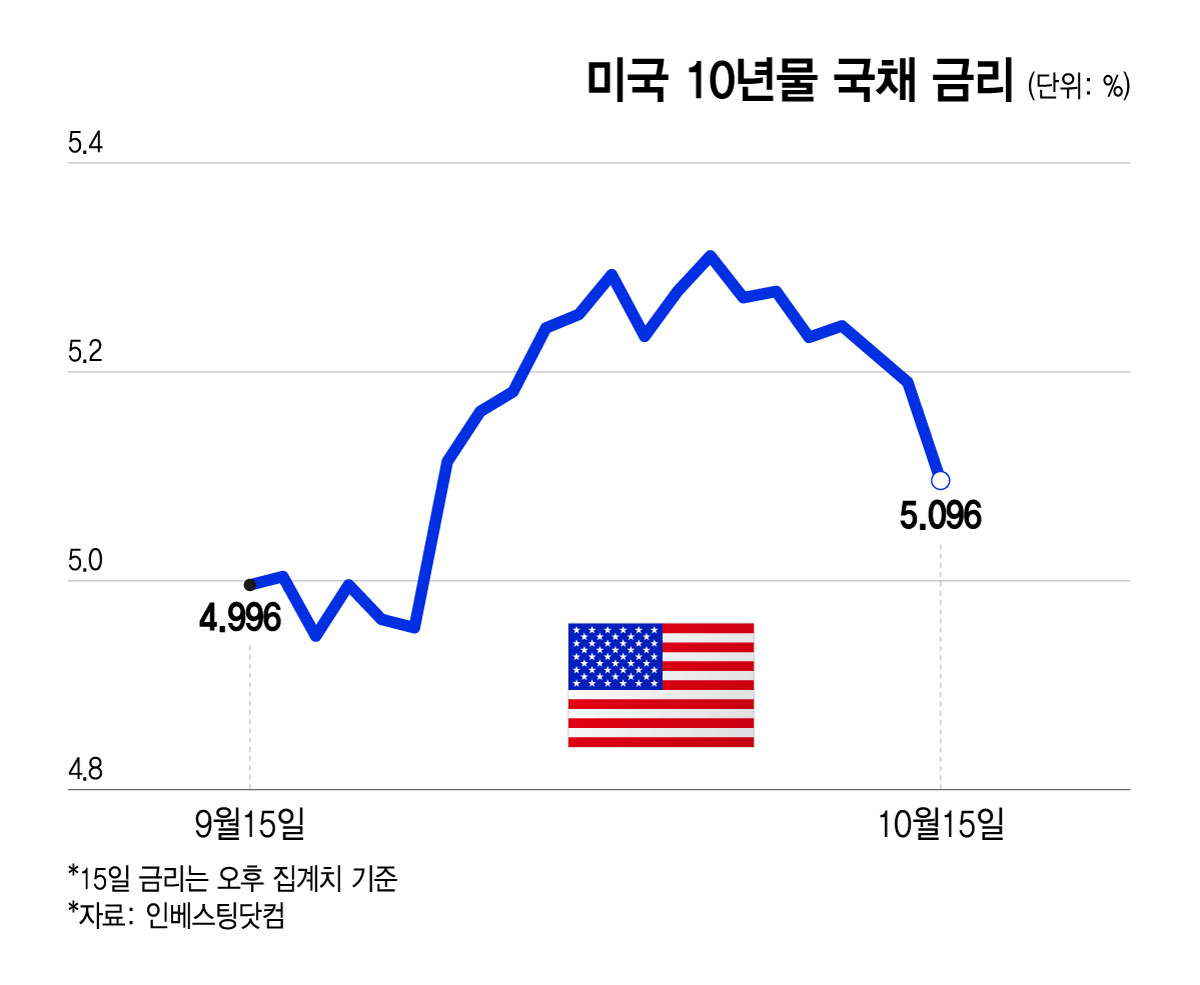
Although the U.S. 10-year Treasury yield exceeded 5.3% in the U.S. bond market on the 14th (local time) due to the shock from the U.S. September CPI, buying interest in U.S. Treasuries also returned. As of the afternoon of the 15th, the U.S. 10-year Treasury yield stood at 5.096%, according to Investing.com data.
KB Securities analyzed that the 5.3% level for the U.S. 10-year Treasury yield acted as a strong resistance line, and that strong demand in last week’s 10-year Treasury auction, along with broader economic concerns, drove buying.
The September CPI released by the U.S. Bureau of Labor Statistics (BLS) on the 14th (local time) rose 3.7% year-on-year. This exceeded market forecasts by 0.1 percentage points. The energy index increased by 5.2% month-on-month, with the gasoline index surging by 9.1%. Core CPI, excluding energy and food, also rose by 2.6%, surpassing expectations by 0.1 percentage points.
Typically, inflation concerns exert upward pressure on bond yields. When prices rise, the real value of bonds paying fixed interest decreases, leading investors to demand higher yields; furthermore, if there are expectations that central banks will raise base rates, already-issued bonds face selling pressure because higher yields may be set for new bonds.
However, as debt risks at CoreWeave, a New York Stock Exchange-listed cloud service provider for AI graphics processing units (GPUs), came to the forefront, this translated into buying of safe-haven government bonds. The yield to maturity on CoreWeave’s corporate bonds maturing in 2032 reached 14.8%, and bond prices fell below 80% of face value.
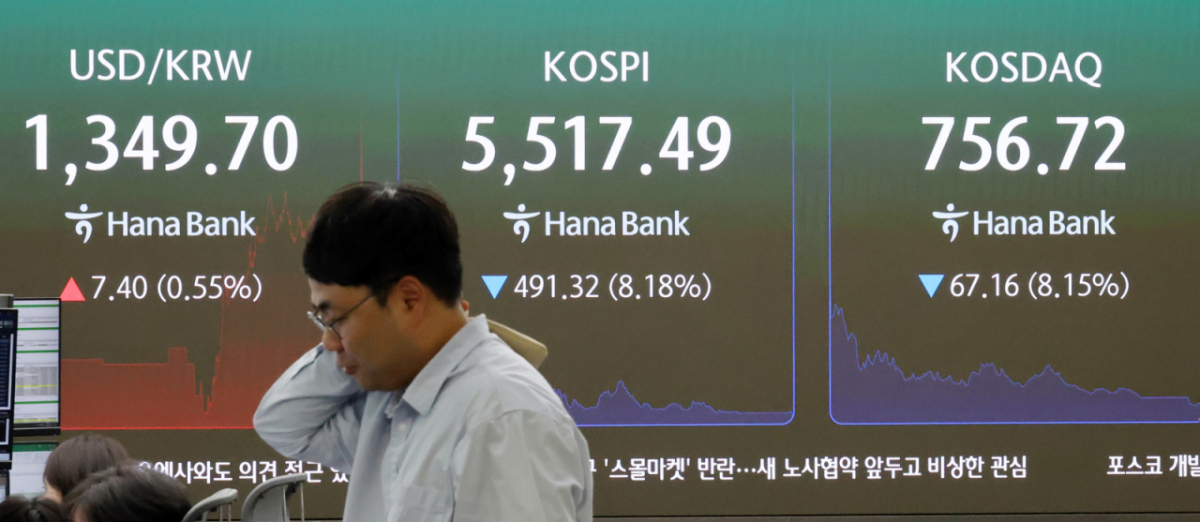
CoreWeave’s debt burden acted negatively on the domestic stock market. The KOSPI and KOSDAQ indices both plunged by more than 8% intraday, triggering circuit breakers (temporary trading halts) simultaneously. Major semiconductor stocks such as Samsung Electronics and SK Hynix were swept up in selling pressure.
Im Jae-gyun, a researcher at KB Securities, stated, “Despite the U.S. Treasury yield falling on the previous day, NASDAQ failed to rebound,” adding, “We assess that the burden on the economy and stock prices from rising interest rates is being confirmed.”
KB Securities predicted that as the U.S. 10-year Treasury yield exceeded 5.3%, buying interest returned, and with economic concerns easing pressure on U.S. rate hikes, foreign buying would continue in the domestic government bond futures market.

 in STOCK


