

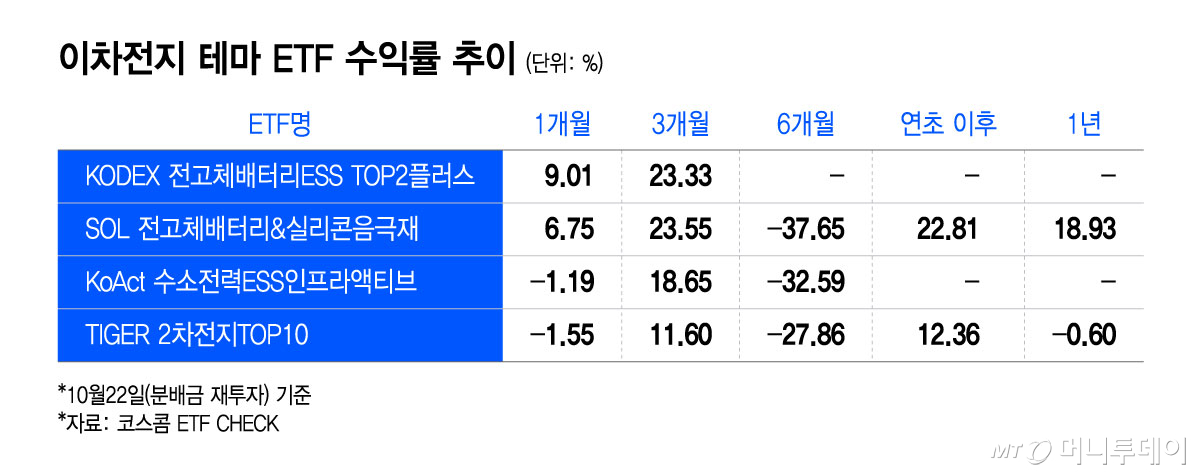
Secondary battery-themed exchange-traded funds (ETFs), which had been overlooked due to the concentration of semiconductor large-cap stocks in the first half, have recently claimed top positions in three-month returns. Despite sluggishness in the electric vehicle market, a traditional key revenue source, expectations for energy storage system (ESS) demand and the commercialization of all-solid-state batteries have boosted investor sentiment.
According to KOSCOM ETF Check on the 22nd, the return (based on reinvestment of distributions) for "SOL All-Solid-State Battery & Silicon Anode Material" over the past three months as of that day was 23.55%. This is the highest return among all ETFs listed in Korea. Funds such as "KODEX All-Solid-State Battery ESS TOP2 Plus" (23.33%) and "KoAct Hydrogen Power ESS Infrastructure Active" (18.65%) also recorded positive returns, securing positions within the top 10.
Investment funds are also flowing in. In particular, KODEX All-Solid-State Battery ESS TOP2 Plus surpassed 200 billion won in net asset value approximately four months after its listing on June 23.
Experts in the financial investment industry cite the expansion of ESS demand and the commercialization of all-solid-state batteries as the reasons behind the high returns of secondary battery-themed ETFs. ESS is a device that stores generated electricity and supplies it when needed, gaining attention as renewable energy demand driven by AI data centers increases. This is because renewable energy sources such as solar and wind power see their electricity generation fluctuate depending on weather conditions. Additionally, all-solid-state batteries are a technology that replaces conventional liquid electrolytes with solids to enhance safety and energy density.
Kim Jung-hyun, head of the ETF Business Group at Shinhan Asset Management, said, "If investment targets in secondary batteries expanded from battery manufacturers in 2021-2022 to material companies such as cathode materials in 2023-2024, going forward, performance recovery through ESS and the competitiveness of next-generation technologies like all-solid-state batteries will become key factors determining corporate valuation."
The growth trend in ESS is also evident in earnings. LG Energy Solution, a leading stock in the secondary battery sector, posted an operating profit of 756 billion won in the third quarter, up 26% year-on-year, and revenue of 9.64 trillion won, up 59%, exceeding market expectations. Lee Chung-jae, a research analyst at Korea Investment & Securities, explained, "The decline in revenue due to sluggish U.S. electric vehicle sales was offset by increased ESS sales," adding, "The company-wide equipment utilization rate in the third quarter was 66%, a significant increase from 52.8% in the first half."
The narrowing position of Chinese companies in the U.S. market is also a positive factor. According to foreign media reports on the 19th, Chinese ESS companies are reportedly considering withdrawing from their U.S. operations. Yoo Ji-woong, a research analyst at Daol Investment & Securities, analyzed, "Chinese ESS companies that entered the U.S. this year are showing signs of struggling to maintain profitability as they face the impact of additional tariffs under Section 301 of the U.S. Trade Act and are excluded from the investment tax credit (ITC) application under the Inflation Reduction Act (IRA)."
With these expectations backed by solid performance, LG Energy Solution, ranked fourth in KOSPI market capitalization based on closing prices, even threatened to displace SK Square, which holds the third position, on the 19th and 20th. The gap in market capitalization based on closing prices narrowed to 1.8127 trillion won and 879.7 billion won, respectively.
However, advice is emerging that investors should select stocks with clear benefits from ESS rather than the secondary battery sector as a whole. Kim Hyun-soo, a research analyst at Hana Securities, said, "The electric vehicle industry remains sluggish, and lithium prices are falling," adding, "Rather than buying the entire sector, we recommend selectively approaching LG Energy Solution and Samsung SDI, which have clear ESS benefits, along with related parts and equipment companies."

 in STOCK
