

As stock market volatility rises, repeated waves of investor outflows have strengthened the case for attracting long-term investment funds.
Some are calling for retirement pension benefits to be revamped to encourage long-term stock investment, similar to the special tax deduction for long-term property ownership.
According to the financial investment industry on Monday, opinions are emerging that tax incentives are needed to attract long-term investment capital as part of additional measures to advance the capital market.
This is from the perspective of expanding the benefits of retirement pensions, which form the foundation of long-term investment funds, to establish a stable supply and demand base.
As stock market volatility has recently increased, the need for inflows of long-term investment funds is growing. Kim Jun-seok and Jang Geun-hyuk, senior research fellows at the Korea Capital Market Institute, stated in their July report, "Reviewing the Background of Rising Stock Market Volatility," that "stock price volatility is an inevitable characteristic that appears in the process of discovering a company's value."
They added, "However, volatility unrelated to changes in a company's intrinsic value, such as worthless information, overreactions, and clustered trading, is unnecessary and impedes the function of the stock market while lowering its credibility."
Therefore, policies should focus on mitigating unnecessary short-term volatility. To this end, they proposed that the foundation for domestic long-term institutional investors must be expanded. Long-term institutional investors can be expanded not only by increasing the size of massive public pensions like the National Pension Service, but also based on individuals' long-term investment funds through retirement pensions and other means.
Investing in domestic stocks actually results in a 'loss'…Incentives for long-term holding are also 'insufficient'
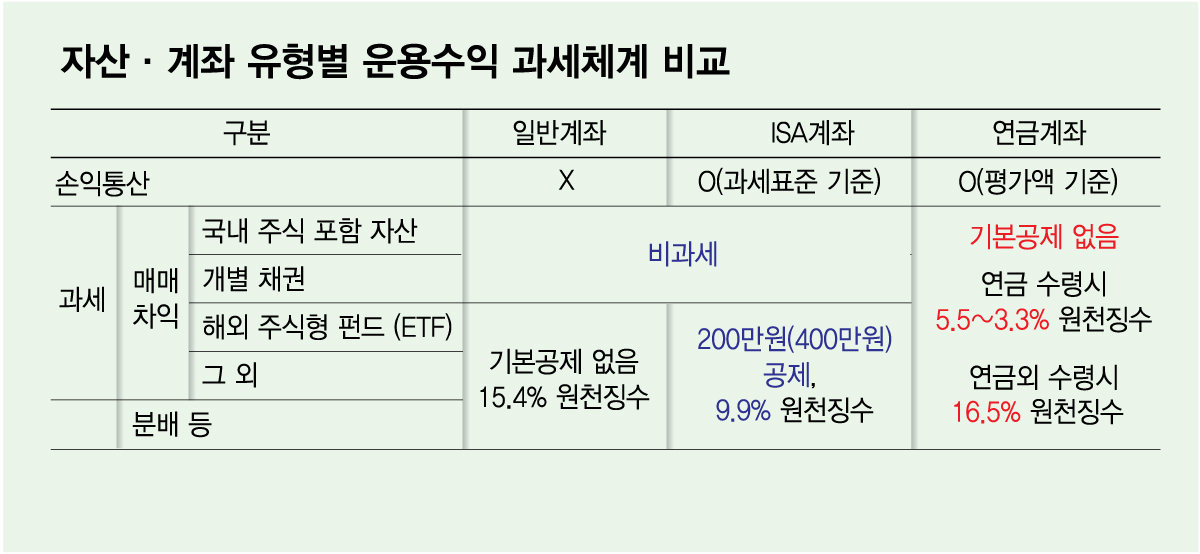
However, it is pointed out that current tax incentives for retirement pensions are insufficient to attract investors. Investing in domestic equity funds through a retirement pension account actually results in a loss.
When trading domestic equity funds in a general stock account, capital gains are tax-exempt, but in a pension account, a tax of 3.3% to 5.5% (upon pension receipt) is applied. This is because pension accounts have the characteristic of taxing the entire management return. Regardless of whether the investment is in deposits, domestic equity funds, or other products, taxes are levied only on the profit increased relative to the principal.
For this reason, retail investors are increasingly using retirement pension accounts to invest in overseas equity funds. Investing in overseas equity funds in a general stock account incurs a 15.4% tax on capital gains, but investing through a retirement pension significantly reduces the tax burden. Moreover, investors can enjoy benefits such as tax deferral and netting of profits and losses across multiple products.
A financial investment industry official said, "Among investors, there is already a widespread perception that it is disadvantageous to put domestic stock products into retirement pensions, while investing in overseas products is more advantageous." They added, "Retirement pension accounts, which should attract long-term domestic investment funds, are instead encouraging capital outflows abroad." Therefore, arguments suggest that a scheme should be introduced to exempt capital gains from tax on domestic equity products even within retirement pension accounts.
Incentives to encourage long-term accumulation in retirement pensions are also lacking. Currently, the retirement income tax is reduced based on how long the pension is received over time. For example, if the severance pay is received as a pension spread over 20 years, the tax is reduced by 50%.
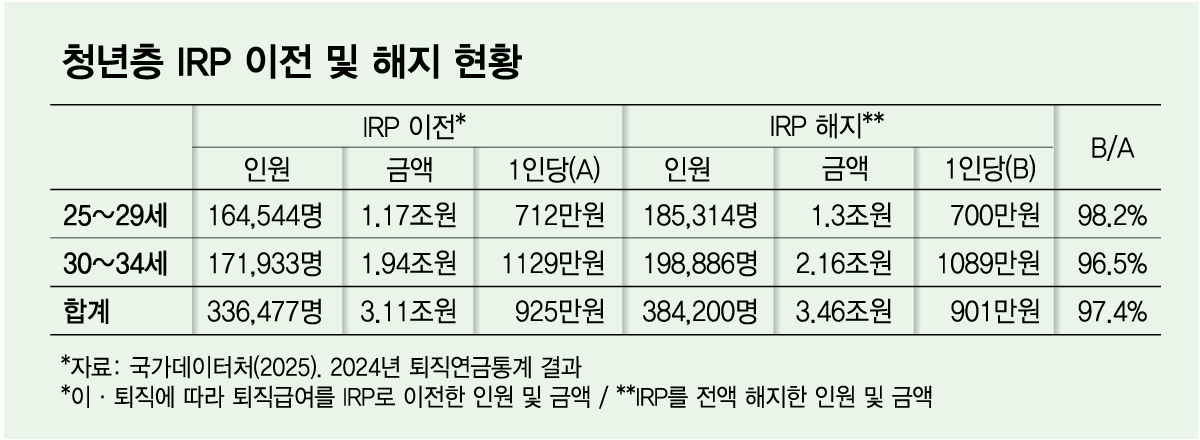
However, for the youth demographic, who frequently change jobs or retire, the effect of retirement income tax reductions that will only occur in 20 to 30 years is difficult to feel. According to the "2024 Retirement Pension Statistics" from the National Data Agency, the amount transferred to Individual Retirement Pensions (IRPs) by young people aged 25 to 34 due to job changes or retirement was 9.25 million won per person, of which 9.01 million won (97%) was canceled. An IRP is an account where severance pay can be transferred or additional funds can be deposited and managed by the individual to be received as a pension after age 55. The statistics show that most young people prefer to withdraw their severance pay in a lump sum rather than managing it as a pension.
In response, the industry proposes improvements in the direction of reducing retirement income tax based on the period during which the IRP is maintained without withdrawing the severance pay in a lump sum. This is a method of reducing taxes based on how long the severance pay is held without being broken up.
Another industry official explained, "Because the reduced tax amount is visible, an incentive to hold long-term may arise." They added, "If it is communicated that 'the tax reduction benefit accumulated over 5 years becomes zero' in case of early cancellation, the loss can also be visually confirmed, which would serve as a device to prevent cancellations."

 in STOCK

