

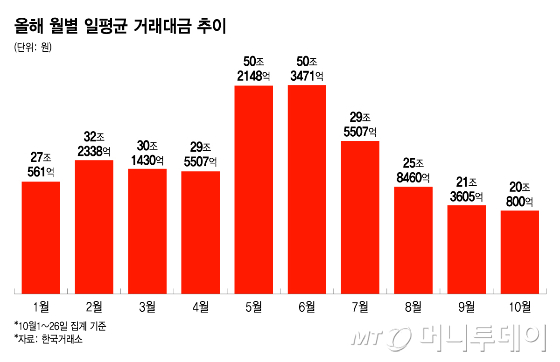
KOSPI trading volume and value have fallen to their lowest levels of the year, dampening domestic stock market vitality. Analysts say that retail investors who bought stocks at peak prices have had their funds locked up due to sharp price declines, while growing caution toward AI (artificial intelligence) investments has further suppressed investor sentiment.
According to Korea Exchange on the 26th, KOSPI market trading value on that day was 1.20108 trillion won, the lowest of the year. It had consistently exceeded 2 trillion won since the beginning of the year but fell below that mark for the first time in mid-August. Trading volume was recorded at 190.46 million shares. This is the first time this year that trading volume has fallen below 200 million shares.
KOSPI trading value has been on a downward trend since July last month. July marked the implementation of regulations on single-stock leverage ETFs (Exchange-Traded Funds). As barriers to entry for single-stock leverage ETFs, which had amplified trading volume and value through ultra-short-term trading, were raised, transactions decreased. In fact, after June, when monthly average daily trading value hit its peak, it has continued to decline through this month (October 1-26). The figures were as follows: △the 50.3471 trillion won △the 36.8754 trillion won △the 25.8460 trillion won △the 21.3606 trillion won △the 20.08 trillion won.
The average daily stock settlement amount has also turned to a downward trend. According to the Korea Securities Depository, the average daily stock settlement amount in the third quarter was approximately 8.8 trillion won. This represents a 12.4% decrease from the previous quarter, halting the upward trend that had continued since the third quarter of last year. In particular, on-exchange stock trading stands out. The average daily trading value in the on-exchange stock market in the third quarter was 77.28 trillion won, a 34.1% decrease from the second quarter. During the same period, the average daily settlement amount in the on-exchange stock market also decreased by 6.6% to 4.097 trillion won.
Supply-demand distortion is cited as a cause for the sharp drop in trading value. Investors who had their funds locked up at peak prices are unable to sell or buy due to the sharp decline in stock prices. In June alone, retail investors made net purchases of 42 trillion won in the KOSPI market. At that time, the KOSPI range moved between the 7,400 and 9,100 levels, which is approximately 1.3 times to a maximum of 1.6 times the closing price on that day (5,649.47).
Cautionary sentiment toward AI investments also fueled the contraction in trading. This month, concerns arose over the financial soundness of Neo cloud company CoreWeave, and doubts grew over whether large-scale funding for AI infrastructure investment would be possible after Meta's third-quarter earnings showed a shift to negative free cash flow (FCF).
Heo Jae-hwan, Managing Director at Eugene Investment & Securities, explained, "Stock prices of Samsung Electronics and SK Hynix, which had active trading in the first half, plunged, causing investors to suffer significant losses. They are currently unable to sell or buy new stocks." He added, "The cooling of AI enthusiasm due to profitability concerns also directly impacted the decrease in trading value."
The decline in trading value is also a burden on brokerage revenues for securities firms. According to Hana Securities, the consolidated net income attributable to owners of the parent for five major securities firms (Kiwoom, Samsung, NH Investment & Securities, Korea Financial Holdings, and Mirae Asset) in the third quarter is projected to be 1.1 trillion won, a 44.9% decrease from the same period last year. This figure represents a sharp 76.6% drop from the previous quarter and falls below the market forecast of 1.5 trillion won.
Go Yeon-su, a researcher at Hana Securities, analyzed, "The slowdown in trading profits due to decreased trading value and rising interest rates will act as a burden on earnings." He added, "If domestic stock market trading value remains at current levels in the fourth quarter, there is a possibility of further profit declines." However, he predicted that "despite short-term earnings slowdowns, dividend appeal will support the downside of stock prices."
It is expected to take time for trading value to recover. This is because it is necessary to confirm the sustainability of AI investments through earnings reports from major big tech companies such as Microsoft, and ahead of the Federal Reserve System (Fed) October Federal Open Market Committee (FOMC) meeting. Concerns over high inflation and high interest rates remain due to rising international oil prices caused by the prolonged Middle East war. Kim Dae-jun, a researcher at Korea Investment & Securities, said, "Sentiment is strong for checking domestic and foreign big tech earnings and various events during the week, so the wait-and-see stance is highly likely to continue for the time being."

 in STOCK
