

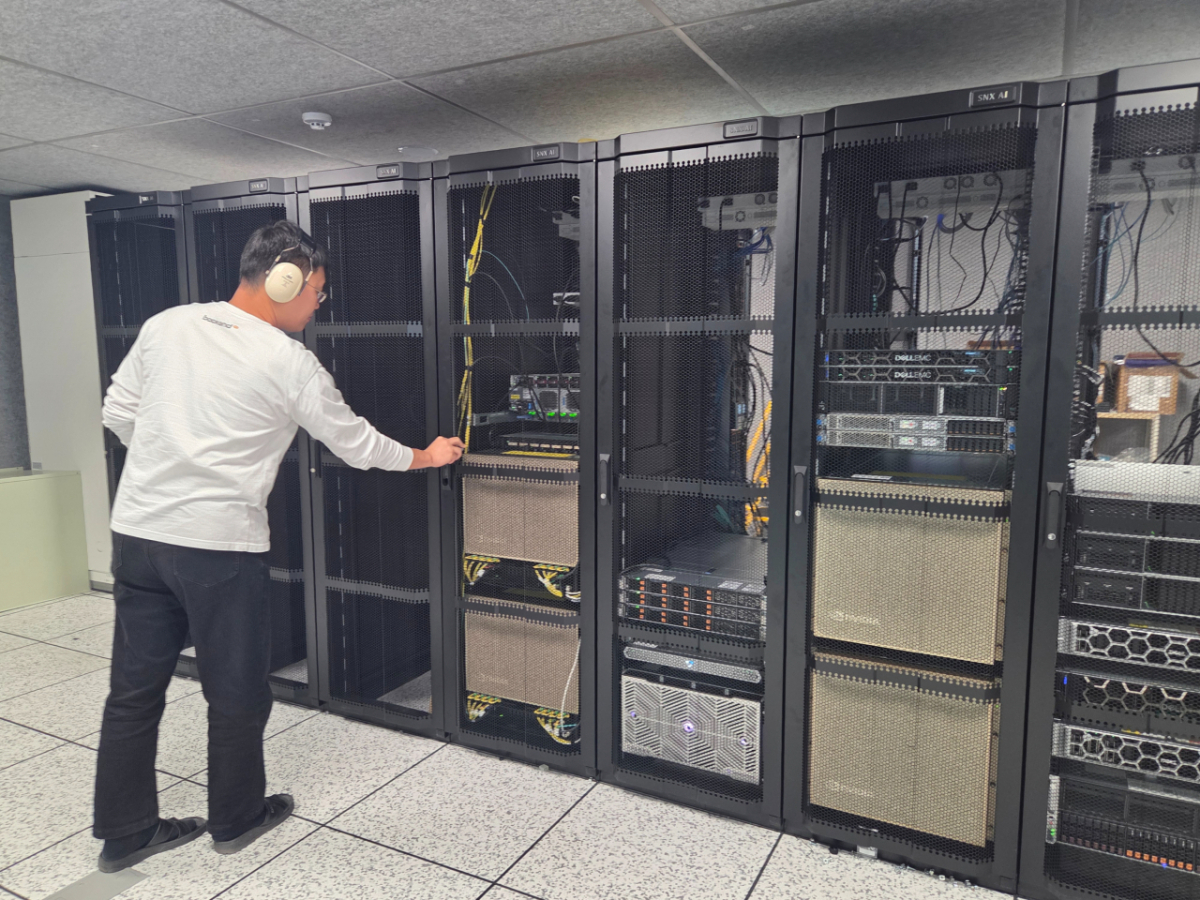
“This is Reblup’s third test DC (data center). It houses NVIDIA GPUs (graphics processing units), Dell servers, and FuriosaAI’s Renegade. We also installed Tenstorrent’s Galaxy for the first time in Korea. The empty slots are scheduled to be filled with the latest models, such as NVIDIA Vera Rubin. Here, we verify whether various AI semiconductors operate smoothly together.”
CEO Shin Jung-gyu of Reblup, met at the company’s headquarters in Gangnam-gu, Seoul, introduced a test DC used to trial the company’s representative solutions, including ‘Backend.AI,’ an AI infrastructure platform. In a test DC composed solely of different GPUs and NPUs (neural processing units), they verify how to boost semiconductor efficiency and whether chips from various models can be bundled together for seamless use. Test DCs are also located in Pyeongchon, Anyang, Gyeonggi-do, and Bupyeong, Incheon. Through Reblup’s solutions, customers have increased GPU utilization rates from 30% to a maximum of 85%, while reducing GPU budgets by 40%.
‘Tens of millions to hundreds of millions of won’ GPUs: Can’t utilize more than 30%? …With Reblup, up to 85%↑
Reblup is a software company that provides software for efficiently managing complex AI infrastructure. In typical AI infrastructure and server environments, GPU utilization is only around 30–50%, but efficiency improves significantly when using Reblup’s software. Even if thousands of expensive GPUs are secured, a separate solution like Reblup is essential to use them properly. This is also why NVIDIA recently acquired Run.ai, a GPU operations software company.
Unlike neo-cloud companies that directly purchase and lease GPUs, Reblup helps customers utilize their existing GPUs more efficiently. While neo-cloud companies compete on how many GPUs they can secure and provide to customers, Reblup focuses on extracting as many computational results as possible from the GPUs. Reblup’s AI infrastructure integrated operation platform, Backend.AI, improves GPU efficiency by up to 2.8 times.
CEO Shin explained, “Recently, concerns over the profitability of neo-cloud companies in the U.S. have worsened AI investment sentiment, but Reblup is actually a risk-hedging company that reduces their costs.”
In fact, KT Cloud reduced average costs per customer by 60% after adopting Backend.AI. The Upstage consortium, which is developing the government’s independent AI foundation model, shortened pre-training time from 120 days to 66 days using Backend.AI in a training environment utilizing approximately 500 NVIDIA B200 GPUs.
Based on this technological capability, Reblup has secured major customers and partners both domestically and internationally. Currently, the company’s products are used at over 120 sites, with more than 2,000 GPUs managed at a single site. Key customers include △Samsung Electronics △LG Electronics △KT △Shinhan Bank △NHN Cloud △CJ △Bank of Korea △Hyundai Mobis △Korean Air △Republic of Korea Navy △Samsung Seoul Hospital △ETRI (Electronics and Telecommunications Research Institute), among others. Partnerships have been established with △NVIDIA △AMD △Intel △Dell △Microsoft (MS) △AWS △Everpure △Rebellion △FuriosaAI △Tenstorrent, and others. In particular, Reblup has collaborated with NVIDIA since 2018 and became the first DGX-Ready Software Partner in the Asia-Pacific region in 2021.
From NVIDIA to domestic NPUs… Different chips work as one
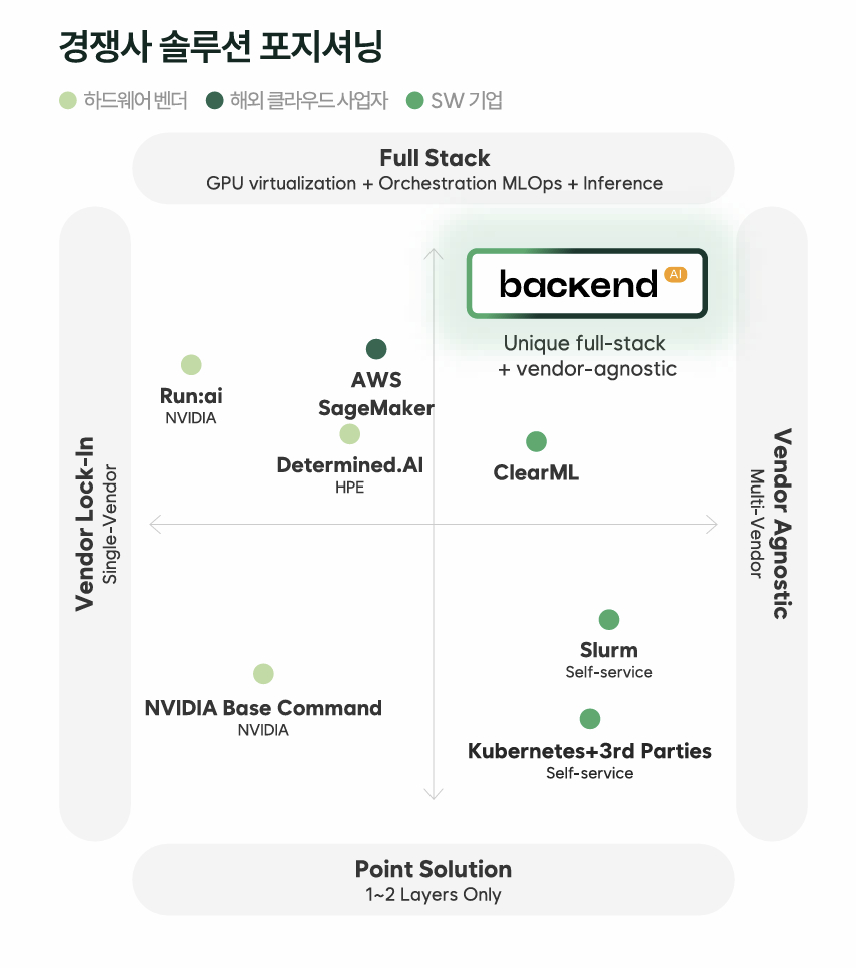
Reblup’s core competitiveness lies in ‘vendor neutrality’ and being a ‘full-stack’ provider. Vendor neutrality means not being dependent on specific semiconductor manufacturers or cloud service providers. Full-stack refers to providing a wide range of functions necessary for AI infrastructure operations, from GPU resource management to AI model training and inference. Reblup explains that its platform is competitive because it simultaneously achieves both of these aspects.
Reblup supports GPUs from NVIDIA, AMD, and Intel, as well as NPUs from companies like Rebellion and FuriosaAI. It can currently integrate and operate more than 11 types of chips. AI semiconductors such as GPUs and NPUs differ in performance, power consumption, and operating methods depending on the manufacturer and generation. Even when equipped with the same NVIDIA GPU, cooling structures and operating environments vary by server manufacturer, such as Dell or HPE (Hewlett Packard Enterprise). It is difficult to apply existing operating systems directly when introducing new chips or using a mix of GPUs from multiple generations.
Reblup has resolved such issues by directly securing and optimizing various hardware. The company converts any hardware configuration chosen by the customer into an AI cloud. CEO Shin explained, “For example, if you need to remove all A100s because they are old models that can no longer be sourced, or if inserting a different model doesn’t run smoothly, Reblup allows it to work even with RTX Pro 6000s or NPUs from other companies.”
CEO Shin emphasizes that Backend.AI has higher stability than Run.ai, which was acquired by NVIDIA. He stated, “Run.ai manages GPU resources based on Kubernetes, a general-purpose container management system, but Reblup uses its own orchestrator, Sokovan, allowing for faster failure recovery and speed optimization.” He added, “Since GPUs frequently experience failures, the importance of technology that enables rapid recovery and stable operation is growing.”
Securing loyal customers drives revenue growth… Overseas results to materialize next year
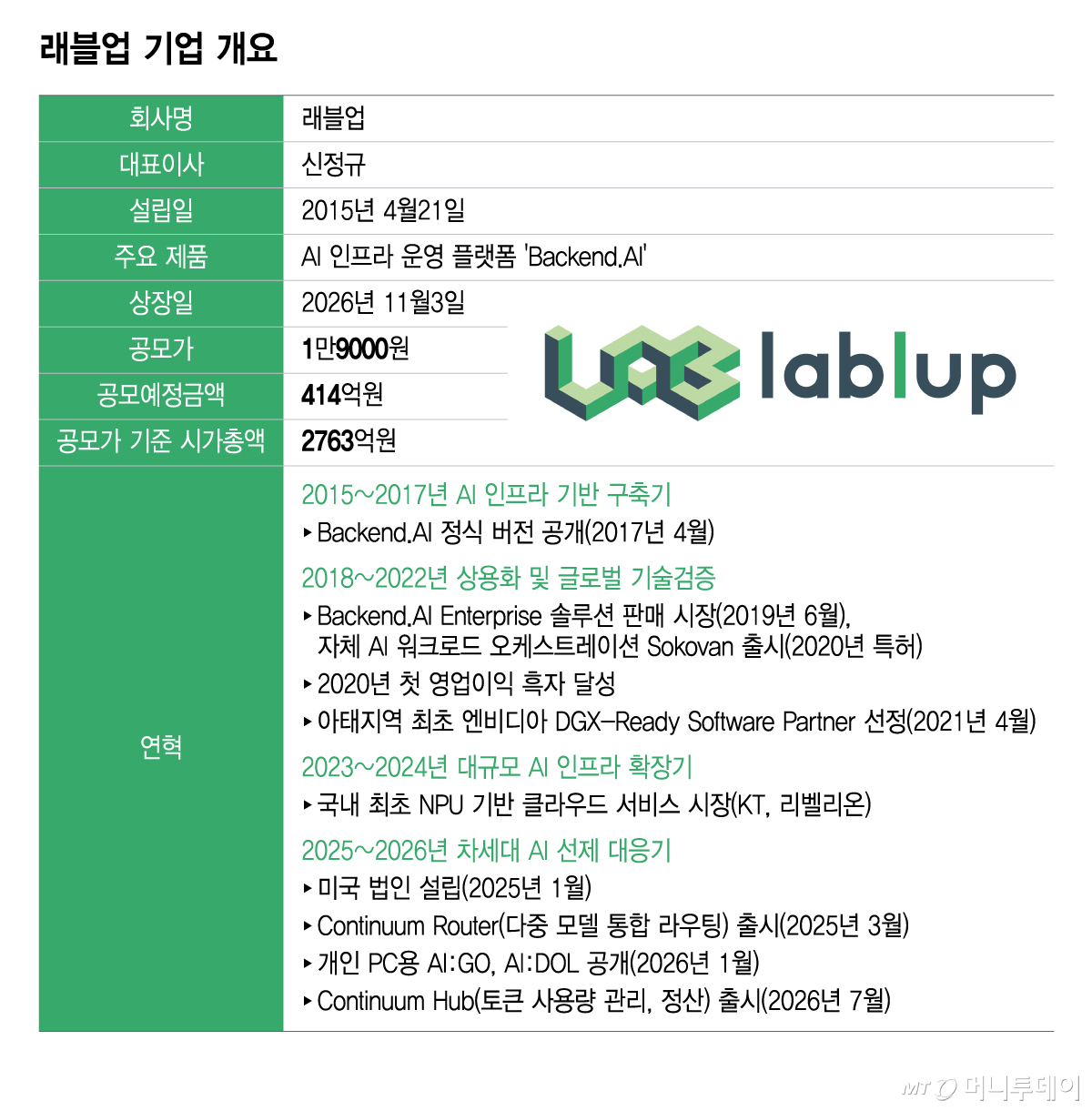
Reblup’s revenue model is based on software license sales. The Backend.AI Enterprise product is provided via subscription, depending on the number of GPUs and performance tiers. Revenue increases as customers introduce additional GPUs or upgrade to high-performance products. Reblup cited its high customer renewal rate as a strength. Last year, 94.7% of revenue was recurring revenue, and the average NRR (Net Revenue Retention) over the past five years is 137.9%. NRR is an indicator showing how much revenue from existing customers is retained or increased, excluding new customers.
Revenue has been on an upward trend: 3 billion won in 2023, 5.9 billion won in 2024, and 6.7 billion won in 2025. Revenue for the first half of this year was recorded at approximately 4.7 billion won. The company turned profitable for the first time in 2020. It has maintained a profit trend since 2024. Last year’s operating profit was 700 million won, and the operating profit for the first half of this year is approximately 600 million won.
Reblup is expanding its overseas sales network in the U.S., Europe, Southeast Asia, and Japan. CEO Shin stated, “We will be able to disclose revenue cases from overseas customers, such as in the U.S., around March or April next year.” New products are also being launched. Continuum, a token usage management optimization solution, recently secured its first customer, generating revenue. Additionally, ‘Reblup Token Factory Suite,’ which provides the company’s own test DC to external parties, is scheduled to be unveiled in early next year.
Reblup will list on the KOSDAQ market on the 3rd of next month. In the public offering subscription for general investors conducted on the 22nd and 23rd, it recorded a competition ratio of 3.55 to 1. The preceding institutional investor demand forecast recorded a competition ratio of 284.53 to 1, and the issue price was finalized at 19,000 won.

 in STOCK


