

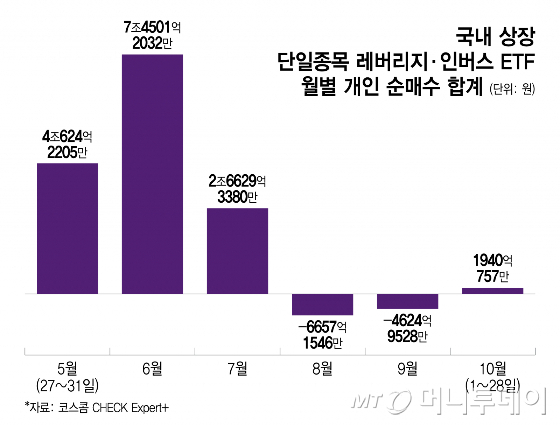
With the share prices of Samsung Electronics and SK hynix plunging since October, retail investors have been buying into single-stock leveraged exchange-traded funds (ETFs) that track the stock prices of these two companies at twice the rate. Retail investors shifted to net purchases this month, with buying pressure particularly concentrated in SK hynix products.
Retail investors made net purchases totaling 194 billion won across 16 single-stock leveraged and inverse ETFs related to Samsung Electronics and SK hynix from the 1st through that day. This marked a shift to net buying for the first time in three months, following net sales of 665.7 billion won in August and 462.5 billion won in September.
Foreign investors also bought 26.3 billion won worth of these products this month. After shifting from net sales of 161.2 billion won in August to net purchases of 269 billion won in September, they have maintained a net buying position for two consecutive months. However, the scale of their net purchases is smaller compared to that of retail investors.
The securities industry views this as an attempt by investors who bought at peak prices and incurred losses to recoup them through leveraged ETFs.
Given the significant drop in Samsung Electronics and SK hynix share prices, this implies investment in products capable of delivering higher returns upon a rebound. Opinions have also emerged suggesting that there may be demand from investors selling their held stocks to switch into leveraged ETFs.
A securities firm official said, "It appears that investors who bought shares at peak prices are attempting to recoup losses through leveraged ETFs, expecting a rebound after the recent sharp decline." On that day, as Samsung Electronics and SK hynix share prices surged, single-stock leveraged ETFs rose by 17% to 23%.
Of the retail net purchases, approximately 75.5%, or 146.5 billion won, was concentrated in eight SK hynix ETFs. Among these, net purchases of seven leveraged ETFs that bet on price increases reached 154.8 billion won. In particular, 98.9 billion won flowed into the "KODEX SK hynix Single Stock Leveraged" fund alone.
The concentration of buying pressure in SK hynix is driven by expectations that it has greater room for share price appreciation than Samsung Electronics. As SK hynix holds a large proportion of its business in memory for AI semiconductors, such as high-bandwidth memory (HBM), benefits from expanded AI investment can be directly reflected in its stock price.
In contrast, Samsung Electronics has businesses outside of memory semiconductors, such as home appliances and mobile devices, making it difficult for the memory semiconductor cycle to be fully reflected in its share price.
Additionally, SK hynix's withdrawal of plans to pursue an initial public offering (IPO) of its subsidiary Solidigm on the 23rd has heightened expectations for a stock price rebound.
A securities firm researcher who requested anonymity explained, "The perception that the Solidigm IPO would involve splitting up a healthy company and listing it spread, which weighed on the share price." The researcher added, "Tech stock prices had fallen due to concerns over AI profitability, but an unrelated variable emerged and acted as negative news."
However, assessments suggest that the recent shift in retail net purchases has a limited impact on overall market supply and demand. This is because the trading volume of related ETFs has decreased compared to before, and the amount of retail net purchases is not large enough to change the direction of the market. Market burden factors, such as foreign investor supply and demand and external uncertainties, also remain.
The issue is that it is still difficult to be certain whether share prices will move in an upward direction. Because leveraged ETFs track the daily return rate of the underlying asset at twice the rate, if stock prices fluctuate repeatedly, losses can expand due to negative compounding effects.
A securities firm researcher said, "It is difficult to judge that share prices have entered a trend of sustained growth based solely on a one- or two-day rebound." The researcher added, "It is necessary to observe the stock price trends through next week, and attention must be paid to the compounding effect of leveraged ETFs in highly volatile market conditions."

 in STOCK
