

LED (light-emitting diode) specialist Seoul Semiconductor announced on the 28th that it has developed the world's first ultra-small white LED that does not use rare earth elements.
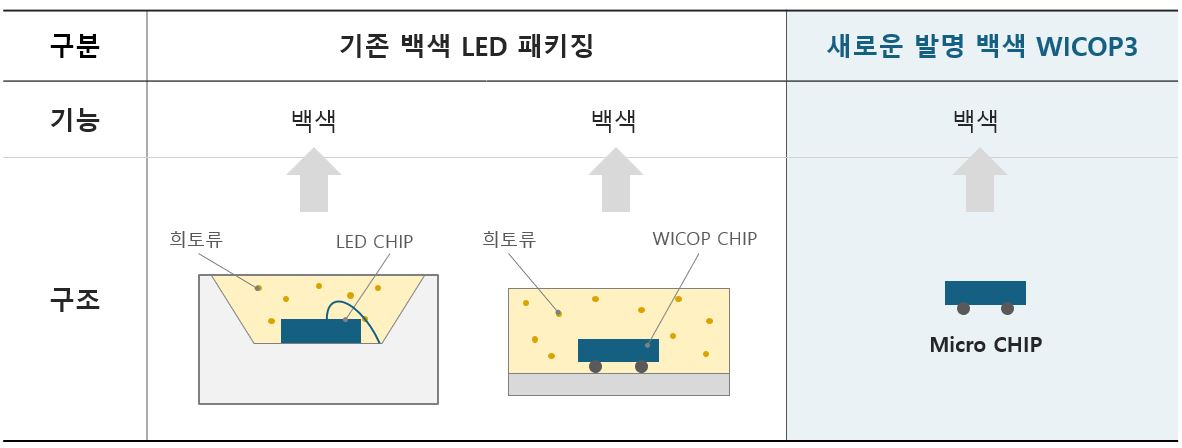
The company explained that for the past 30 years, producing white LEDs required rare earth elements such as 'yttrium aluminum garnet' (YAG), but this has now changed. The chip (optoelectronic device) developed by Seoul Biosys (a subsidiary of Seoul Semiconductor) and Seoul Semiconductor emits white light at a size of up to 10 micrometers (µm; 1 µm is one-millionth of a meter) without the use of rare earths. It is an optoelectronic device based on 'WICOP (Wafer Integrated Chip On Package) 3rd Generation,' Seoul Semiconductor's proprietary technology that requires no packaging.
Seoul Semiconductor stated that the global white LED market, measured by LED package standards, is approximately $10 billion in size, and that this market can be replaced with WICOP 3rd Generation technology, which does not require rare earths. The company also noted that the product is environmentally friendly as it does not use rare earths, artificially made silicone resin, plastic, or lead frames. Manufacturing costs are also reduced to half.
A Seoul Semiconductor official stated, "We will begin mass production of WICOP 3 starting this fourth quarter and will prioritize supply to customers who have primarily used Seoul Semiconductor products in the past."
The official added, "WICOP 3 technology can now realize white light without rare earths and achieve a dream-like, semi-permanent white light source even at sizes below 100 micrometers, which are invisible to the naked eye," while noting, "However, adhering to the principle that 'the company does not compete with its customers,' we plan to jointly explore new application markets with key customers." This means that, separately from supplying customers, the company will not directly manufacture and sell products using the new technology.

 in INDUSTRY
