

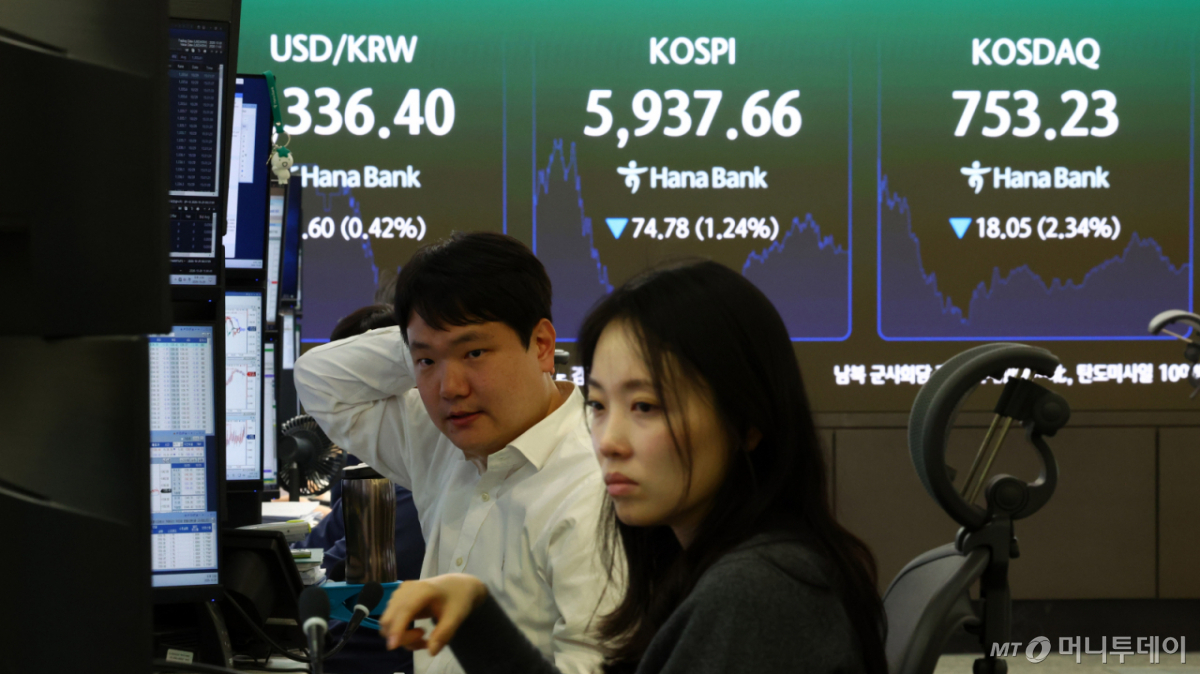
KOSPI gave up the 6,000 mark it had reclaimed for the first time in 10 trading days just one day later. The decisive blow was a surge of disappointment selling after Samsung Electronics, which accounts for 27% of KOSPI market capitalization, failed to disclose specific shareholder return plans, amid overlapping negative factors such as LG Chem’s sale of its stake in LG Energy Solution and the failure to secure a construction contract for a Czech nuclear power plant.
On Thursday, KOSPI closed at 5,937.66, down 74.78 points (1.24%) from the previous trading day. The index opened at 6,017.22, up 4.78 points (0.08%) from the previous close, and rose as high as 6,100.11 during intraday trading before reversing into a decline as a large number of stocks plunged.
KOSPI fell to 5,817.92 at one point during the session but partially recovered its losses in the afternoon as stocks such as Hanwha Vision rebounded on the back of strong earnings results.
In the KOSPI market, retail investors made net purchases of 33 billion won, and foreign investors made net purchases of 69 billion won, while institutional investors made net sales of 447.2 billion won.
Foreign investors continued their streak of net purchases for three consecutive trading days, but the scale of net purchases, which reached 400 billion won around 11 a.m., decreased sharply in the afternoon.
By sector, financials and securities rose by more than 1%. In contrast, electric power and gas, electronics, manufacturing, and general services fell by more than 1%; transportation equipment and parts, metals, and IT services dropped by more than 2%; chemicals and entertainment and culture declined by more than 3%; and machinery and equipment and construction fell by more than 5%.
Among top market capitalization stocks, SK Square rose by more than 3% and SK hynix by more than 2%, extending their gains for a second consecutive day. KB Financial Group rose by more than 1%, while Shinhan Financial Group, Samsung SDI, Kia, and Samsung Life Insurance were slightly higher.
Celltrion, Samsung C&T, and Samsung Biologics Logic were slightly lower, and Samsung Electro-Mechanics and Hyundai Motor fell by more than 1%. Despite announcing record-breaking earnings, Samsung Electronics dropped by more than 4% after failing to present the new shareholder return plan the market had expected, and LG Energy Solution plunged by more than 8% on news of a stake sale by its largest shareholder, LG Chem.
On this day, Samsung Electronics rose as high as 249,000 won, up 2.89%, just before its earnings release but reversed into a decline immediately after the announcement. At one point during intraday trading, it fell by more than 6% to 226,000 won.
Researcher Kang Jin-hyuk of Shinhan Investment said, “Disappointment selling emerged as Samsung Electronics’ shareholder return plan announcement was delayed.”
It is interpreted that investor sentiment deteriorated sharply as no additional share buyback and cancellation plans were announced to prevent further downside in the stock price.
Samsung Electronics completed a 1.5 trillion won share buyback earlier this month. It is predicted that concerns over a supply gap will be difficult to dispel until an additional announcement is made in January next year.
Amid concerns over Samsung Electronics’ supply, events such as U.S. economic indicator releases, Japan’s monetary policy, and U.S. Big Tech earnings announcements are lined up one after another, prompting securities firms to advise a focus on risk management.
Researchers Im Jeong-eun and Tae Yoon-sun of KB Securities stated, “With the U.S. scheduled to release its September PCE (Personal Consumption Expenditures) price index tonight, caution is needed regarding the possibility of increased short-term volatility ahead of the Bank of Japan’s monetary policy decision on the 30th and earnings announcements from companies such as Amazon and SanDisk.”
KOSDAQ closed at 753.23, down 18.05 points (2.34%). The index opened at 767.78, down 3.50 points (0.45%), and remained weak throughout the session.
In the KOSDAQ market, retail investors made net purchases of 217.3 billion won, while foreign investors made net sales of 130.7 billion won and institutional investors made net sales of 75.9 billion won.
By sector, publishing and media materials were strong, rising by more than 11%. Medical and precision equipment, machinery and equipment, and transportation equipment and parts fell by more than 3%. The electronics sector also dropped by more than 2%, as the semiconductor materials, components, and equipment (so-bu-gang) segment took a leading hit from Samsung Electronics’ decline.
Among top market capitalization stocks, all were weak except for PSK Holdings, which was slightly higher. Alteogen fell by more than 1%; HLB and Rino Industrial by more than 2%; HPSP, Robotis, and Simtech by more than 3%; Ecopro, Wonik IPS, and Jusung Engineering by more than 4%; Ecopro BM by more than 5%; and Rainbow Robotics by more than 6%.
In the Seoul foreign exchange market, the won/dollar exchange rate closed daily trading at 1,336.8 won, down 0.9 won from the previous trading day.

 in STOCK
