

As the government has strengthened market-cap-based delisting requirements to remove insolvent companies from the KOSDAQ, controversy continues, with criticism emerging not only from industry but also from the political sphere that the measures are inappropriate.
In particular, it is argued that it is difficult to determine insolvency based solely on market capitalization for special-listing companies, which have become a major listing method in the KOSDAQ market and often continue R&D investment without significant revenue. Voices are rising that the evaluation method should be changed to reflect factors such as the stage of technology development and commercialization prospects.
According to the financial investment industry on the 4th, demands are growing for diversifying evaluation methods as some KOSDAQ companies face delisting risks due to the strengthened market-cap-based delisting requirements.
The government has progressively strengthened market-cap-based delisting requirements with the aim of swiftly removing insolvent companies from the market. Starting January 1 this year, the delisting market cap threshold was raised to 20 billion won for KOSPI and 15 billion won for KOSDAQ.
The criteria of 30 billion won for KOSPI and 20 billion won for KOSDAQ, originally scheduled for application in January next year, were brought forward by six months and applied starting July 1 last month. The plan was to raise the thresholds once more to 50 billion won for KOSPI and 30 billion won for KOSDAQ starting January 1 next year.
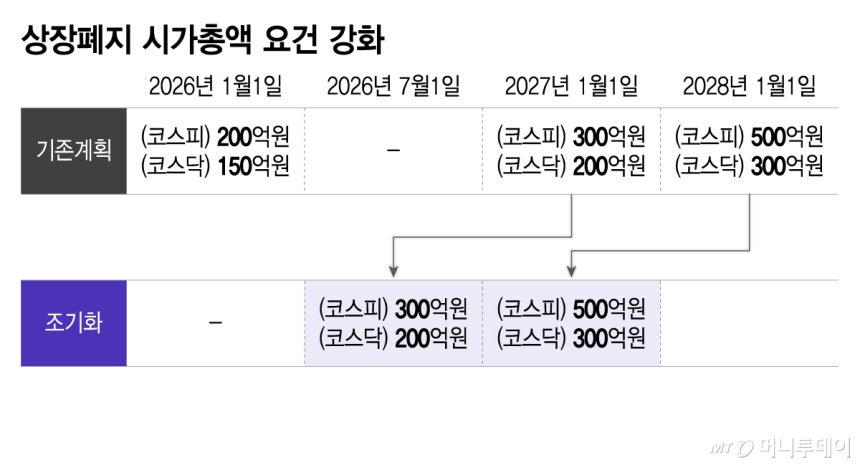
However, controversy persisted following industry backlash and deterioration in the KOSDAQ market, as well as a court's acceptance of an application to suspend the delisting effect for companies failing to meet market cap requirements. Ultimately, the government and Korea Exchange postponed the application period for the 50 billion won (KOSPI) and 30 billion won (KOSDAQ) criteria from January next year to July next year, a six-month delay. The exchange also decided to postpone delisting procedures.
Opinions are emerging that the evaluation method should be changed to reflect the different financial characteristics of special-listing companies, which, unlike general companies, must devote long periods to R&D. Special-listing companies account for 52% of the KOSDAQ market by market capitalization as of last year.
Democratic Party of Korea lawmaker Min Byung-deok also pointed out during last month's National Assembly audit that "revenue, cash flow, financial soundness, debt repayment capacity, and technological capabilities must be considered comprehensively."
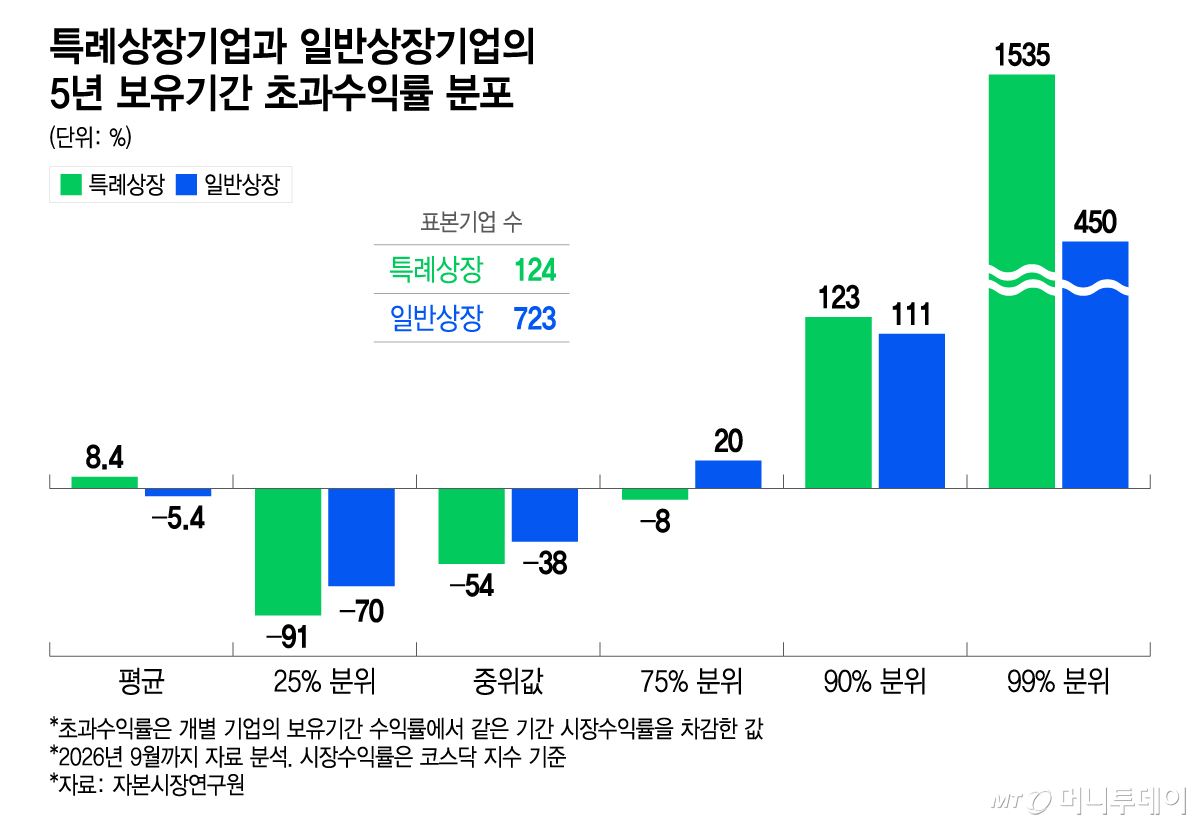
According to the Capital Markets Institute, the average excess return (holding period return minus KOSDAQ index return) over a five-year post-listing period was 8.4% for special-listing companies, higher than that of general-listing companies (-5.4%).
Conversely, the median was -54% for special-listing companies, lower than that of general-listing companies (-38%). This means that while many companies underperformed, a small number achieved significant results. In fact, the excess return at the 90th percentile (top 10%) reached 123%, and the 99th percentile (top 1%) reached 1,535%, significantly outperforming general-listing companies. The Capital Markets Institute analyzed that this demonstrates the effectiveness of special listings in identifying companies with high growth potential.
Lee Seok-hoon, senior research fellow at the Capital Markets Institute, said, "Looking at the trend of cumulative excess returns after listing, performance improvement is significantly observed in the period beyond five years post-listing for special-listing companies," adding that this "can be interpreted in connection with the characteristics of companies that require long periods for technology development and commercialization."
The explanation is that to judge the growth potential of special-listing companies, one must look not only at financial statements but also at whether technology development is actually progressing and whether commercialization prospects are improving.
Lee explained, "Technology assessments must be refined so that companies with growth potential at the time of listing can be distinguished from those with low sustainability." He added, "In cases where it is difficult to judge based solely on post-listing revenue and profit, market cap requirements reflecting market evaluation can be utilized, but those market prices must be formed based on sufficient information and rational evaluation."
He further emphasized, "Therefore, if market capitalization is to be used as a delisting criterion, the quality of disclosures and research must be improved, and market surveillance for stocks approaching delisting thresholds must be strengthened."

 in STOCK

