

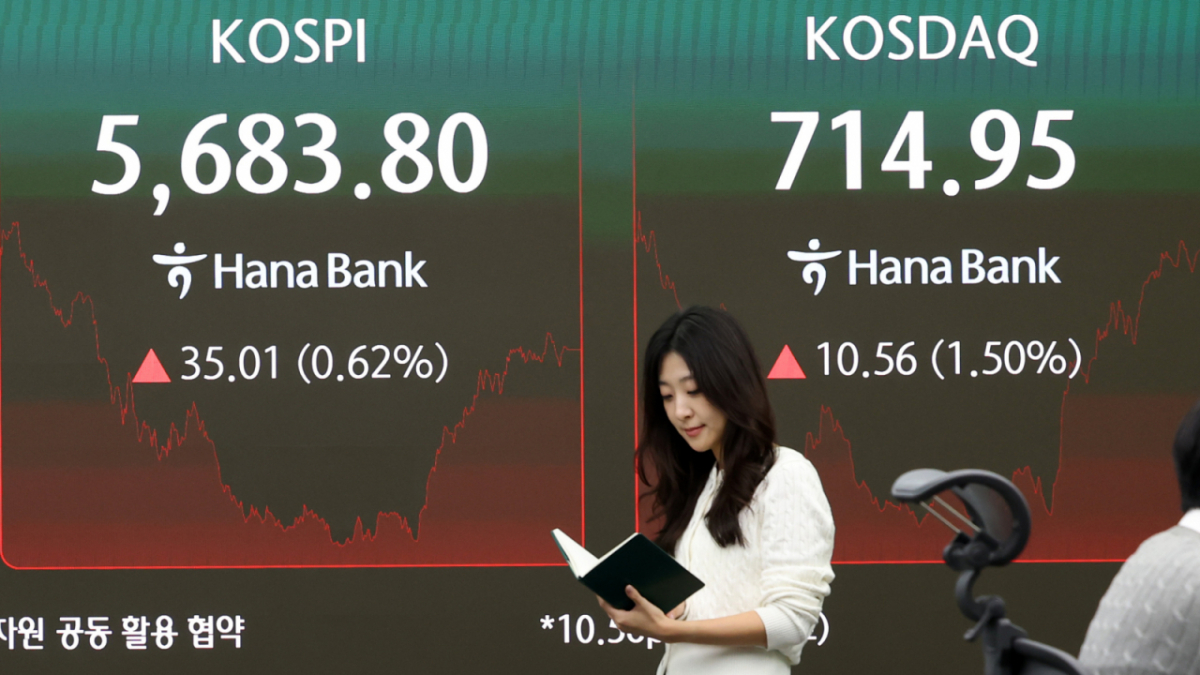
KOSPI, which fluctuated moment by moment in response to the U.S. midterm election vote-counting results, ended regular trading on Wednesday with a slight gain. KOSDAQ closed up more than 1%, driven by strength in semiconductor materials, components and equipment (so-bu-bang) and the secondary battery sector.
KOSPI closed at 5683.80, up 35.01 points (0.62%) from the previous trading session. After opening at 5786.13, up 137.34 points (2.43%), KOSPI rose by more than 3% in early trading to surpass the 5,800 mark, but was pushed down to the 5,400 level at one point as foreign selling intensified.
In late trading, net buying by retail investors and institutional investors continued, leading to a slight gain at the close. According to Korea Exchange data as of 4:04 p.m., retail investors made net purchases of 1 trillion 147.9 billion won, while institutional investors made net purchases of 1 trillion 14 billion won. Foreign investors were provisionally recorded as making net sales of 2 trillion 506.3 billion won.
Among top market capitalization stocks, large-cap semiconductor names closed slightly lower, while eco-friendly and secondary battery sectors showed strength. Samsung Electronics, SK hynix, and SK Square closed slightly lower. LG Energy Solution surged by more than 3%, and Samsung SDI jumped by more than 9%. This is interpreted as expectations for benefits to secondary battery and eco-friendly stocks following a landslide victory for the U.S. Democratic Party.
By sector, telecommunications, electricity and gas rose by more than 4%, pharmaceuticals by more than 3%, and metals, chemicals, and IT services by more than 2%. Entertainment and culture fell by more than 6%.
Lee Kyung-min, an analyst at Daishin Securities, said, "Investor sentiment in the semiconductor sector weakened due to concerns over data center investment following the U.S. midterm election results."
Lee added, "Conversely, policy expectations from the Democratic Party's victory in local elections acted as upward pressure on eco-friendly sectors, and the secondary battery sector also showed strength."
KOSDAQ closed at 714.95, up 10.56 points (1.50%). Although KOSDAQ was pushed down to the 700th level during intraday trading, it ended higher as semiconductor materials, components and equipment and secondary battery sectors both showed strength.
In the KOSDAQ market, retail investors made net sales of 53.8 billion won, while institutional investors and foreign investors made net purchases of 63.5 billion won and 1 billion won, respectively.
Among top market capitalization stocks, EcoPro BM and Simtech surged by more than 9% each. EcoPro rose by more than 8%, and Jusung Engineering climbed by more than 7%, showing strength. ISC rose by more than 4%, and Rino Industrial increased by more than 3%. Conversely, HLB fell by more than 16% after news emerged of a delay in new drug review in the United States.
As a result, analysts say that low-price buying flowed in as uncertainty surrounding the U.S. midterm elections subsided on the day.
Kim Seok-hwan, an analyst at Mirae Asset Securities, said, "In the domestic stock market, solar power, ESS (energy storage systems), secondary batteries, and renewable energy themes showed exceptional strength amid expectations of a Blue Wave (Democratic Party victory)." He added, "It is estimated that low-price buying flowed in following the resolution of election uncertainty, as U.S. overnight futures also quickly narrowed their losses in the afternoon."
In the Seoul foreign exchange market on the day, the won/dollar exchange rate closed daily trading at 1,341.5 won per dollar at 3:30 p.m.

 in STOCK
