

To break the vicious cycle in which other companies with the same credit rating face fundraising difficulties after a major credit event, experts point out that it is necessary to distinguish credit risks on a company-by-company basis and broaden funding supply channels.
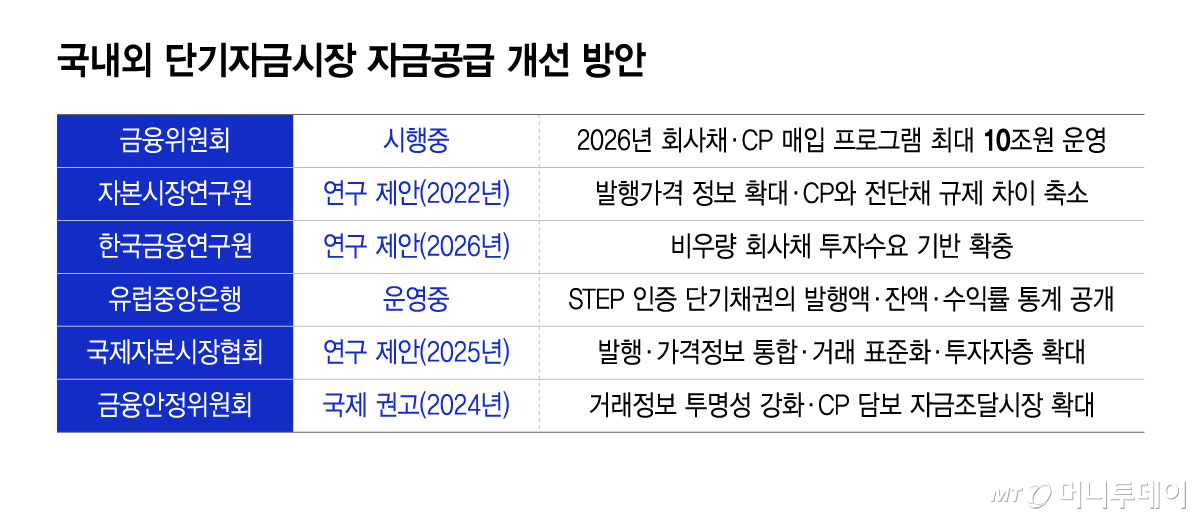
Key tasks include increasing the utilization of the corporate bond and CP purchase program operated by financial regulators, enhancing the transparency of issuance prices, and broadening the investor base to mitigate investment aversion based on credit ratings.
According to financial regulators and the financial investment industry on the 5th, the Financial Services Commission is operating a corporate bond and CP purchase program of up to 10 trillion won this year through entities such as the Korea Development Bank, the Industrial Bank of Korea, and the Credit Guarantee Fund.
The total support scale of the bond and short-term funding market stabilization program, including the Bond Market Stabilization Fund and the Credit Guarantee Fund's P-CBO (Primary Collateralized Bond Obligation), is up to 37.6 trillion won.
The corporate bond and CP purchase program originated as a market stabilization measure introduced in response to the 2020 COVID-19 shock and has been repeatedly extended. The Financial Services Commission included A1 to A3-rated CP and electronic short-term bonds (short-term bonds) in the support targets in 2023 and extended the operation period until the end of 2024.
It subsequently maintained the program and decided in December last year to extend it again until the end of this year. According to the Financial Services Commission, approximately 11.8 trillion won was newly purchased through all market stabilization programs, including corporate bond and CP purchases, from January to November last year, focusing on non-investment-grade securities.
Although the policy finance support system is being maintained, the outstanding balances of A3-rated CP and short-term bonds have decreased significantly compared to before the Homeplus incident. Voices are emerging that the effectiveness of the support should be examined by detailed rating, as liquidity supplied to the entire market does not immediately translate into improved fundraising conditions for companies with relatively lower credit ratings.
The Capital Market Institute proposed organizing the issuance and credit evaluation system for CP and short-term bonds and enhancing the transparency of market information. In particular, it suggested a plan to assign ratings by explicitly stating issuance limits in CP credit evaluations, similar to short-term bonds.
According to current disclosures by credit rating agencies, while issuance limits are separately indicated for short-term bonds, there are cases where they are not for CP. The institute also proposed providing more information on actual issuance prices and yields by credit rating.
The Korea Financial Research Institute warned of refinancing risks due to the contraction in corporate bond issuance and the increase in CP and short-term bond issuance, calling for the expansion of the investment demand base for non-investment-grade corporate bonds. It stated that to reduce companies' reliance on short-term funding, investment demand must be secured for companies with various credit ratings in the corporate bond market as well.
Abroad, the funding supply function of the short-term funding market is being improved by enhancing information transparency and standardizing transactions. The European Central Bank (ECB) regularly discloses the issuance amount, outstanding balance, and yield to maturity of short-term bonds that meet common standards through 'STEP' (Standardization of European Short-Term Paper). It allows for comparison of market fundraising conditions by distinguishing between issuers, maturities, and credit ratings.
It is not that there is no information disclosure system in Korea. CP and short-term bond issuance information is provided through the Korea Securities Depository and KOSCOM, and yields can be checked through the Korea Financial Investment Association and bond rating agencies. However, the key issue is how easily investors can compare actual issuance prices, maturities, and interest rates by credit rating.
The International Capital Market Association (ICMA) proposed integrating issuance and price information, standardizing transactions, and expanding the investor base in its report on the development of the European CP market last November.
The content includes integrating fragmented information and standardizing issuance and settlement procedures to reduce transaction costs, as well as improving regulations and investment practices related to MMFs (money market funds) to create conditions for companies with various credit ratings to participate in the market.
An official from the financial investment industry said, "The shock of a credit event should not adversely affect the fundraising of other companies," adding, "It is important to strengthen the information necessary for investors' risk assessment and diversify funding supply channels, rather than simply increasing the sale of A3-rated products."

 in STOCK
