

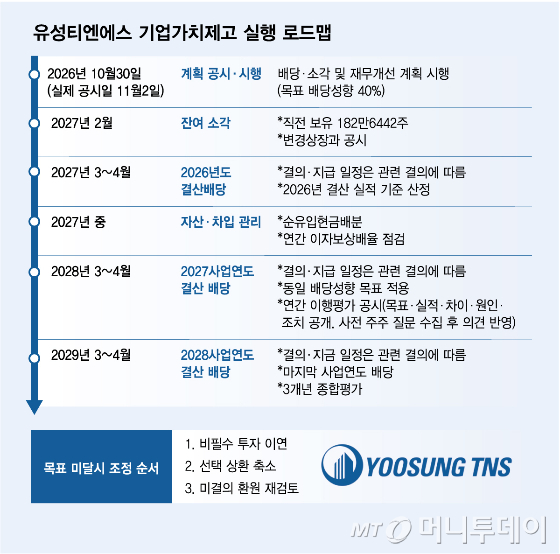
The first KOSDAQ-listed company to announce a corporate valuation enhancement plan following the Korea Exchange’s disclosure of the low-PBR (price-to-book ratio) company list on Nov. 2 has emerged. The steel logistics firm Yuseong TNS announced shareholder return targets, including a 40% dividend payout ratio and the full cancellation of treasury shares.
It also presented specific execution measures and plans for communication with shareholders. Attention is now turning to whether the disclosure of the low-PBR company list will serve as a catalyst for substantive efforts to enhance corporate valuation.
According to electronic disclosures from the Financial Supervisory Service on the 5th, Yuseong TNS voluntarily disclosed its “Corporate Valuation Enhancement Plan for 2026–2028” on the 2nd.
This was the same day the exchange first published the list of 151 low-PBR companies, including 96 KOSPI-listed firms and 55 KOSDAQ-listed firms. Yuseong TNS is a KOSDAQ-listed company included in the low-PBR list, with its current PBR at approximately 0.25 times. The plan was approved by Yuseong TNS’s board of directors on the 30th of last month.
Yuseong TNS is a logistics company specializing primarily in the transportation and storage of steel products. It has long-term logistics contracts with major steelmakers such as POSCO and Hyundai Steel, and operates logistics hubs in Gwangyang, Pohang, Dangjin, Uiwang, and Gunsan.
Starting in 2026, Yuseong TNS set a target dividend payout ratio of 40% based on standalone net income for the current period over the next three years. This marks a shift from its no-dividend policy maintained during the two-year period of 2024–2025.
Following the cancellation of half of its treasury shares in July, the company will cancel all remaining treasury shares by February next year. The total number of shares to be cancelled is 1,826,442, valued at approximately 7.9 billion won. It also decided to utilize dividends from Seohi Construction, its largest shareholder, for shareholder returns. Separately, the plan includes improving the profitability of its core steel and logistics businesses to secure internal cash generation capabilities.
A notable aspect is that the company categorized the causes of its undervaluation into four distinct factors and presented a corresponding improvement plan for each. These factors include: △shrinking profit scale in core business, △the gap between investment performance and actual cash receipts, △concentration of debt maturities, and △lack of predictability in shareholder return policies.
Proposed solutions include improving core business profitability, utilizing dividends from its affiliate Seohi Construction, repaying debt and reducing interest expenses, and expanding shareholder returns through dividends and treasury share cancellations. The plan also specifies key performance indicators (KPIs) and review cycles for monitoring these measures. To enhance communication with shareholders, the company disclosed a dedicated representative phone number for disclosures and investor relations (IR).
This differs from some corporate valuation enhancement plans submitted in anticipation of the low-PBR list disclosure to secure exclusion from the list.
As of the 22nd of last month, 62 listed companies had disclosed PBR improvement plans, of which 34 that met the criteria for low-PBR companies were excluded from the published list. However, some companies merely presented general directional guidelines, such as attributing undervaluation to simple external business environments or stating that specific plans would be announced in the future without setting target timelines, leading to criticism regarding their effectiveness.
The stock price also rose. Yuseong TNS’s share price increased by 7.34%, from 3,885 won on the 30th of last month to 4,170 won on the 5th. On the 2nd, when the corporate valuation enhancement plan was disclosed, the stock also rose by 6.99% in a single day.
However, it remains to be seen whether specific plans will translate into actual improvements in corporate valuation. In particular, a variable is that Yuseong TNS relies heavily on dividends from affiliates such as Seohi Construction as a core source of funds for shareholder returns. Indeed, the 8.02 billion won in standalone operating cash flow in the first half of this year includes 8 billion won in received dividends.
During the same period, dividend income recognized from Seohi Construction reached 6.68 billion won. Jang So-hyun, a researcher at NICE Credit Rating, also pointed out in a technical analysis report on Yuseong TNS published in August that the performance trends of its affiliates are a key variable determining the stability of Yuseong TNS’s net income.

 in STOCK
