

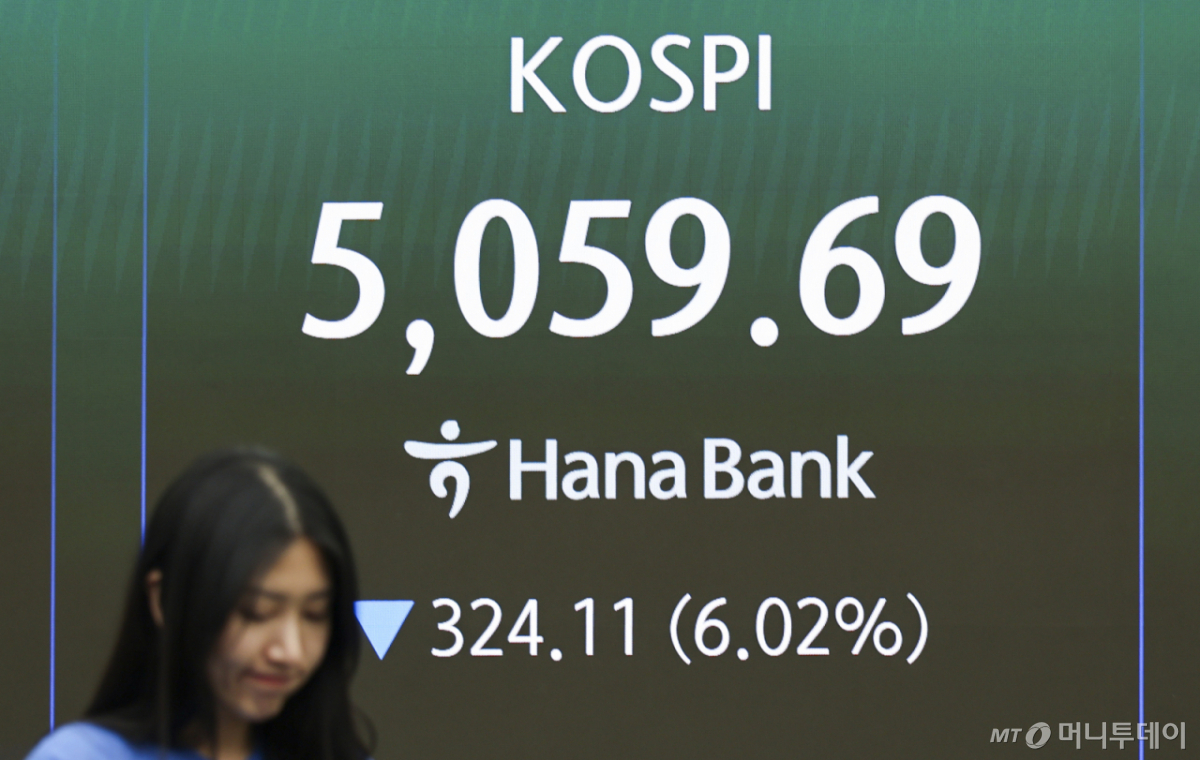
The KOSPI plunged 12% last week (the 2nd–6) following the 'Blue Wave,' in which the U.S. Democratic Party took control of both houses of Congress. This was due to growing concerns over strengthened regulations on AI data centers. With the aftershocks of the Blue Wave still lingering, market attention is focused on earnings reports from AI companies and U.S. inflation indicators that could impact the stock market.
According to the Korea Exchange on the 8th, the KOSPI closed last week at 5,059.69, down 671.05 points (11.71%) from Jeonju (5,730.74). During this period, foreign investors made net sales of 1,044.3 billion won in the KOSPI market. Retail investors and institutional investors made net purchases of 397.1 billion won and 449.9 billion won, respectively.
Amid growing controversy over AI profitability last week, investment sentiment in AI stocks worsened as the Democratic Party won the U.S. midterm elections. Concerns grew that the U.S. Democratic Party would strengthen regulations on AI data centers, and the KOSPI index plunged 10.98% on the 5th–6. During trading hours on the 6th, the 5,000 mark was broken for the first time in nine months.
Experts in the financial investment industry assess that this decline caused by the Blue Wave is excessive. Researcher Ha Jang-gwon at Hanwha Investment & Securities stated, "Approximately 75% of the capacity scheduled to be completed next year for AI data centers has already entered the construction phase. Even if regulations are strengthened, the impact will be limited to projects starting after 2028," and analyzed that "concerns over slowing the pace of data center construction are excessive in a situation where the U.S.-China hegemony competition surrounding AI is intensifying." On the 6th (local time), semiconductor stocks rebounded in the U.S. stock market, and KOSPI 200 night futures also closed higher.
Experts advised that attention should be paid to the third-quarter earnings report of CoreWeave, a U.S. AI infrastructure company, scheduled for release on the 10th (local time), given the current slump in AI investment sentiment. This is because CoreWeave's earnings report could serve as a key turning point in gauging whether AI investment sentiment will recover.
Lee Kyung-min, Head of the FICC Research Department at Daishin Securities, said, "Since the surge in corporate bond yields and CDS (credit default swap) premiums triggered concerns over AI credit, attention should be paid not only to CoreWeave's revenue growth but also to its cash flow, interest costs, and funding plans." He added, "If the maintenance of AI investment plans and funding capacity are confirmed, it could serve as a catalyst for recovering semiconductor investment sentiment. However, if debt burdens are highlighted again or investment plans are revised downward, additional adjustment pressure may expand across the entire AI value chain."
It remains to be seen whether macroeconomic burdens will also ease through the U.S. October CPI (consumer price index) and PPI (producer price index), scheduled for release on the 10th and 13th, respectively. If inflation exceeds expectations, the possibility of additional interest rate hikes by the Federal Reserve System (Fed) will expand, likely placing a greater burden on the stock market. Conversely, if a slowdown in inflation is confirmed, a rebound centered on growth stocks may emerge alongside stable interest rates, given that current levels are oversold.
The IPO (initial public offering) of Anthropic, the developer of AI 'Claude,' is also an issue. Anthropic will begin its official IPO roadshow (initial public offering presentation) this week.
In response, NH Investment & Securities forecast that the KOSPI will move between 5,000 and 6,000 this week. Researcher Na Jeong-hwan at NH Investment & Securities stated, "During the Anthropic IPO roadshow period, supply and demand for domestic semiconductor stocks could face pressure as global funds are reallocated." He added, "However, since foreign investors switched to net purchases on the listing day of SpaceX's IPO, supply and demand pressures will likely ease once the public offering schedule is completed."
Advice has emerged that, given the KOSPI has set a new historic low with a 12-month forward PER (price-to-earnings ratio) below 4x, investors should focus on normalizing stock prices in the medium to long term. However, analysis suggests that risks should be reduced through split buying rather than chasing rallies, as investment sentiment remains subdued and schedules such as CoreWeave's earnings, inflation indicators, and the Anthropic IPO roadshow remain ahead.
Researcher Ha stated, "The elasticity of stock prices following an index rebound will likely be greatest in semiconductors, IT (information technology) hardware, and insurance." He added, "While the profit outlook for all three sectors has been revised upward by double digits over the past four months for next year, 12-month forward PERs and PBRs (price-to-book ratios) have declined." He continued, "Following the Democratic Party's victory, among secondary batteries, ESS (energy storage systems), and power equipment—sectors with clear profit growth—split buying during adjustments is more effective than chasing rallies for power equipment."

 in STOCK
