

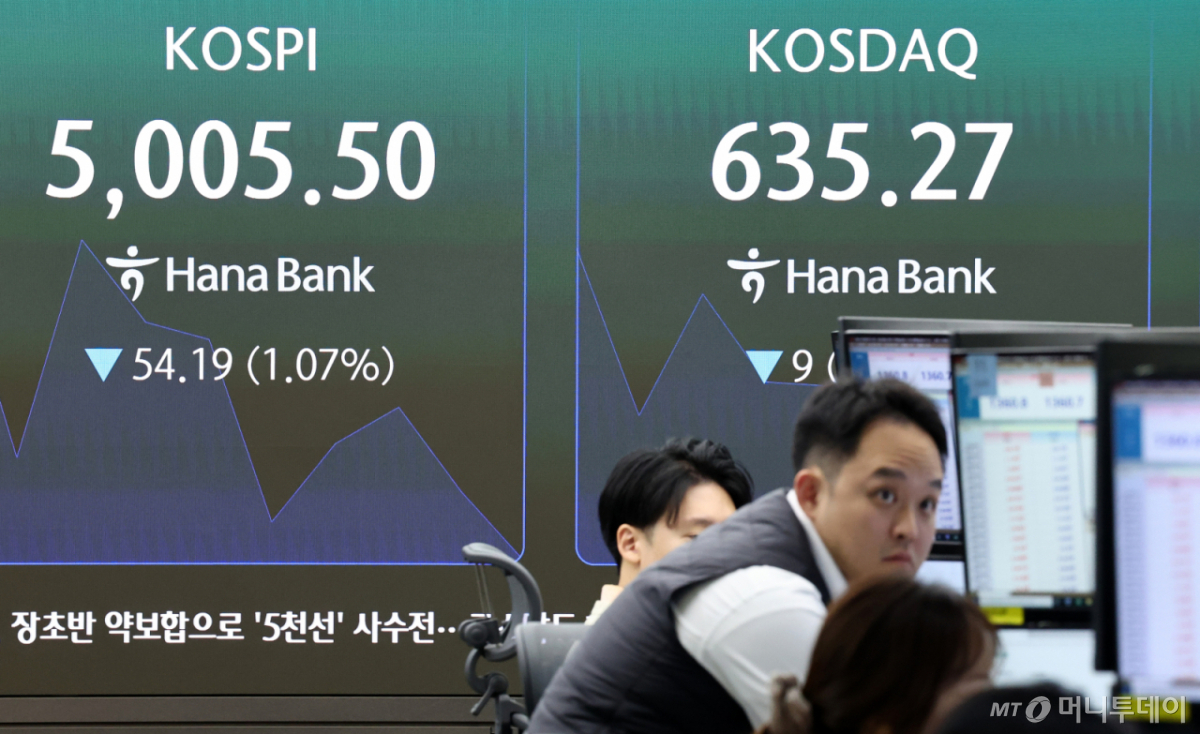
Samsung Electronics and SK hynix rebounded in tandem, driven by bargain hunting, pulling KOSPI above the 5,100 mark. Although foreign investors have been net sellers for seven consecutive trading days, institutional investors, representing retail investors' buying of ETFs (Exchange-Traded Funds), absorbed the selling volume. However, cautious views also emerged that it is premature to declare a trend reversal as long as foreign selling continues.
As of 10:56 a.m. on the 9th in the KOSPI market, Samsung Electronics was trading at 193,400 won, up 4,700 won (2.49%) from the previous session, while SK hynix was trading at 1,179,000 won, up 47,000 won (4.15%). The two stocks, which started slightly lower in early trading, gradually widened their gains on institutional investor buying.
At the same time, KOSPI recorded 5118.17, up 58.48 points (1.16%) from the previous session. On this day, KOSPI opened lower and fell to 4990.66 in early trading before reversing course to rise as high as 5151.84.
Although retail investors and foreign investors are net selling 138.9 billion won and 537.6 billion won, respectively, institutional investors are net buying 537.8 billion won, lifting the index. In particular, financial investment, where ETF trading is reflected, showed net buying of 581.8 billion won, suggesting that retail buying has effectively flowed in.
According to Daishin Securities' HTS (Home Trading System), as of 11:10 a.m. on this day, the top two stocks by institutional investor net buying were Samsung Electronics (79.9 billion won) and SK hynix (31.8 billion won). Conversely, the top two stocks by foreign net selling were SK hynix (424.4 billion won) and Samsung Electronics (144.6 billion won).
According to Toss Securities' WTS (Web Trading System), at the same time, foreign investors net sold 740,000 shares of Samsung Electronics, while institutional investors net bought 410,000 shares. It is interpreted that domestic investors, including institutional investors and retail investors, are absorbing the foreign selling volume.
For SK hynix as well, while foreign investors are selling 360,000 shares, institutional investors are buying 27,000 shares. Other corporations, including share buybacks, also showed net buying of SK hynix worth 130.5 billion won.
The rise in KOSPI on this day is interpreted as being influenced by bargain hunting flowing into semiconductor stocks. Concerns over strengthened AI (Artificial Intelligence) regulations arose due to a U.S.-originated blue wave, and sentiment toward semiconductor investment deteriorated sharply last week.
As a result, Samsung Electronics fell more than 6% on the 6th, dropping below 200,000 won on a closing price basis for the first time in about seven months, while SK hynix also fell more than 10%, ending trading in the 1.1 million won range.
Researcher Kang Jin-hyuk of Shinhan Investment Corp explained, "KOSPI broke through 5,100 on the semiconductor rebound and the inflow of bargain hunting sentiment for the index."
The securities industry advises that now is the time to increase exposure, as profits in the semiconductor sector are growing while only stock prices are falling. KOSPI has fallen 44.5% from its late-June peak, receiving an impact close to that of the dot-com bubble (-52%), but unlike then, corporate earnings are providing support, leading to the judgment that valuation appeal has increased.
The 12-month forward PER (price-to-earnings ratio) for Samsung Electronics and SK hynix is 3.1 times and 2.6 times, respectively, falling below their lows since 2013.
Goldman Sachs analyzed in a report on this day that the three-year forward PBR (Price-to-Book Ratio) of the semiconductor sector has fallen to 0.7 times, a historically low level. It explained that current stock prices already reflect a scenario where semiconductor sector profits in 2027 decrease by 70% compared to market forecasts.
Goldman Sachs forecasted, "If the market regains confidence in earnings forecasts, an increase in net asset value and valuation recovery will combine, allowing semiconductor sector stock prices to rise to twice their current level."
Analyst Han Dong-hee of SK Securities also said, "The fact that stock prices for Samsung Electronics and SK hynix remain at historically undervalued levels despite upward revisions to earnings forecasts means the market does not trust the earnings outlook of the memory sector itself." He added, "In the past, order declines appeared within three months after the memory sector formed a stock price peak, but there are no signs of order decline yet since the June stock price peak this year," and "The memory sector will continue to prove its value through performance in the future."
However, it is pointed out that it is premature to view this as a complete trend reversal, as foreign investors are still continuing net selling. Foreign investors have been net sellers for seven consecutive trading days and are gradually widening their intraday selling scope.
Lee Seung-hwan, executive at LS Securities, said, "Foreign selling is the liquidation of AI beneficiary stocks due to data center regulation issues," adding, "The variable today is whether foreign net selling shrinks."

 in STOCK
