

Nvidia is expanding its collaboration with Naver Cloud on AI model development. Naver Cloud is participating in the development of Nvidia's open-source AI model 'Nemotron' and is also utilizing related technologies for its proprietary model, 'HyperCLOVA X.'
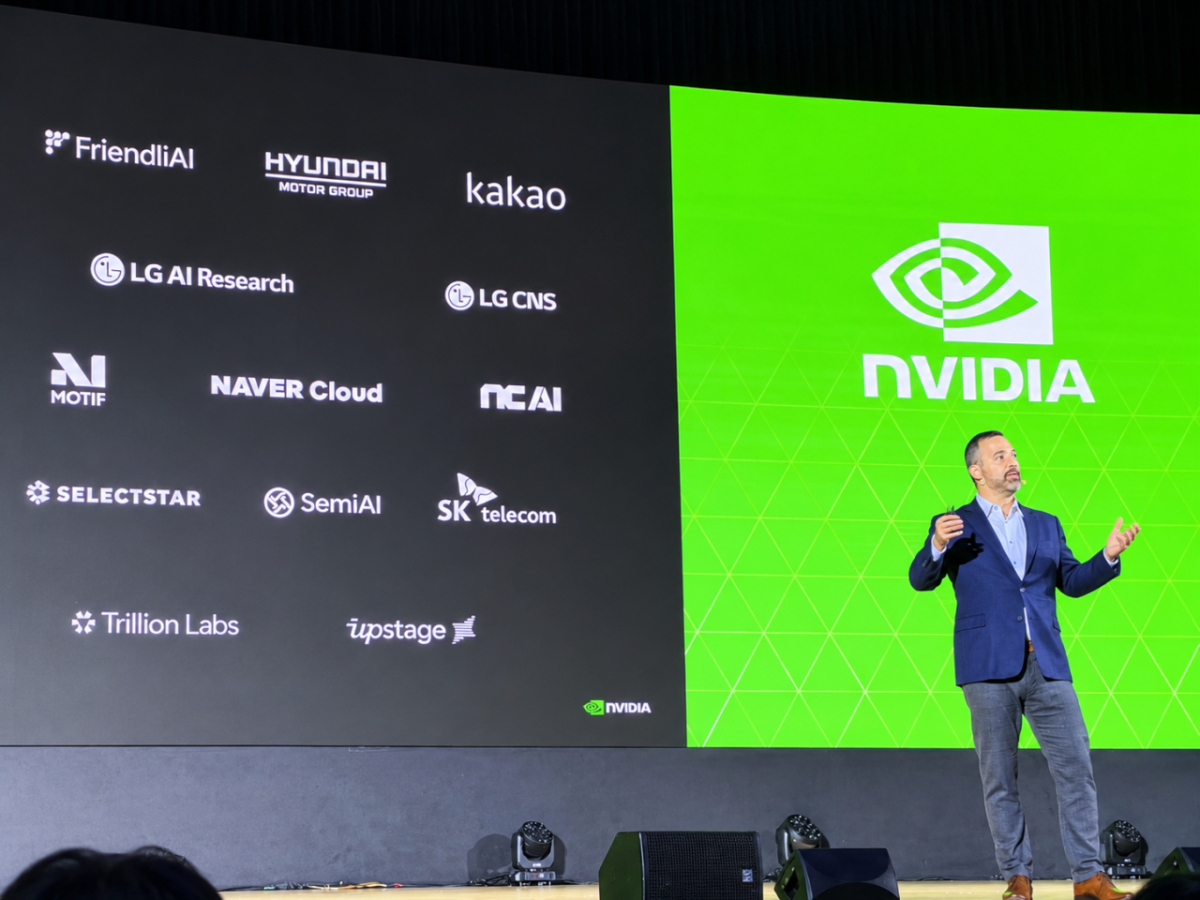
Jonathan Cohen, vice president of the Applied Research division at Nvidia, introduced these collaboration details at the 'Nvidia AI Day Seoul 2026' at COEX in Gangnam-gu, Seoul, Monday.
In a keynote speech themed around agentic AI and multi-agent orchestration, Cohen explained the collaboration with Naver Cloud in three aspects.
He said, "As a member of the Nemotron Alliance, Naver Cloud is sharing data, task assignments, and reinforcement learning environments necessary for pre-training and post-training." The Nemotron Alliance is a collaborative framework established by Nvidia to develop open-source AI models with external companies.
Naver Cloud is also utilizing Nvidia technologies for its proprietary AI model, HyperCLOVA X. This involves leveraging the model architecture and pre-training technologies of Nemotron 3 while combining them with proprietary data and Korea-specific data.
Vice President Cohen explained, "Models can be developed by combining data specialized in Korean language, culture, and society." The two companies are also collaborating in areas involving joint research on core technologies required for AI model optimization and model development and deployment.
Vice President Cohen emphasized that not only the performance of AI models but also processing speed and cost are important. He said, "Most real-world tasks have constraints on cost and time," adding, "Faster models can generate more tokens and perform more inferences within the same amount of time." He further added, "Efficiency is directly linked to intelligence in practical applications."
Nvidia also introduced 'Switchyard' technology, which selects different AI models depending on task difficulty. This approach utilizes high-performance models for complex tasks and relatively cheaper models for simple tasks. Vice President Cohen presented a case study showing that this method reduced AI model usage costs while maintaining an 80% task success rate.
Security issues regarding AI agents were also cited as a major challenge. Vice President Cohen pointed out, "When multiple agents collaborate, they can bypass the permission restrictions set on individual agents." Nvidia introduced 'OpenShell' as a technology to mitigate these risks. This method separately controls agents' network and file access permissions and manages authentication information and task logs.
Towards the end of his speech, Vice President Cohen also introduced collaboration cases with the Korean AI ecosystem. The presentation screen featured domestic companies including Naver Cloud, SK Telecom, LG AI Research Institute, LG CNS, Hyundai Motor Group, Kakao, Upstage, NC AI, Friendly AI, Select Star, and Trillion Labs. Nvidia is collaborating with Korean companies in various fields ranging from AI model development to infrastructure construction and service application.

 in TECH
