

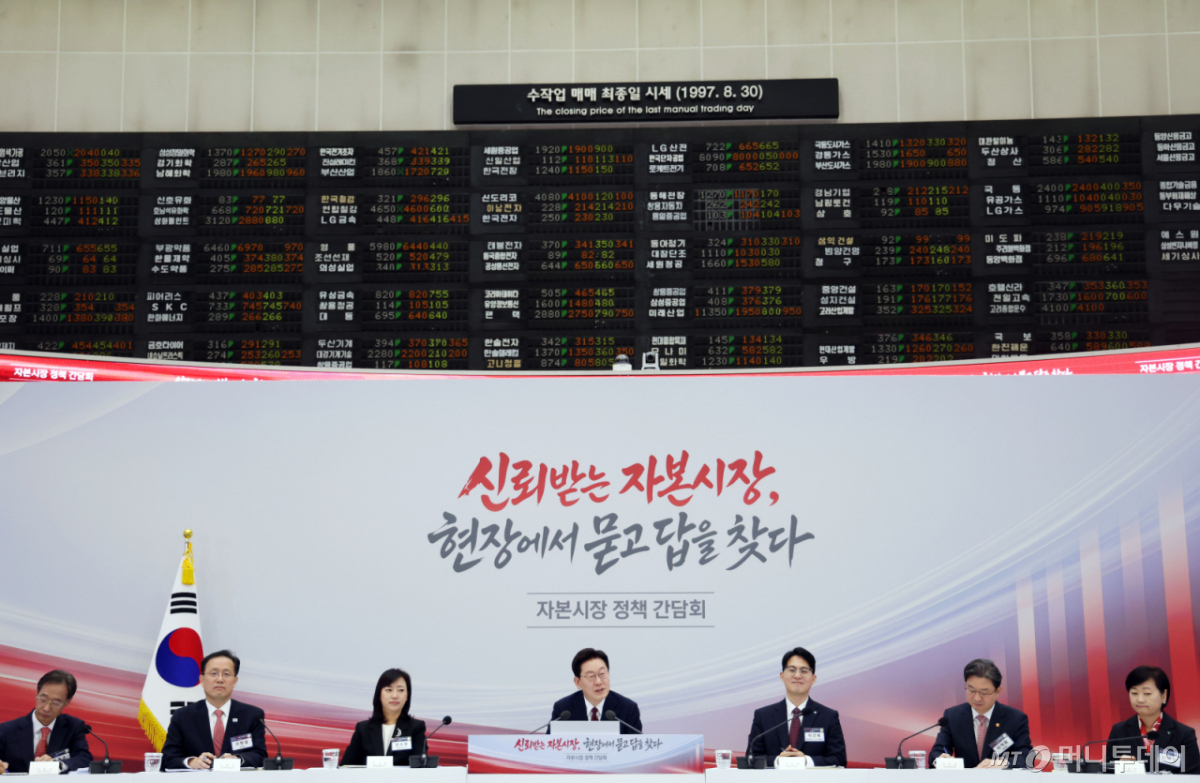
KOSDAQ shows strong gains of over 3% amid expectations for government market reforms. This follows President Lee Jae Myung's emphasis on KOSDAQ reform and the expansion of a stable investment base at the capital market policy consultation. With top market capitalization stocks rising across the board, 76% of KOSDAQ-listed companies are currently trading higher.
As of 11:05 a.m. on Friday, KOSDAQ stands at 725.12, up 28.59 points (4.10%) from the previous trading day. This marks the first time in eight trading days since the 3rd that KOSDAQ has recovered the 720th level during intraday trading.
KOSDAQ opened at 705.96, up 9.43 points (1.35%) from the previous close, and at one point rose by more than 4% to reach 725.81 during the session. The index expanded its gains while President Lee delivered opening remarks at the 'Capital Market Policy Consultation,' which began in Seoul Yeouido at 9:30 a.m.
Among the 1,749 KOSDAQ stocks currently trading, approximately 76%, or 1,343 stocks, are rising. There are 351 declining stocks and 56 unchanged stocks. Top market capitalization stocks are also rising across the board, pulling up the index. Rainbow Robotics is up in the 14% range, ISC in the 12% range, Robotis in the 7% range, and Ecopro BM in the 5% range.
At the consultation on this day, President Lee addressed market concerns regarding KOSDAQ, presenting market reform and the expansion of a stable investment base as key tasks. He said, "We must review the entire evaluation system for market entry and exit to transform the KOSDAQ market into one where innovative companies can grow and investors can invest with confidence."
He also called for the swift delisting of distressed companies and the protection of companies with growth potential. President Lee said, "Distressed and low-performing companies should be swiftly delisted by applying delisting requirements," while adding, "It is also important to ensure that companies possessing technological growth potential are not harmed." He emphasized the need for investment infrastructure and institutional improvements to support long-term stable growth.
The consultation on this day discussed measures to restore trust in the KOSDAQ market and expand the investment base. Research Fellow Im Hyeong-jun of the Korea Financial Research Institute diagnosed that delays in delisting distressed and low-performing companies are undermining market trust and suppressing long-term and institutional investor investments.
Regarding the restructuring of segments distinguishing the KOSDAQ market, he suggested that while it could be expected to facilitate inflows of long-term and institutional investor funds and ease incentives for representative companies to uplist to KOSPI, the stigma effect on lower-tier company groups should also be considered.
President Lee requested the review of specific measures to resolve issues of concentrated shareholding by controlling shareholders and the lack of checks on management rights.
This stems from concerns that many KOSDAQ-listed companies are operated with a focus on controlling shareholders, ignoring the interests of general shareholders while major shareholders hold high stakes of 70% to 80%. This is also linked to the undervaluation problem of KOSDAQ companies where checks on management rights are difficult due to concentrated shareholding.
President Lee said, "I think we must prevent them from enjoying all the benefits of listing while effectively running a monopoly-style operation," and added, "We should devise market exit measures for those operating excessively like individual markets."
He also requested a comprehensive investigation into whether institutional mechanisms exist that block hostile M&A (mergers and acquisitions) intended to check management rights.
It is expected that efforts will proceed in the direction of refining listing maintenance requirements and external checks to ensure listed companies respect the interests of all shareholders. This is interpreted as an intent to create incentives for long-term investment funds to flow into KOSDAQ.
Meanwhile, KOSDAQ rose to 1,229.42 intraday on April 27 this year, driven by expectations for government policies, but subsequently gave back those gains.
Burdens included the concentration of funds in large semiconductor stocks and the sluggishness of biotech stocks, while recently, stock market adjustments due to U.S.-originated AI investment uncertainties have compounded the situation. The index rebounded by 10.35% over the two days of the 10th and 11th to recover the 700th level, but fell again by 1.22% on the previous day to close at 696.53.
The government and Korea Exchange have been pushing for institutional reforms to improve the fundamental nature of the KOSDAQ market. In July last month, they strengthened delisting requirements, including raising the minimum market capitalization standard for maintaining a KOSDAQ listing from 15 billion won to 20 billion won.
On the 2nd of this month, they published a list of 151 low-PBR (price-to-book ratio) companies, including 55 KOSDAQ firms, to encourage efforts to enhance corporate valuation. They are also promoting the introduction of a KOSDAQ promotion and relegation system that classifies listed companies into high-quality, general, and managed company groups.

 in STOCK
