

Expectations are growing for a proposed tiered system for the KOSDAQ market after President Lee Jae Myung called for measures to boost the market during a visit to the Korea Exchange in Yeouido, Seoul, on Nov. 13. Experts, however, say the reform will have little impact without a stable inflow of long-term investment capital from institutional investors.
Discussions on reforming the KOSDAQ market have gained momentum following a capital markets policy meeting chaired by the president last week, according to financial industry sources on Monday.
Lee stressed the need to improve the market's overall structure by removing underperforming companies and nurturing promising innovative businesses.
Particular attention is focused on a proposed tiered system that would classify KOSDAQ-listed companies according to their growth potential and financial soundness.
The plan aims to give companies that have demonstrated growth and competitiveness greater recognition while tightening oversight of financially troubled firms.
The government is targeting implementation next year, with measures to attract more investment into high-quality companies at its core.
However, market experts say simply classifying companies will not automatically bring more investment into promising businesses. Unlike the benchmark KOSPI market, the KOSDAQ is heavily dominated by retail investors, while institutional participation remains relatively limited.
Retail-driven trading supports market liquidity but tends to be concentrated in short-term transactions, increasing the risk of sharp share price swings.
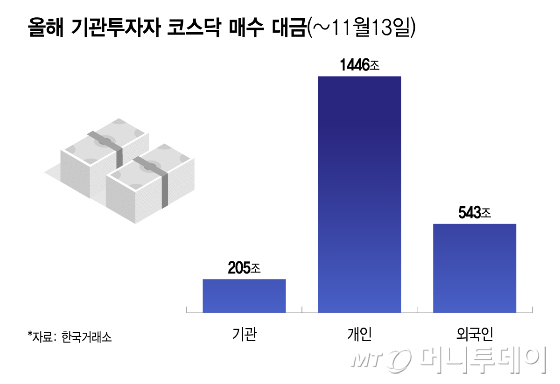
According to the Korea Exchange, institutional investors purchased 205 trillion won worth of KOSDAQ shares from January through Nov. 13 this year, far below retail investors' 1,446 trillion won and foreign investors' 543 trillion won.
On the KOSPI, institutional purchases totaled 1,690 trillion won, a narrower gap compared with retail investors' 2,578 trillion won and foreign investors' 2,301 trillion won.
Institutional investors typically assess not only corporate earnings and growth prospects but also market liquidity, corporate governance and investment risks before committing funds.
Analysts say the proposed tiered system could have limited effects unless the market offers conditions that encourage major institutional investors to make long-term commitments.
This was also why experts who presented at the presidential meeting on Nov. 13 emphasized the importance of attracting long-term investment capital as a key to revitalizing the KOSDAQ.
"Market reform depends less on how the system is designed than on how it is operated," said Lim Hyung-joon, a research fellow at the Korea Institute of Finance. "If the tiered system helps high-quality companies remain listed on the KOSDAQ and attracts institutional and index-tracking funds, it could boost corporate valuations and market liquidity."
Kim Hak-kyun, head of research at Shinyoung Securities, also stressed the need to restore institutional investors' confidence through an investment and distribution structure that prioritizes long-term performance and cost competitiveness over sales figures and short-term returns.
"The success of KOSDAQ revitalization will depend not only on how effectively promising companies are identified and troubled firms removed, but also on whether market restructuring leads to actual capital inflows," an industry official said. "Efforts are needed to build market credibility and encourage long-term institutional investment."

 in STOCK
