

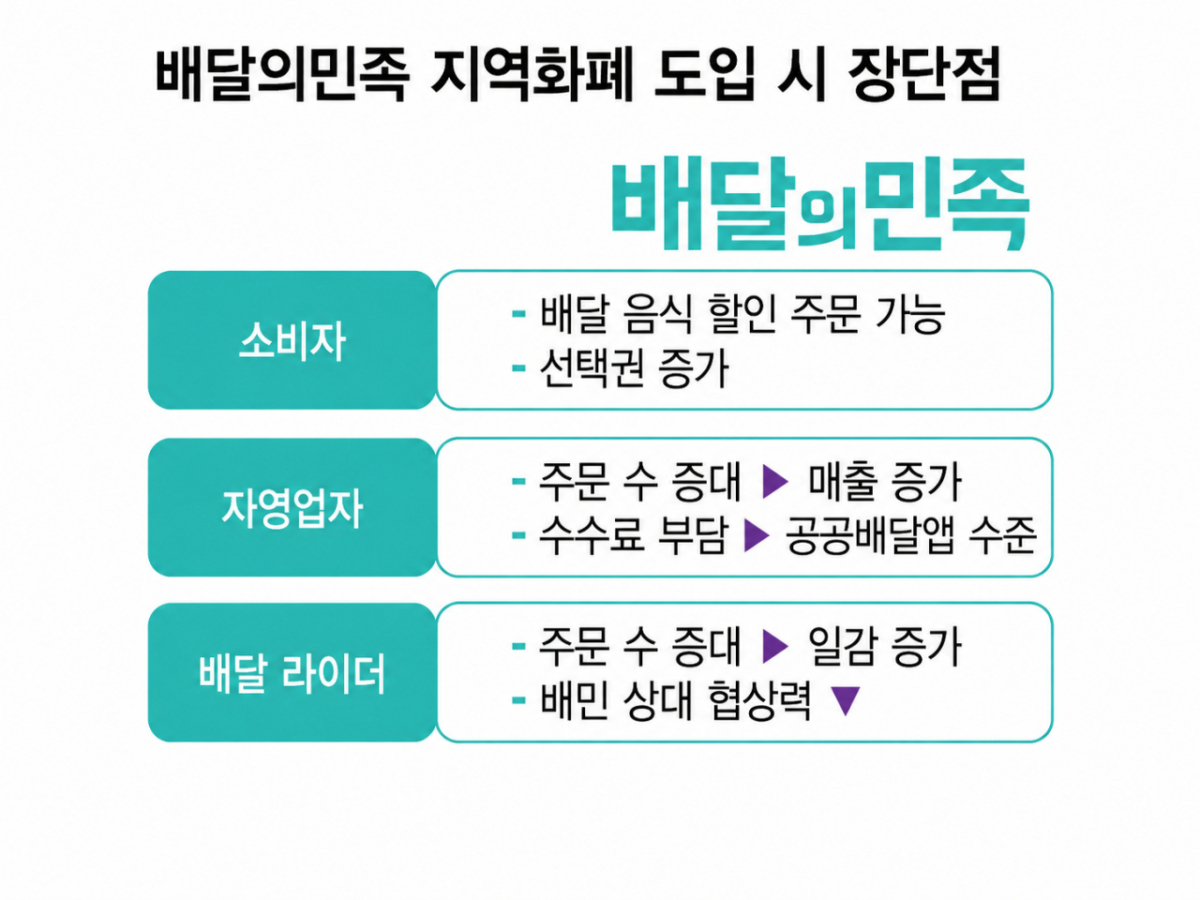
Expectations are rising that Baemin's adoption of local currency could lead to an increase in overall social welfare. Analysts suggest that consumers will find it easier to use local currency, while sales for self-employed business owners and work opportunities for riders are likely to grow.
According to industry sources on the 23rd, local currency pairs well with food delivery apps. Gunsan City's public delivery app, "Baedal Myeongsu," reported that as of May 6 this year, local currency accounted for a high 66% of payments.
Icheon City in Gyeonggi Province also revealed that the share of local currency payments among users of its public delivery app, "Baedal Teukgeup," was approximately 70% in the first half of this year. For local currencies, which have faced criticism for having "nowhere to be used" due to a shortage of merchant locations, the partnership with Baemin is certainly good news.
Consumers also benefit. Using local currency on their usual delivery app provides a 10% discount effect. Additionally, because Baemin has many registered restaurants, it offers diverse choices.
Self-employed business owners registered on Baemin will also see benefits. Woowa Brothers, the operator of Baemin, is considering applying an intermediary fee at the level of public delivery apps (around 2%) for local currency transactions.
This would be cheaper than the existing intermediary fee, which can go up to 7.8% depending on sales volume and other factors. There is also a high likelihood that self-employed business owners who link local currency payments will receive support for additional exposure on the app's screen. In such cases, advertising costs could also be reduced. If the number of orders increases due to the effect of linking local currency, sales will rise as well.
Delivery riders, however, need to do the math. While work opportunities may increase as orders grow, there is an issue that their bargaining power against platforms could weaken if the oligopolistic structure of the three major delivery apps strengthens.
Hong Chang-ui, chairman of the Delivery Platform Labor Union, argued during last year's general strike, "Coupang Eats and Baemin, which were once competing to attract riders, are now cutting delivery fees and not specifying distance-based rates, leaving riders with no choice but to go wherever calls come in at that moment."
Ultimately, the overall social welfare is likely to increase due to Baemin's linkage with local currency. Hwang Yong-seok, a professor in the Department of Media Communication at Konkuk University, explained, "If local currency can be used on Baemin, sales for self-employed business owners will increase, and social welfare will grow."
He added, "It will also help resolve, to some extent, the perception that there is nowhere to use local currency." He further noted, "While delivery riders are in temporary jobs, they serve as a 'bumper' for employment in our country," adding, "They have a fairly high level of employment effect."
However, the fact that discount issuance benefits funded by national and local government budgets could be converted into fee revenue for private delivery platforms remains a point of contention. Lee Jung-hee, a professor in the Department of Economics at Chung-Ang University, stated, "Because local currency is issued by local governments with government support, if linkage with Baemin or Coupang Eats becomes concrete, opposition may arise from the government, the National Assembly, or consumer groups."

 in TECH
