

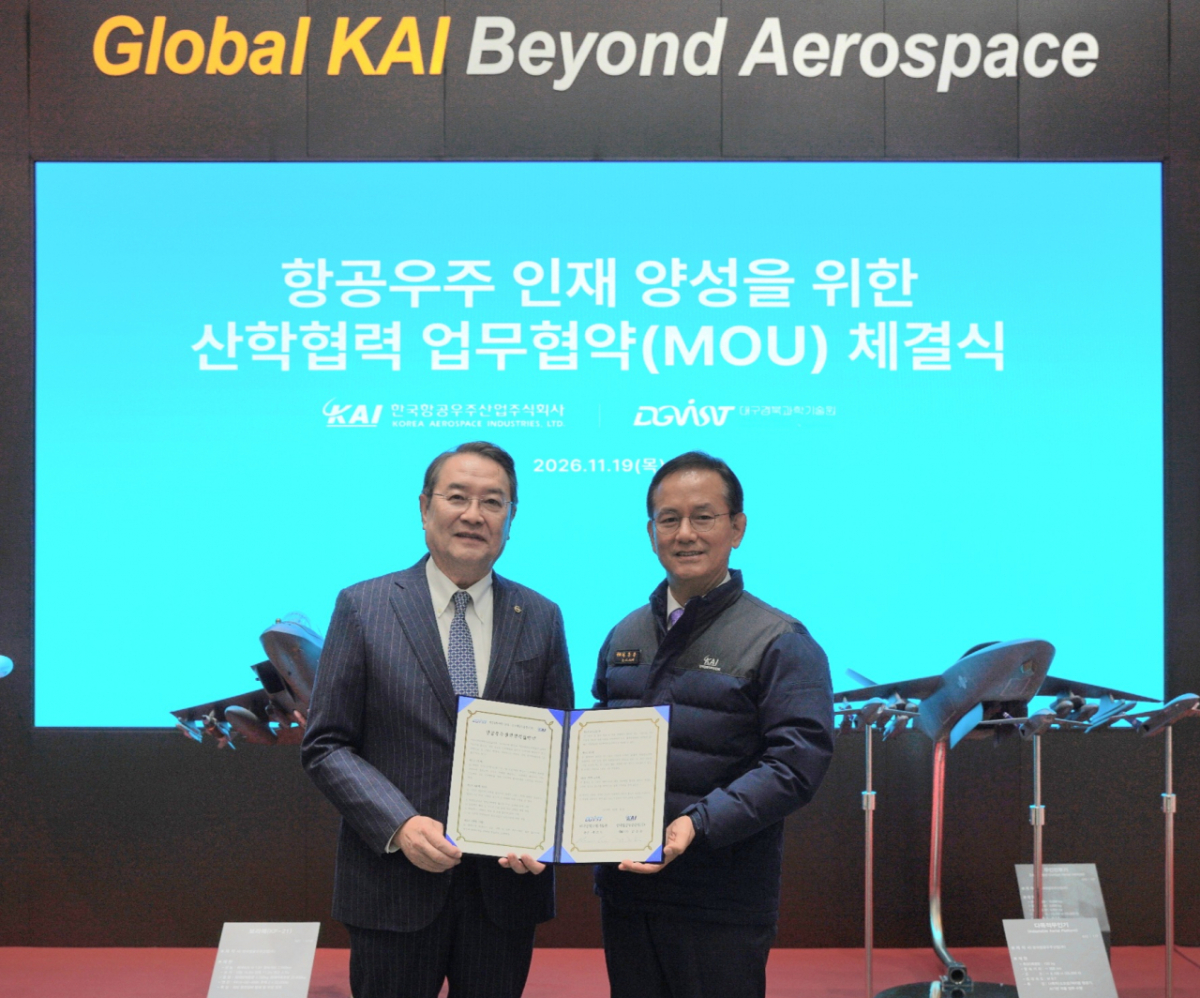
KAI (Korea Aerospace Industries) announced on the 23rd that it has signed "Aerospace Industry-Academia Cooperation Agreements (MOUs)" with the Daegu Gyeongbuk Institute of Science and Technology (hereinafter DGIST) and the Ulsan National Institute of Science and Technology (hereinafter UNIST), respectively, to cultivate specialized talent in the future aerospace field and promote joint research.
The agreement ceremony with DGIST was held at KAI's headquarters on the 19th, while the ceremony with UNIST took place at UNIST on the 20th.
This agreement was pursued to combine KAI's aerospace system development capabilities with the strong research expertise of DGIST and UNIST, aiming to cultivate specialized talent and establish a practical foundation for cooperation in future aerospace technology development.
KAI and each science and technology institute plan to cooperate primarily on: △ forming a future aerospace industry-academia human resource development council; △ exchanging information on joint research activities, knowledge, and technology; △ exchange and cooperation through academic events, seminars, and special lectures; and △ the shared use of human resources and existing facilities.
Based on this, KAI plans to nurture next-generation specialized personnel to enhance competitiveness in future aerospace technology. It will also strengthen the industry-academia cooperation system so that research outcomes can be cyclically converted into practical technological advancements.
Since starting with the Korea Advanced Institute of Science and Technology (KAIST) last September, KAI has been consecutively signing industry-academia cooperation agreements with major domestic science and technology institutes for the cultivation of future aerospace talent.
Kim Jong-chul, CEO and President of KAI, stated, "To lead in future aerospace technology, it is most important to read rapidly changing technological trends such as AI, space, and unmanned/autonomous flight, and to cultivate next-generation core talent." He added, "Taking this cooperation with major domestic science and technology institutes as an opportunity, we will devote even more effort to cultivating highly specialized talent and expanding joint research to elevate the competitiveness of Korea's aerospace technology to a new level."

 in INDUSTRY
