

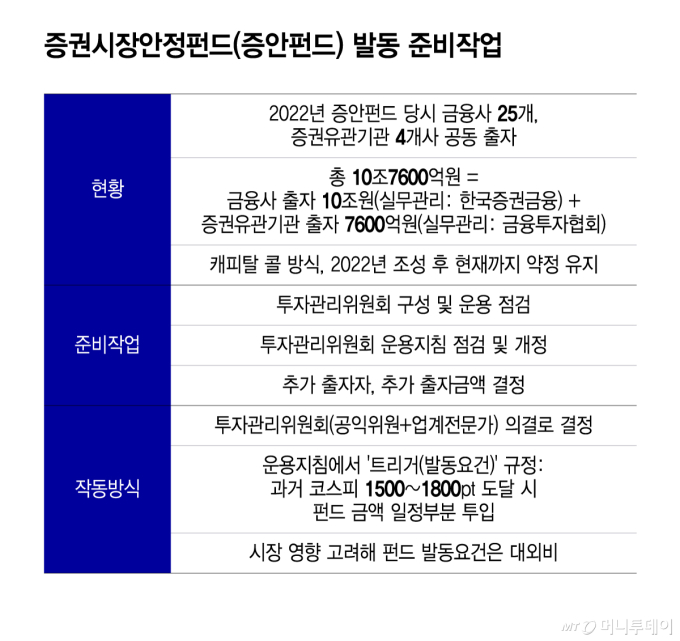
Financial authorities are accelerating preparations to activate the Securities Market Stabilization Fund. They are revising the deployment criteria, which were previously set at KOSPI levels of 1,500 to 1,800, and considering whether to raise additional funds.
The goal is to load up on ammunition that can be deployed at any time during a market plunge, sending a signal to the market that they will not tolerate a sharp decline. However, many analysts note that past cases show the fund has been more effective in calming investor sentiment than directly propping up stock prices.
According to financial investment industry sources on Monday, financial authorities have begun organizing the activation framework for the Securities Market Stabilization Fund, centered around the Financial Services Commission.
Discussion topics include the composition of the Investment Management Committee, operational guidelines, and the fund execution index (activation conditions). The Securities Market Stabilization Fund is a mechanism that uses capital contributed by financial institutions and securities-related agencies to purchase stocks, thereby absorbing selling pressure during market crashes.
The core issue is determining when and how much capital to deploy, as defined by the execution index. Existing operational guidelines are based on KOSPI levels of 1,500 to 1,800, so the timing and scale of deployment must be newly established to suit the current situation where the KOSPI fluctuates between 4,000 and 5,000.
The Investment Management Committee, composed of representatives from contributing financial institutions and external public interest committee members, is highly likely to undergo a comprehensive reorganization given the time that has passed since its initial formation.
The currently contracted funds amount to 1,076 trillion won, formed in 2020 and re-contracted in 2022. This total combines 100 trillion won contracted by financial institutions such as KB Kookmin, Shinhan, Hana, Woori, Industrial Bank of Korea, and Industrial Bank of Korea, plus 760 billion won raised by securities-related agencies. The fund operates on a capital call basis, where contributions are pledged under specific conditions.
Discussions on additional fundraising are also expected. According to the Korea Exchange, foreign net selling reached 773.3 billion won in a single day on June 29, accounting for approximately 72% of the Securities Market Stabilization Fund's contracted amount.
This suggests that if foreign selling pressure remains intense, it may be difficult to defend the index even with full fund deployment. Authorities are not disclosing operational guidelines or decisions regarding additional fundraising, as revealing the timing and scale of deployment could potentially increase volatility.
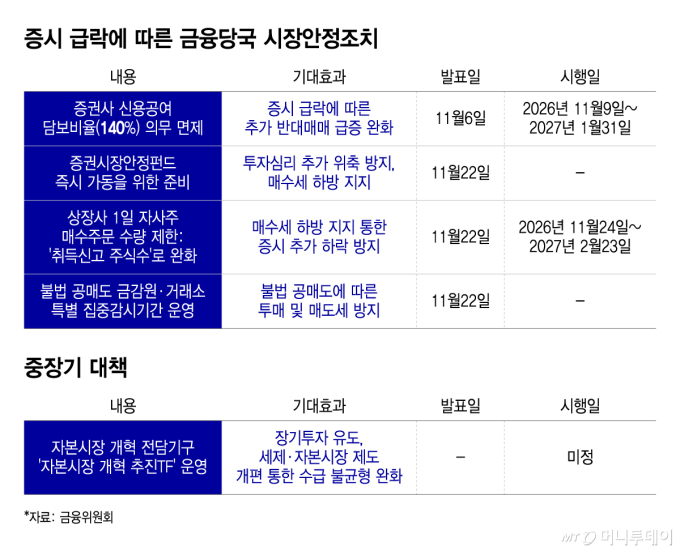
Financial authorities have also deployed all three components of the "Market Stabilization Measures" implemented during the 2022 stock market crash.
Following a regular meeting of the Financial Services Commission on that day, they relaxed the limit on daily self-share purchase orders by listed companies to "the total number of shares in the acquisition report," and are operating a special intensive monitoring period for illegal short selling. Since the 9th, they have temporarily exempted securities firms from the obligation to maintain a 140% collateral ratio for credit lending.
The Securities Market Stabilization Fund has actually been deployed three times: in 1990, 2003, and 2008. The 1990 Stock Market Stabilization Fund, launched with a scale of approximately 485 billion won, was close to a failure.
Despite initial purchases, the downward trend continued, and the KOSPI fell to 459.07 in August 1992. In 2003 (40 billion won) and 2008 (51.5 billion won), the stock market hit its bottom around the time of the measures, while in 2020 and 2022, the market rebounded without any fund deployment.
Experts believe the effectiveness of the Securities Market Stabilization Fund lies primarily in psychological stabilization.
Song Min-gyu, a senior researcher at the Korea Institute for Financial Industry, stated in a 2023 report that "effects such as alleviating psychological anxiety through volatility mitigation appear relatively clearly, while trends are observed regarding actual stock price rebound effects and liquidity supply effects."
Shinhan Investment analyzed that "in both instances where funds were actually deployed—in 2003 and 2008—the fund size was at the level of 0.1% of the market capitalization at the time, making it difficult to view the Securities Market Stabilization Fund as a direct cause of the rebound."
There are also voices expressing concern about the burden associated with actual execution. A financial industry official said, "The Securities Market Stabilization Fund carries more significance as a tool for 'a battle of momentum against selling forces.' If the fund is actually executed and the capital is depleted in just a few days, the problem could become even larger."
Analysis suggests that the key to a trend-based rebound ultimately lies in resolving uncertainty surrounding AI (artificial intelligence) investment.
Han Ji-young, a researcher at Kiwoom Securities, stated, "Fundamental anxiety factors that triggered the stock market correction after October, such as AI-related uncertainties, remain unresolved," adding, "Whether delayed monetization by AI companies and funding burdens will lead to reduced capital expenditure, and whether this ripple effect will lower profit forecasts for domestic semiconductor companies, is crucial for a rebound."

 in STOCK

