

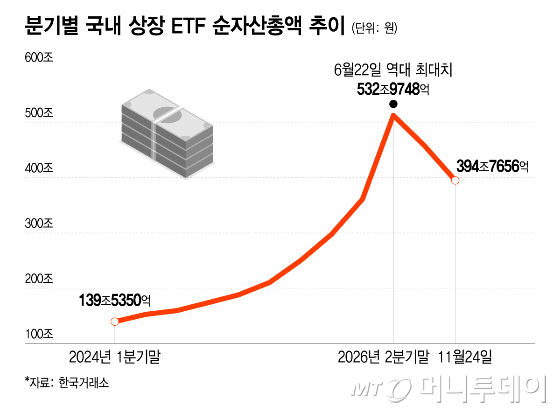
About 138 trillion won in net assets evaporated from the domestic listed ETF (Exchange-Traded Fund) market in about five months. This is due to the shrinking size of domestic equity products, which had led the ETF market in the first half of this year, amid stock market corrections.
Funds with nowhere to go amid volatility have been absorbed into Money Market Active funds, boosting the presence of parking-type ETFs.
According to Korea Exchange on the 25th, the total net asset value of domestically listed ETFs was recorded at 394.7656 trillion won as of the 24th.
After reaching an all-time high of 532.9748 trillion won on June 22, it entered a downward trend alongside declines in the KOSPI and KOSDAQ indices. As a result, net assets decreased by 138.2092 trillion won (25.9%) in about five months.
The decline in net assets was particularly pronounced in domestic equity ETFs. Compared to June 22, when the net asset value of the ETF market hit its peak, all of the top 10 products by net asset value decline were ETFs investing in domestic stocks.
The scale shrank in the following order: 'KODEX 200' (12.3335 trillion won), 'TIGER Semiconductor TOP10' (7.0532 trillion won), 'KODEX Leverage' (7.0524 trillion won), 'KODEX SK hynix Single Stock Leverage' (5.3218 trillion won), and 'TIGER 200' (4.7448 trillion won).
ETF net asset values fluctuate not only based on capital inflows and outflows but also according to the prices of underlying assets, making them susceptible to stock market sentiment.
For example, KODEX 200, which rose to the top in net asset value this year thanks to a boom in the domestic stock market, ceded its position to 'TIGER US S&P500,' which had been ranked first in net assets at the end of last year, as the KOSPI index fell back below the 5,000 mark it had broken through earlier this year.
As of the previous day, the net asset values of the two products were 20.2164 trillion won and 20.2207 trillion won, respectively, showing a difference of about 4.2 billion won.
In contrast, parking-type ETFs, used for short-term idle funds, have grown in size. It is interpreted that investors who could not find suitable investment destinations amid increased stock market volatility flocked to parking-type products.
Money Market Active ETFs accounted for half of the top 10 products by net asset value increase during the same period. These include 'KODEX Money Market Active' (4.4769 trillion won), 'TIGER Money Market Active' (1.2482 trillion won), 'RISE Money Market Active' (965.6 billion won), 'ACE Money Market Active' (464.9 billion won), and 'KODEX US Money Market Active' (339.7 billion won).
In particular, 'KODEX Money Market Active' jumped seven spots from 10th place in net asset value on June 22 to 3rd place as of the previous day. Yoon Seong-in, head of the short-term bond management team at Samsung Asset Management, said, "As uncertainty in the domestic stock market continues to rise, capital inflows from retail investors into parking-type products that provide stable returns and liquidity are ongoing."
Attention is turning to whether the ETF market will rebound, as the upper end of next year's KOSPI index forecasts released by the securities industry falls below this year's peak of 9,300, with LS Securities suggesting a level of 6,500 on the previous day.
The asset management industry views the recent decline in net assets as a result of stock market corrections rather than a reversal in the growth trend of the ETF market itself.
This is because capital inflows from retail investors continue, and the utilization of ETFs as long-term investment vehicles such as retirement pensions is increasing. In fact, retail investors made net purchases of 28.2207 trillion won in the ETF market from June 22 to the previous day.
An official at an asset management company said, "The rapid increase in net assets due to the sharp rise in the KOSPI index has simply been corrected; compared to the previous year, growth remains fast." The official added, "Whether investors are consistently entering the ETF market is a better barometer of growth than net assets linked to stock price fluctuations."

 in STOCK
