

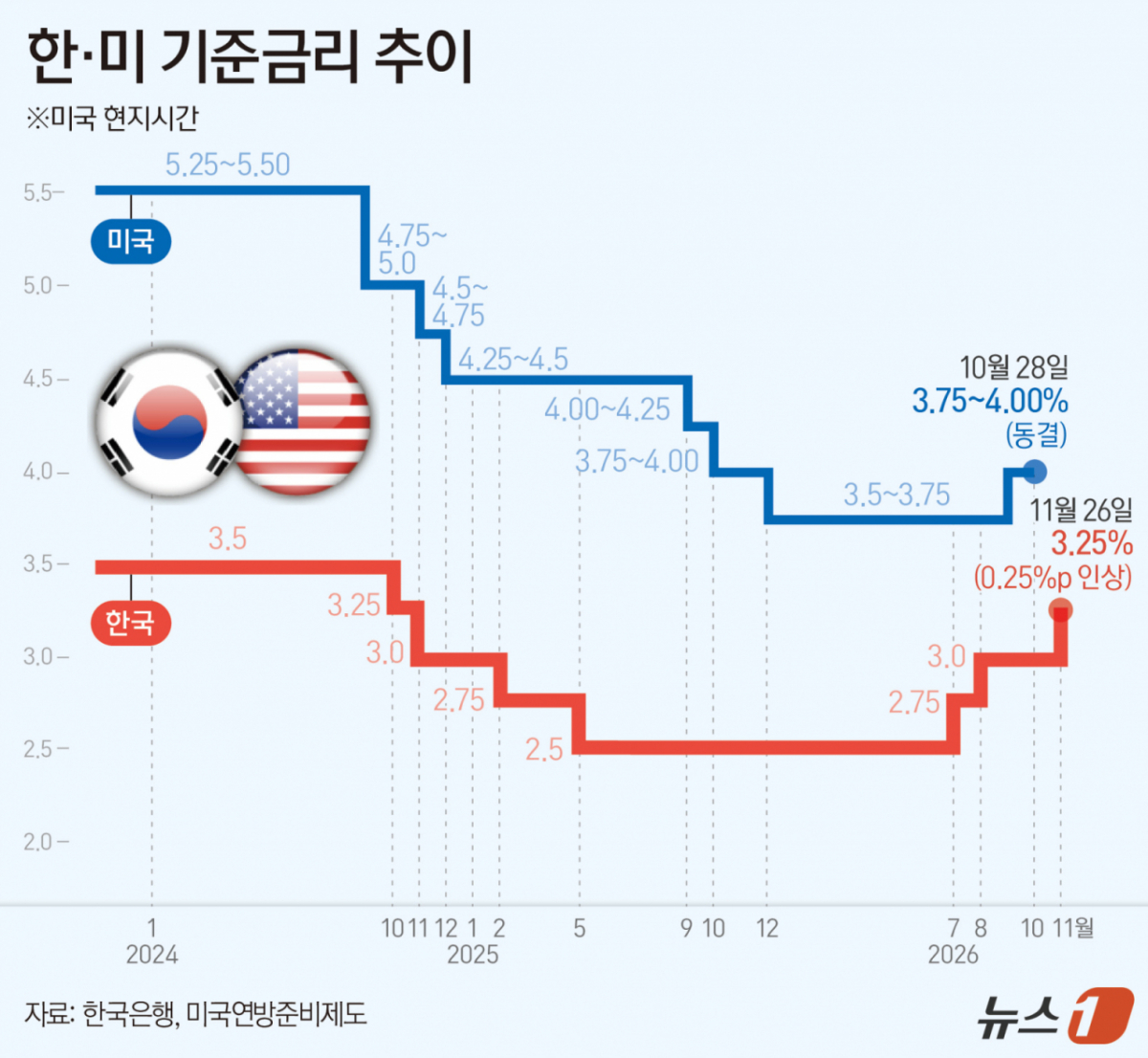
The KOSPI rebounded more than 1 percent on Nov. 26 after the Bank of Korea raised its key rate to 3.25 percent. Bargain hunting following the previous day's sharp decline and smaller losses among U.S. semiconductor stocks supported the recovery.
Analysts largely expect one more rate hike in the first half of 2027 before the tightening cycle ends. However, with the upper end of policymakers' rate projections rising to 3.75 percent, some caution that further tightening remains possible.
At 10:58 a.m. on Thursday, KOSPI was trading at 4,753.87, up 56.36 points (1.20%) from the previous trading day. It rebounded after plunging 308.52 points (6.16%) the previous day but narrowed its gains compared to the intraday high of 4,817.77. Foreigners and institutional investors were net buyers of 230.6 billion won and 203.2 billion won, respectively, while retail investors were net sellers of 562.0 billion won.
Samsung Electronics was trading at 174,000 won, up 1.93%. SK hynix showed a gain of 4.08% to reach 1,072,000 won. Among other top market capitalization stocks, Samsung Electro-Mechanics (6.36%), SK Square (3.94%), and Samsung Electronics Preferred Shares (1.34%) were strong. Conversely, Hyundai Motor (-3.34%), KB Financial Group (-2.03%), Samsung Biologics Logistics (-1.47%), LG Energy Solution (-1.46%), and Celltrion (-0.69%) were falling.
Overnight, U.S. semiconductor stocks recovered a significant portion of their intraday losses, leading to inflows of buying into domestic semiconductor stocks.
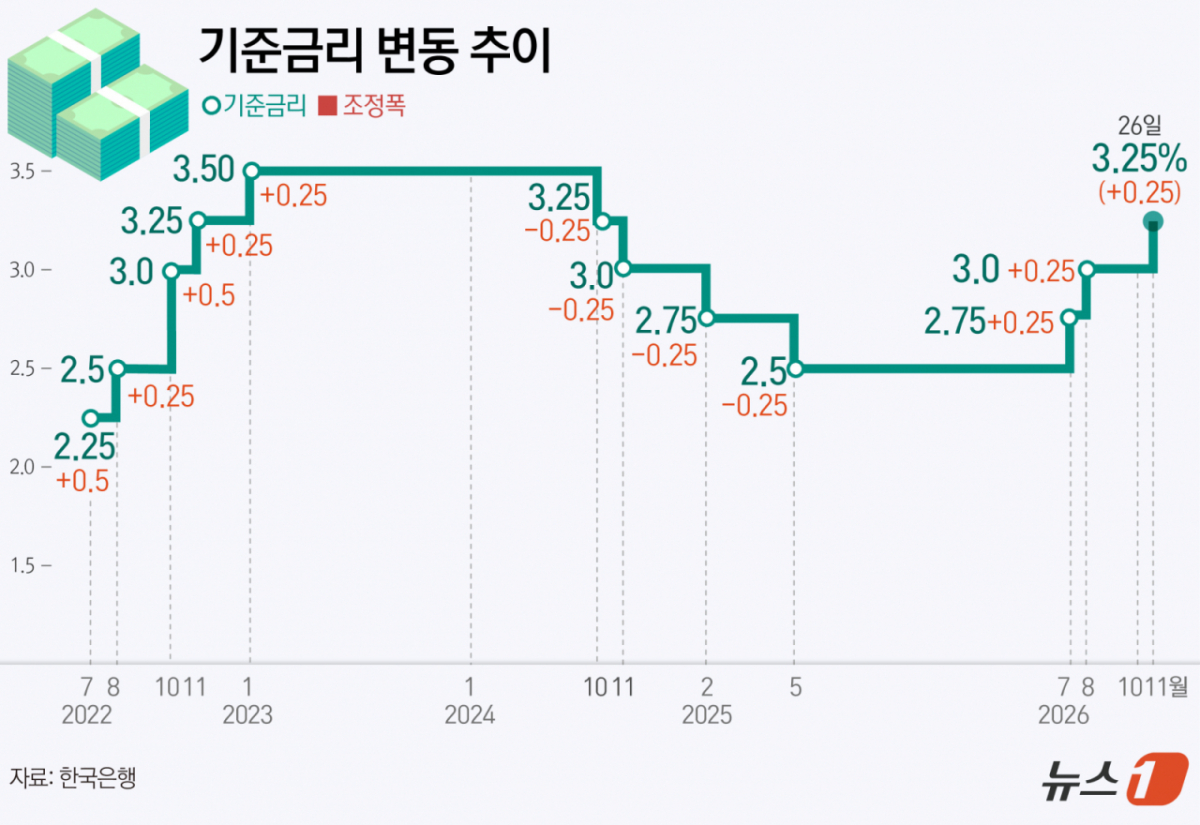
The Bank of Korea Monetary Policy Board decided on Thursday to raise the base rate by 25 percentage points from 3.00% to 3.25%. This follows consecutive hikes in July and August and a hold in October, marking the first increase in three months. The decision aligned with market expectations.
All 10 bond market experts surveyed by Money Today ahead of the Monetary Policy Board meeting had expected a 25bp hike this month. Five out of seven Monetary Policy Board members voted in favor of the hike, while Commissioners Hwang Geon-il and Lee Su-hyung expressed opinions for a hold.
The market is paying attention to the remaining room for rate hikes until the peak of the base rate. In the same survey, all 10 experts predicted that with one additional hike in 2027, the final interest rate of this tightening cycle would reach 3.50% annually. This is a level 25bp higher than the current rate. Nine out of the 10th expected the final interest rate to be reached in the first quarter next year.
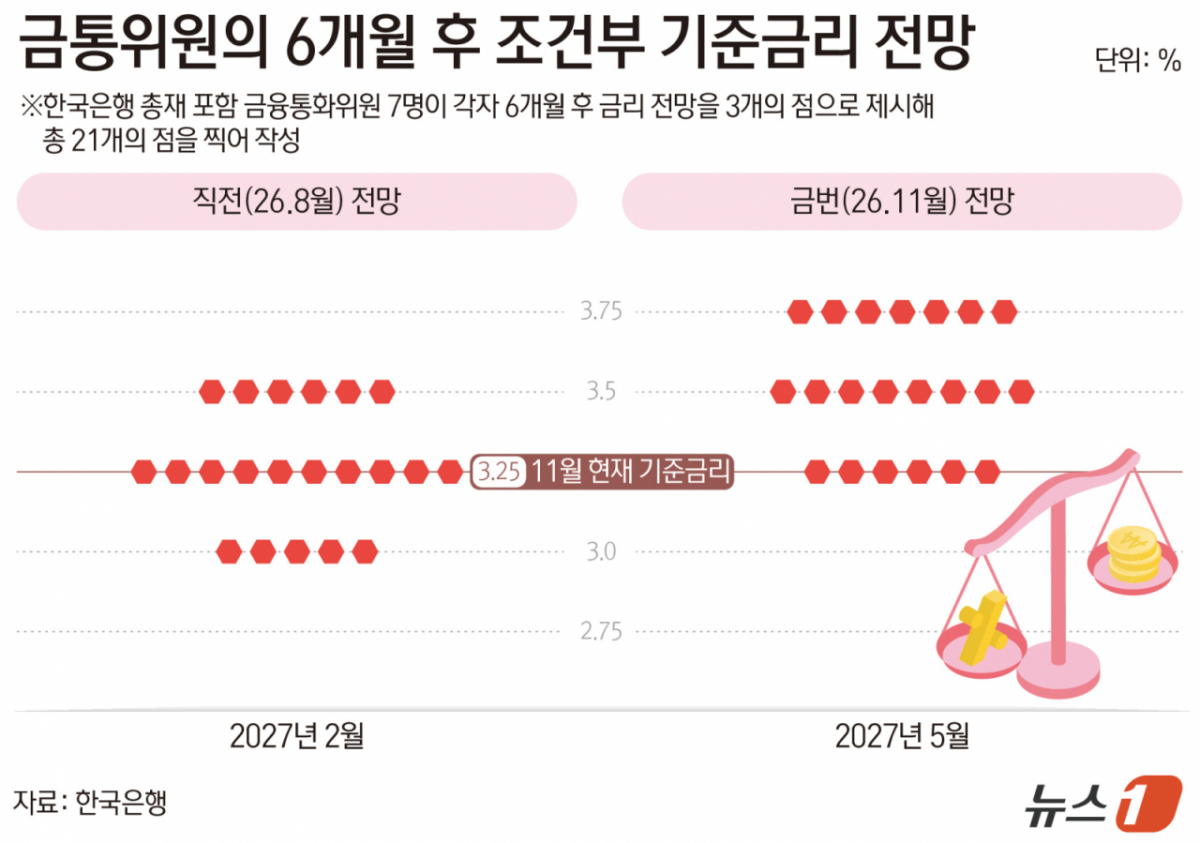
The Monetary Policy Board members' conditional interest rate forecasts six months later (dot plot) also rose this time. On the dot plot, out of a total of 21 dots, seven were at 3.75%, eight at 3.50%, and six at 3.25%. In August last year, there were six dots at 3.50%, ten at 3.25%, and five at 3.00%.
Kim Myeong-sil, analyst at iM Securities, said, "Looking at the dot plot, with seven dots at 3.75% and eight at 3.50%, the market seems likely to interpret this as hawkish."
Kim said, "If growth exceeds 4% next year and fundamentals are good, I believe 3.75% is possible."
He added that the hold opinions of Commissioners Hwang Geon-il and Lee Su-hyung meant not stopping rate hikes but rather waiting a bit longer to observe. He also projected that even assuming a rate-cutting cycle begins in 2028, cuts would likely start no earlier than the second half of 2028.
In the bond market, foreign buying of government bond futures continued. From the 18th to the 24th, foreigners bought 10-year government bond futures for five consecutive trading days, resulting in a cumulative net purchase of 25,808 contracts.
Net purchases on the 24th alone were 13,018 contracts, the largest amount since June 2. The market interprets this buying as being made with the possibility in mind that the current rate hike is approaching the end of the present tightening phase.

 in STOCK


