

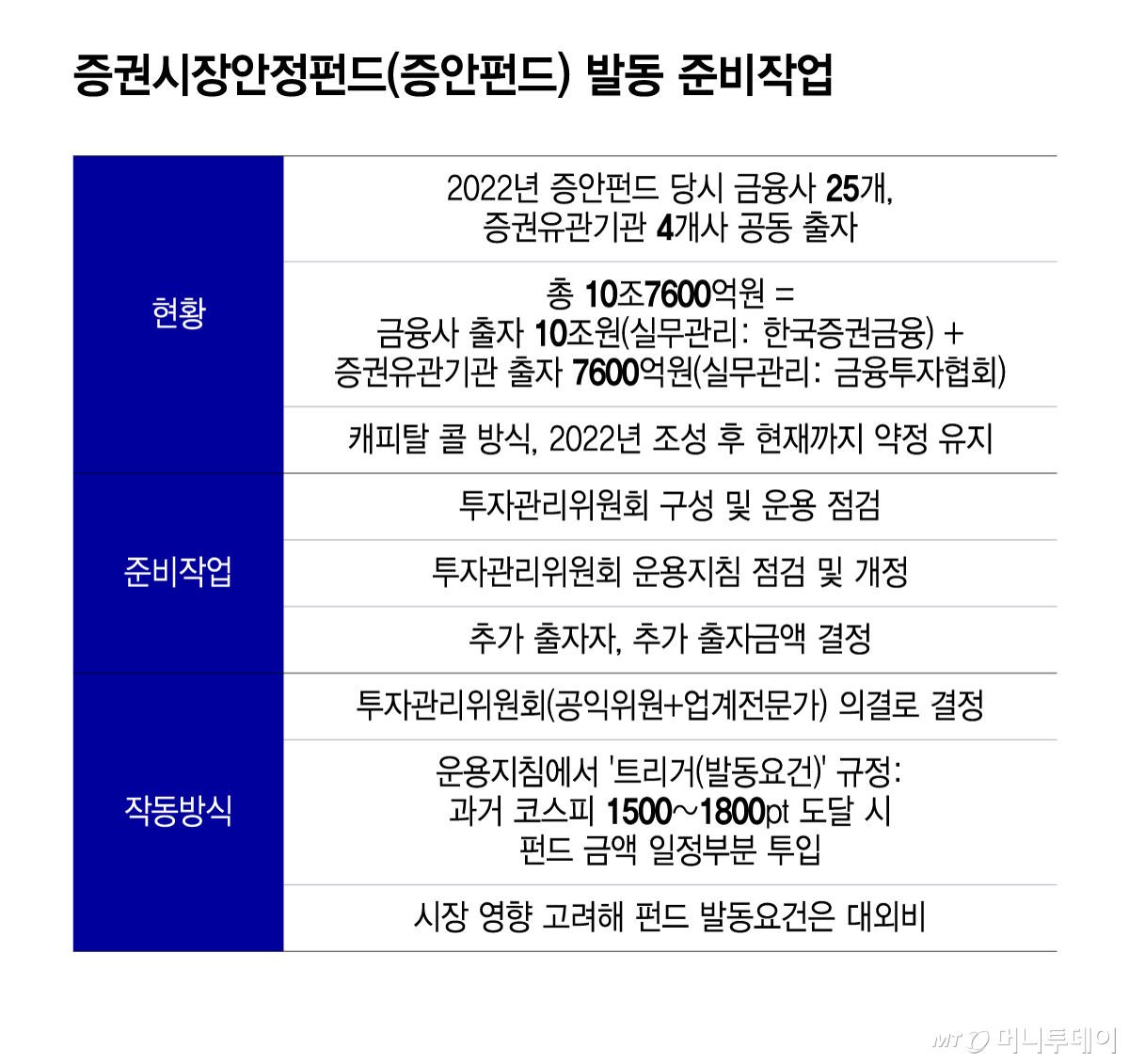
The investment management committee of the 10 trillion won securities market stabilization fund (market stabilization fund) will meet on Nov. 29 to discuss revisions to its operating guidelines.
The meeting will address the deployment index, which determines when and how much of the fund will actually be deployed. Financial authorities are also reviewing funding plans submitted by financial institutions that have pledged contributions to the fund.
According to the financial investment industry and banking sector on Sunday, the fund's investment management committee will hold a meeting in the afternoon to discuss revisions to its operating guidelines.
The 10 trillion won fund was initially established in 2020, led by state-run and commercial banks, and renewed in 2022. The key agenda item is adjusting the deployment index to reflect changes in stock market conditions.
According to industry sources, the current guidelines set the deployment index at a KOSPI range of 1,500 to 1,800 points, based on market conditions in 2022. With the benchmark index now fluctuating between 4,500 and 5,000 points, the deployment threshold is expected to be raised substantially.
The investment management committee consists of representatives from financial institutions that have pledged contributions to the fund and public interest committee members.
A total of 11 people are expected to attend the meeting, including representatives from nine private financial institutions that have committed contributions and two public interest members. The committee also takes into account opinions from outside experts in the private sector and academia when making decisions.
It remains unclear whether the operating guidelines will be revised at the meeting. Further discussions may be necessary if the committee fails to meet the quorum required for approval.
The fund's deployment index is kept strictly confidential. If the trigger level for activating the fund becomes public, investors could use it as a benchmark for buying and selling stocks, potentially undermining the policy's effectiveness.
Meanwhile, discussions on expanding the fund and deploying its capital have also gained momentum. On Nov. 23, the Korea Development Bank sent emails to private financial institutions, including banks and securities firms, asking whether they would make additional contributions and, if so, how much.
The move came amid growing calls that the existing 10 trillion won fund may not be sufficient. The fund operates under a capital call system, under which participating financial institutions contribute their pledged amounts when certain conditions are met.
Financial authorities are reviewing funding plans to check how institutions that have pledged contributions to the 10 trillion won fund will actually secure the money.
The Financial Services Commission will hold an emergency financial market review meeting at the government complex in Seoul on the morning of Nov. 30, chaired by FSC Chairman Lee Eog-weon.
The heads of the country's five major financial groups — KB, Shinhan, Hana, Woori and NH — as well as the chairman of the Korea Development Bank and heads of financial industry associations will attend. They will discuss conditions in the financial and securities markets following the Bank of Korea's benchmark interest rate hike.

 in STOCK
