

[For more diverse corporate information on startups mentioned in this article, please visit 'Data Lab' on the Unicorn Factory Big Data Platform .]
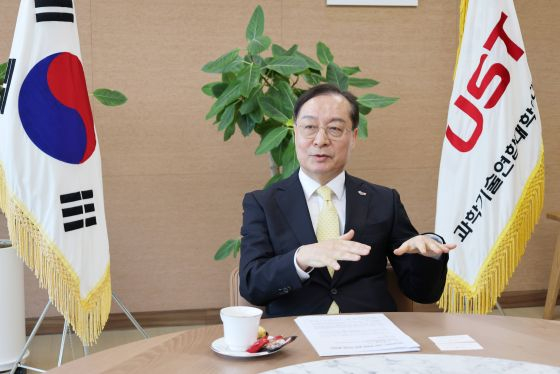
"We will cultivate talents who do not remain in laboratories but connect technology to business and change the world."
Kang Dae-im, President of the United States-Korea Graduate University (UST), stated, "I realized painfully that even the best technology has no meaning if customers do not choose it." He added, "Based on my experience in venture companies, I am reshaping the educational framework by designing a 'Master-Apprentice Co-Travel Startup Model.' Furthermore, he emphasized that during his term, he considers two key evaluation indicators: establishing an academic system where students who fail in startups are not expelled but can return to their laboratories, and fostering a startup culture where research does not end as mere research but evolves into business."
Established in 2003, UST is a graduate university supported by national research institutions. It operates under an apprenticeship-style education system where professors and students conduct research together across 30 affiliated institutes, including the Korea Institute of Science and Technology (KIST) and the Electronics and Telecommunications Research Institute (ETRI). With approximately 1,700 current students and around 4,300 cumulative graduates, UST is an internationalized institution for cultivating research talent, with foreign students accounting for about 26% of its population.
Kang Dae-im, who previously served as the director of the Korea Research Institute of Standards and Science (KRISS), took office in February last year. After leaving KRISS following 38 years of service, he held positions such as Vice President for Research at DGIST before serving as CEO of Hexa, a venture company developing hydrogen storage devices, for over two years. Although the technology development was successful, financial issues within the parent company led to the closure of the company after just two and a half years. Through this experience, he realized painfully that even the best technology is meaningless without customer acceptance, leading him to reflect on his overly technology-focused approach during his time at national research institutes.
Within about a year of taking office, President Kang has implemented significant changes, including launching a student startup track (conversion and master types) for master-apprentice deep-tech startups, introducing an AI utilization certification system, operating flagship majors in strategic national fields, and promoting the restoration of science and technology policy majors. Money Today's startup media platform, Unicorn Factory, interviewed President Kang to learn about his vision for UST's future.
-Why did you leave KRISS five years before retirement to join a venture company?
▶I believed that companies were the best places to realize the various benefits provided by the state. I joined a small company with only 15 employees, which had a business model for storing and transporting liquefied hydrogen. Although the parent company received hundreds of billions of won in investments during the government-led hydrogen industry boom, the business model itself was difficult to establish. Eventually, I took over the spin-off company that separated only its research and development division.
-What was the biggest difference you felt between the laboratory and the venture field?
▶As a researcher, it was natural to aim for world-first or best-in-class technologies. However, after directly experiencing the investment landscape in a company, I realized that such achievements alone are insufficient for business success. If my 38 years as a researcher were life in a greenhouse, those two and a half years in venture companies were like surviving in the wild. Ultimately, I came to understand that even the best technology is useless without customer acceptance, leading me to reflect on how overly technology-focused I had been during my time at national research institutes.
-Did this experience lead you back to academia and research?
▶In a sense, yes. After working at Chungnam National University Yeon Gu (Prof.), I learned about the open recruitment for UST president and applied. I wanted to share my venture company experiences with students. I began to believe that education should enable students to consider markets from the very beginning of research planning. Therefore, when submitting my plan for the presidential recruitment, I wrote that I wanted to provide startup opportunities for about 10% of current students. This was because I believed that even if startups do not necessarily succeed, the experience itself would change students' perspectives and attitudes toward research.
-What did you find upon taking office?
▶Reviewing UST's annual reports over the past five years shows that startup-related education existed. However, there was not a single case of student startups. Upon investigation, I found that students were not unwilling to start companies but were unable to do so due to internal regulations at national research institutes requiring them to leave their affiliated institutes if they started a business during their studies.
-How did you resolve this issue?
▶I requested institutional improvements from the National Research Council of Science and Technology (NST). Fortunately, as the government strongly encouraged researcher startups, the atmosphere became more favorable. Around December last year, relevant regulatory guidelines were revised. Based on this, we first signed memorandums of understanding (MOUs) with five institutions—ETRI, Korea Institute of Chemical Technology, Korea Institute of Machinery and Materials, Korea Research Institute of Bioscience and Biotechnology, and Korea Research Institute of Standards and Science—to prioritize pathways for students from these institutions. Currently, many other institutions have updated their regulations accordingly.
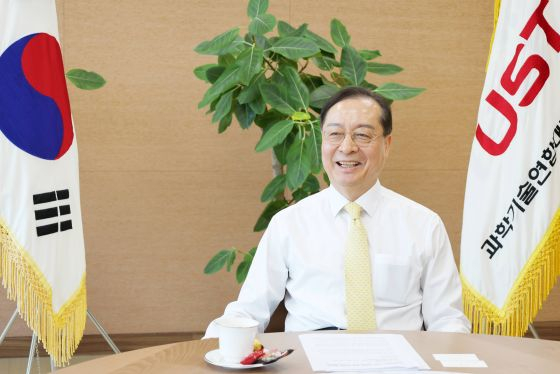
-What specific startup models are you envisioning?
▶A representative model is the 'Master-Apprentice Co-Travel Startup Model,' where students serve as CEOs and professors act as CTOs, or vice versa. This approach allows requirements such as publishing first-author papers in SCIE-level international journals (mandatory for obtaining a doctoral degree) to be replaced with startup achievements. However, defining what constitutes 'a certain level of achievement' is still under development. We plan to establish criteria through consultations with startup experts and investors regarding company incorporation, Series A funding, etc.
-How was the startup track structured?
▶There are two types: 'Conversion Type,' where students who have conducted research at UST for several years and possess certain technologies start companies using those technologies; and 'Master Type,' designed from the outset with entrepreneurship in mind. For the Master Type, we first survey all approximately 1,800 faculty members to identify commercially viable technologies. These technologies are then made public, and interested students enroll as master's candidates to serve as CEOs themselves. Professors with the technology participate as CTOs or in-kind investors, while startup experts and investors join as mentors. In simple terms, this involves matching students with existing technologies to guide them through to startup formation—a model that does not exist anywhere domestically or internationally.
-How have students responded?
▶Last year, we conducted a survey on startup intentions among current students. About 450 participated, with 90 expressing interest in entrepreneurship. This year, the inaugural 'UST Student Startup Track (Conversion Type) – Master-Apprentice Deep-Tech Startup' competition received applications from 15 teams across 12 schools. Startups focused on technologies of a depth only achievable at national research institutes, such as quantum computer resource optimization middleware, radiation drug efficacy prediction services, and satellite camera sensor modules.
-What other areas are you focusing on alongside startups?
▶Cultivating professional talent to lead future industries. Starting this year, we have designated four fields—biotechnology, AI, quantum, and robotics—as 'Flagship Majors' and secured budgets for the 'UST Global Alpha Class,' which invites top international scientists. In June, we conducted a lecture in the biotechnology field, and this summer, three professors from Harvard Medical School will visit to teach students. We currently have a pool of about 30 overseas distinguished faculty members, with the goal of fostering practical collaboration, student-faculty visiting research, and post-doctoral linkages with them in the future.
-I heard you are also introducing a new system that makes 'AI Utilization Certification' mandatory.
▶It will be implemented next year. When I first announced this concept in March last year, interest in AI was not as high as it is now. In the meantime, the government has elevated AI to a national agenda. Rather than through separate exams or certificates, this system requires students to document how they utilized AI in their research papers, aiming to simultaneously improve research quality and assess AI capabilities. It is essentially an 'intrinsic' certification system. Already, overseas journals are rapidly increasing cases where researchers have achieved high-level results by effectively utilizing AI.
-If you had to name one task you must accomplish during your term, what would it be?
▶Restoring the science and technology policy major, which was abolished in 2022. Although it operated from 2005, declining enrollment due to passive management led to its closure. It is rare even among general universities to operate a degree program that cultivates policy experts for each national research field. While technical education is sufficiently provided, the problem lies in the lack of 'conductors' who can comprehensively design these efforts at the national level. As national R&D budgets continue to grow, there is an urgent need to cultivate professional talent with policy capabilities to efficiently design these funds. Particularly given UST's characteristic of having 28% foreign students, we must nurture them into pro-Korean talents capable of leading their home countries' science and technology policies upon returning.
[Money Today Startup Media Platform Unicorn Factory]

 in TECH

