

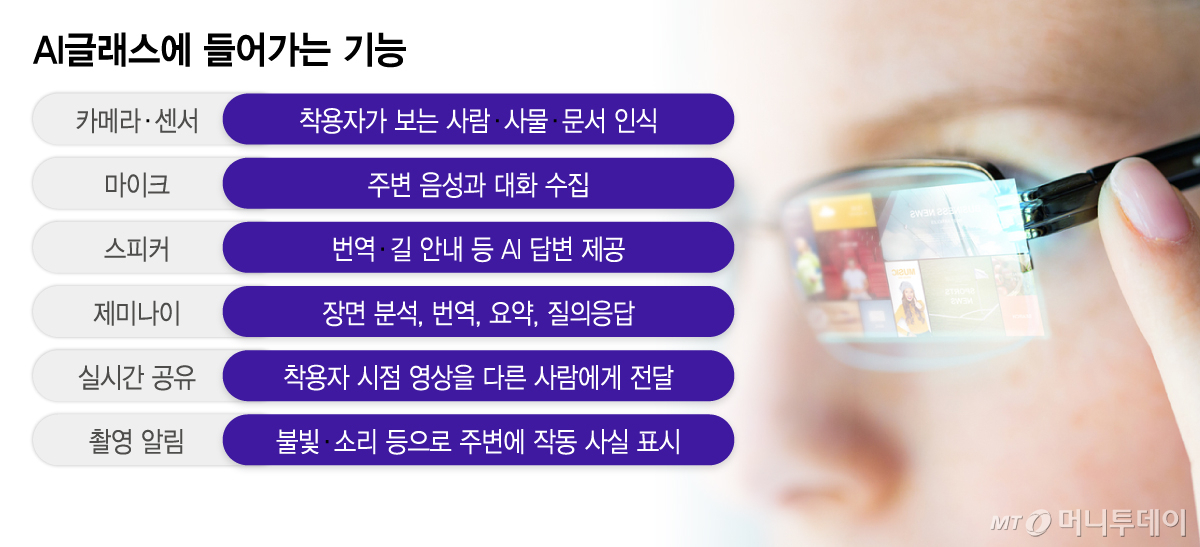
#. A person wearing AI glasses looks at a restaurant menu. The AI inside the glasses speaks the translated foreign language aloud. As they walk, it recognizes buildings and signs to guide them to their destination, and during meetings, it summarizes participants' remarks and whiteboard content.
For the wearer, it is a convenient AI assistant. For those within the glasses' field of view, however, it is a different story. It is difficult for them to know whether they are being captured by a camera, whether their voice is being collected, or whether video is being saved. As AI glasses spread, the center of personal information protection has expanded from "the person using the device" to "the person within the device's field of view."
AI glasses are not simply products with cameras attached to eyeglasses. Cameras, microphones, and various sensors read the surrounding environment like a user's eyes and ears, and AI analyzes this in real time. While some functions do not store information, such as translation or navigation, others record the faces and voices of those around them, including video recording, real-time sharing, and conversation summarization.
Unlike existing smartphones, information collection is not easily noticeable. To take a photo with a smartphone, one must take out the device, open the camera app, and point it at the other party. The subject can relatively easily recognize the situation. In contrast, AI glasses operate while worn like ordinary eyeglasses. It is difficult for the other party to distinguish whether the user is looking at them or whether AI is analyzing their face and voice.
The boundary between recording and simple recognition is also blurred. For AI to read menu text or recognize buildings, the camera must receive input of the surrounding scene. Even if this is not saved as a photo or video, information collection and analysis still occur. This is why new standards are needed regarding whether indicator lights alone are sufficient, or whether notifications are also required for voice/face recognition and cloud transmission.
The solution lies in "Privacy by Design"
The solution emphasized by personal information protection authorities is "Privacy by Design." Rather than limiting functions whenever problems arise after a product is released, this approach involves minimizing collected information and storage periods from the development stage and designing systems so that those around can recognize when the device is operating.
Representative measures include announcing recording status via prominent indicator lights or sounds and preventing users from arbitrarily turning off these display features. Another discussed method involves processing sensitive information such as faces and voices within the device itself to reduce transmission to external servers. There is also a need for functions that allow users to view and delete collected information, as well as structures that automatically discard data after a certain period.
It is difficult to solve all problems with technology alone. Some argue that since people can freely capture images at distances during holidays like Chuseok or Seollal, why should strong regulations apply only to AI glasses? Making recording indicators too conspicuous could also damage the product's design and usability. Conversely, if indicator lights are small or easily obscured, their effectiveness in protecting those around may diminish.
Song Kyung-hee, a personal Jeong Bo-bo-ho (Chairman), stated, "The benefits brought by technology are enormous, but third parties' privacy can be infringed upon," adding, "Users must also consider that they can become third parties when others use AI glasses."
AI Glasses Are Just the Beginning… Demanding Corporate Responsibility for Security
AI glasses are just the beginning. The era is approaching when robots equipped with cameras and sensors enter homes and workplaces, and autonomous vehicles continuously recognize people and vehicles on roads. As AI begins to directly see and hear reality, personal information regulations must also shift toward defining how products view the world in advance.
Lee Gi-hyuk, a professor at Chung-Ang University's Convergence Security Department, explained, "Smart glasses technology is nearly at computer level, so security elements found in computers should be incorporated." He added, "Currently, South Korea has IoT security standards, but there are no such standards for smart glasses yet." He further noted, "Usually, products do not establish security standards before commercialization. For now, the only way forward is for manufacturing companies to take responsibility for security and develop accordingly."

 in TECH

