

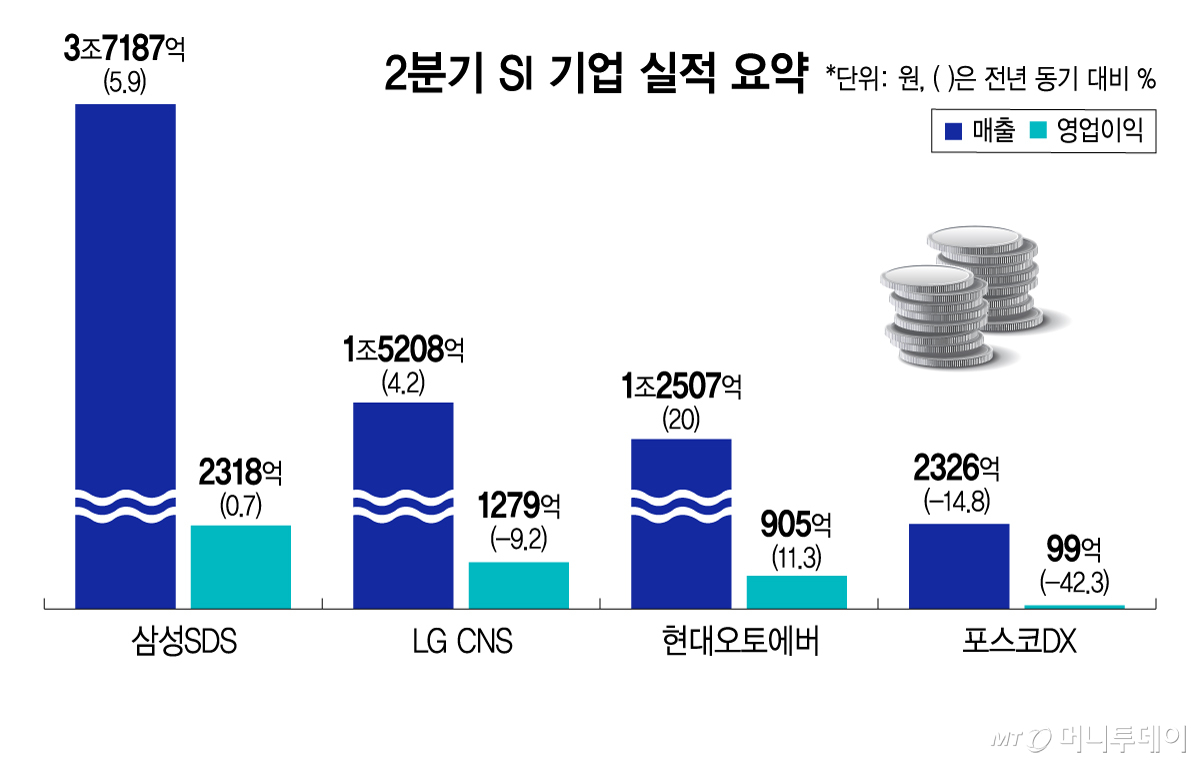
Major domestic SI (system integration) companies defended their performance based on their AI and cloud capabilities. While each company increased related investments, differing strategies are expected to determine future results.
According to the IT industry on the 3rd, SamsungSDS (Samsung SDS) and LG CNS (LG CNS) posted strong results in the second quarter one after another.
For SamsungSDS, revenue from the CSP (cloud service provider) segment of its cloud business increased by 24% year-on-year, leading performance. This was driven by increased demand for SCP (Samsung Cloud Platform) and expanded GPUaaS services for public and external industries. Revenue in the MSP (managed services) segment also rose 17% year-on-year, as the AX business in the financial sector and the ERP (enterprise resource planning) business in the shipbuilding sector grew.
SamsungSDS plans to expand strategic investments in digital assets and physical AI fields. Having secured a 4% stake in Dunamu last May, the company aims to uncover new business opportunities in the digital asset infrastructure market based on this holding. It also plans to expand its existing 110MW-scale AI infrastructure to 230MW by 2029 and further grow its AI infrastructure business to over 800MW by 2031, including DBO (design, build, operate) projects.
LG CNS also saw a 5.1% year-on-year increase in revenue from its AI and cloud businesses. Growth was driven by rising demand for cloud-based AI services and expansion of the MSP business. Projects to build AI platforms and data areas continued to grow, while demand for AI infrastructure construction increased and stable growth in maintenance businesses persisted.
LG CNS plans to focus on the physical AI sector in the second half of the year to accelerate robot commercialization. The company intends to partner with promising robot firms to expand its RX (robot transformation) ecosystem, optimizing from general-purpose RFM (robot foundation models) to high-difficulty 'robot hand' RFMs for industrial sites. Overseas, it plans to complete the Indonesia AI data center, which it secured as the first domestic company, and expand its efforts to penetrate the North American manufacturing AX market.
Hyundai AutoEver and POSCODX saw mixed results influenced by their parent groups.
For Hyundai AutoEver, strong external growth of major overseas subsidiaries continued due to expanded global IT investments driven by accelerated digital transformation within the group. Additionally, as cloud demand increased and next-generation ERP transition projects were built amid accelerated group digital transformation, revenue and operating profit rose 20% and 11.3%, respectively, year-on-year.
In contrast, POSCODX saw revenue and operating profit decline by 14.8% and 42.3%, respectively, year-on-year due to the aftermath of group investment adjustments. POSCODX has declared itself a full-fledged AI-native company and plans to drive its business with physical AI and agentic AI as two pillars. The strategy involves simultaneously expanding physical AI at manufacturing sites and AX within the group. However, the expansion of external customers, which reached only 3% in the second quarter, remains a challenge.
An industry insider stated, "As we face an AI transition period, favorable winds are blowing for SI companies' performance." They added, "Almost all companies are increasing related investments, so strong results are expected for some time; however, as competition intensifies, strategies to secure customers have become crucial."

 in TECH
