

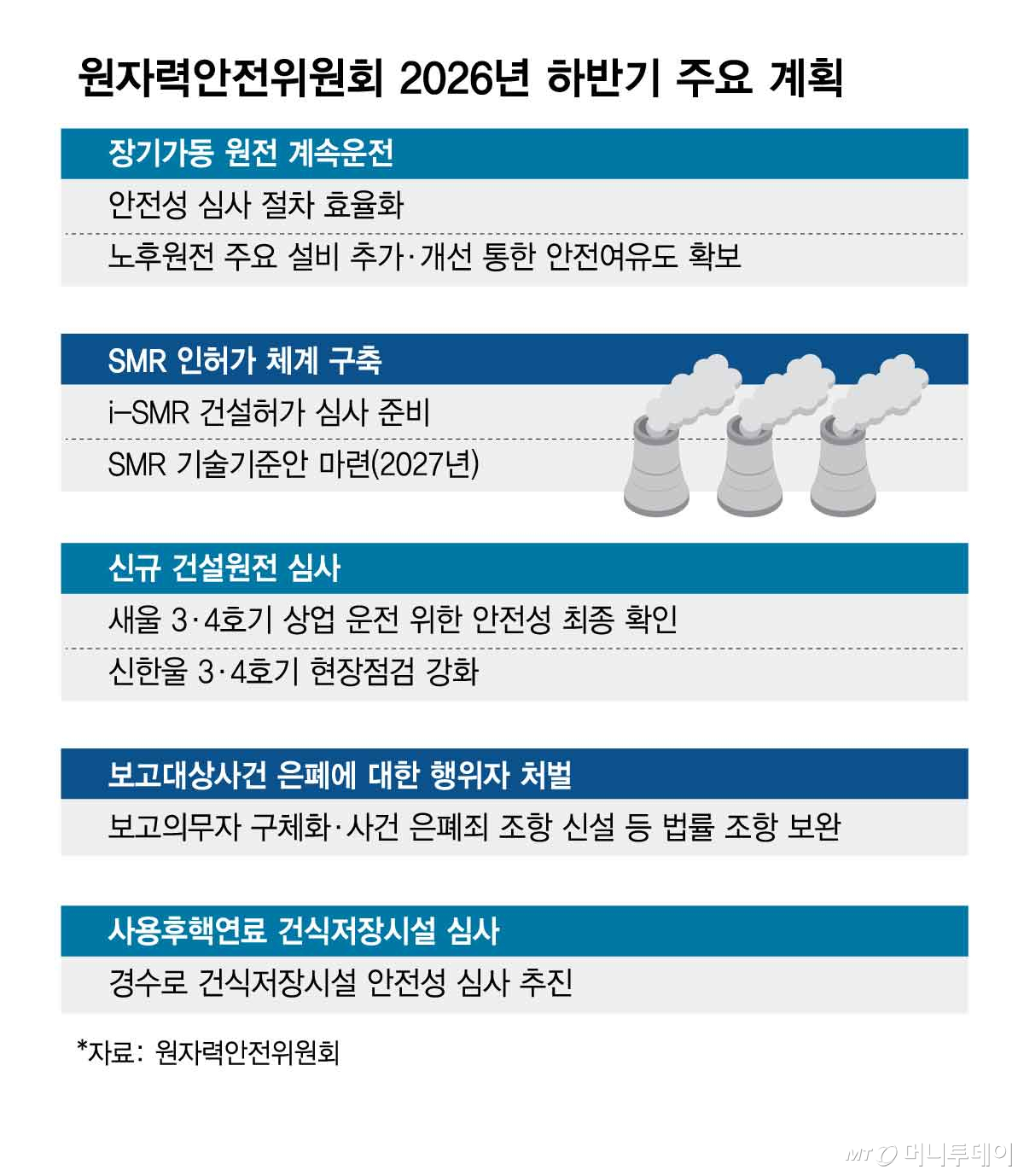
Amid consecutive heatwaves pushing this year's power demand beyond its peak, the Nuclear Safety and Security Commission plans to streamline licensing for new nuclear reactors and review the safe restart of aging plants to ensure national energy supply stability.
On the 4th, the Nuclear Safety and Security Commission reported these 2026 second-half work plans to the President at Cheong Wa Dae's guesthouse.
The commission aims to comprehensively secure nuclear and radiation safety by addressing diverse regulatory demands—including licensing for new and continuing-operation reactors, SMR (small modular reactor) approval systems, and the introduction of dry storage facilities for spent nuclear fuel—as well as expanding radiation use across industries.
First, the Nuclear Safety and Security Commission stated it will thoroughly verify the safety of reactors applying for continued operation, such as Hanbit Units 1 and 2 and Gori Units 3 and 4, at a level equivalent to new reactors. Particularly considering that some reactors have operated for over 40 years, the commission plans to strengthen facilities and equipment to ensure adequate safety margins.
Currently, 10 reactors have applied for continued operation. Among them, Gori Unit 2 was approved for continued operation in November last year—the first such approval—and has been operating at 100% output since April this year.
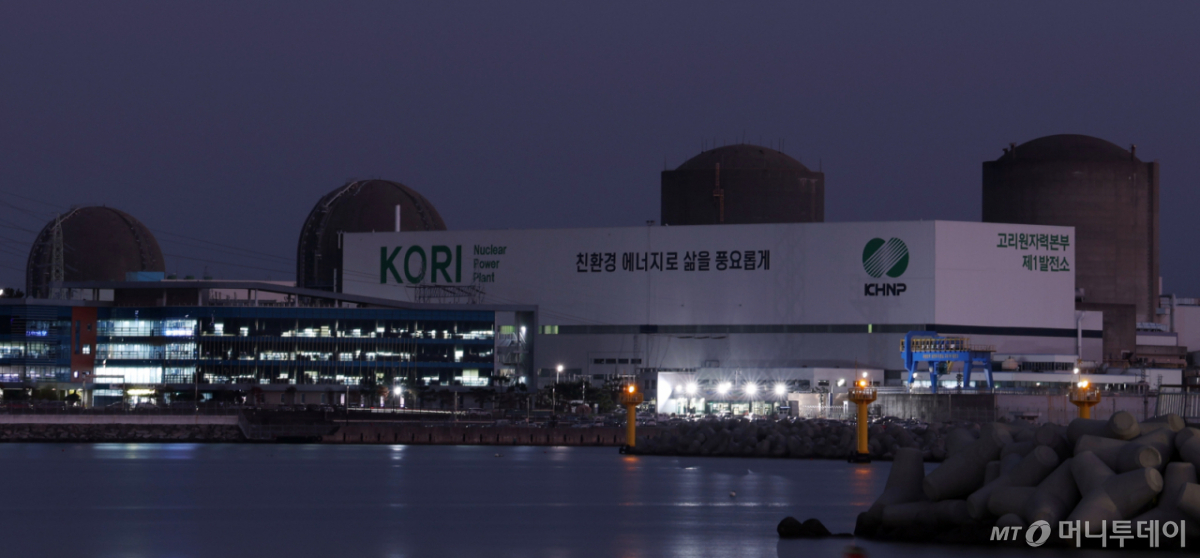
Gori Units 3 and 4 will also submit their continued operation license applications to the Nuclear Safety and Security Commission in the second half of this year. Hanbit Units 1 and 2 are scheduled for the first half of 2027. To expedite resolutions on continued operations, the commission plans to operate a regulatory issue review team while concurrently conducting expert committee reviews to streamline procedures.
The commission will also establish an approval system for SMRs. The innovative SMR (i-SMR), which applied for standard design certification in February, will be subject to dedicated review organizations and specialized guidelines. Additionally, technical standards and evaluation methodologies for verifying safety during the Jeonju phase (construction, operation, decommissioning) will be refined.
Furthermore, the commission plans to finalize SMR technical standards by the end of 2027 and revise the legal framework by 2030 to encompass various reactor types serving diverse purposes.
The commission also intends to meticulously review the design and structural integrity of the "dry storage facility for spent nuclear fuel," which will be first introduced at domestic light-water reactors (Hanbit Nuclear Power Plant). While leveraging experience from reviewing dry storage facilities currently operating at Wolseong Nuclear Power Plant, the commission will focus on verifying design differences specific to light-water reactor fuels. Review findings will be fully disclosed to local residents.
Safety of six large-scale nuclear reactors totaling 8.4 gigawatts (GWe) under construction will also be verified. Saewol Unit 3 is expected to receive commercial operation approval as early as October. For Saewol Unit 4, the commission plans to submit its operation license application immediately after completing reviews, with December being the most likely timing. Additionally, on-site inspections for each major construction phase of Shin-Saewol Units 3 and 4 will be strengthened, and preliminary technical standard checks will be conducted at Yeongdeok, Gyeongbuk, a potential site for new reactors.
Meanwhile, amendments to the Nuclear Safety Act are being pursued to hold individuals who intentionally conceal nuclear or radiation incidents accountable. The Nuclear Safety and Security Commission is considering reinforcing legal provisions to penalize not only operators but also employees directly responsible for concealing reportable events, clarifying reporting obligations, and potentially establishing a new crime of incident concealment. The revised bill is scheduled to be finalized by December following consultations with relevant institutional investors.
Choi Won-ho (Chairman) stated, "For national energy policies to proceed without delay, safety that the public can trust must be ensured above all else." He added, "To support the Republic of Korea's irreplaceable status, we will thoroughly verify the safety of nuclear facilities and transparently disclose both the process and results."

 in TECH

