

A measurement of electromagnetic wave exposure levels from products and facilities encountered in daily life, including AI home appliances, single-person small appliances, and data centers, revealed that all met Korea's human health protection standards.
The Ministry of Science and ICT announced on the 10th that a total of 22 types (34 units) of consumer products, four smart bus stops, and 4,780 living environment sites were measured for electromagnetic wave exposure levels, and all met Korea's human health protection standards for electromagnetic waves.
To alleviate public concerns about electromagnetic waves in daily life, the Ministry of Science and ICT annually selects high-interest products and locations on a semi-annual basis to measure electromagnetic wave intensity and publicly release the results. From 2019 through last year, investigations covered 218 types (544 cases) of consumer products and facilities, as well as 31,055 living environment sites.
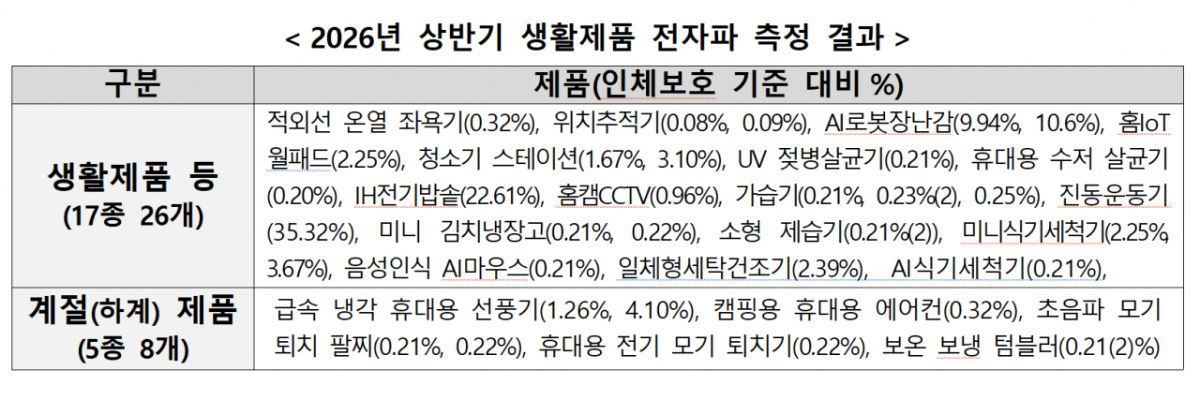
In the first half of this year, the National Radio Research Institute conducted precise measurements of electromagnetic wave intensity over approximately one month for 22 types (34 units) of consumer products, including AI home appliances and single-person small appliances. The results showed that electromagnetic wave levels generated by consumer products ranged from 0.08% to 35.32% of the human health protection standard. By product type, vibration exercise machines recorded the highest level at 35.32%, followed by IH electric rice cookers at 22.61%, and AI robot toys ranging from 9.94% to 10.6%. AI dishwashers measured at 0.21%, and voice-recognition AI mice also registered at 0.21%.
Seasonal products with increased summer usage also remained well below the standard. Portable rapid-cooling fans measured between 1.26% and 4.10% of the standard, portable camping air conditioners at 0.32%, and ultrasonic mosquito repellent bracelets at 0.21% to 0.22%.
Smart bus stops, which house multiple ICT (information and communications technology) facilities such as heating and cooling systems, air circulation devices, and Wi-Fi equipment, were also included in the survey. Measurements of four smart bus stops in Songdo New City, Incheon, under summer usage conditions revealed electromagnetic wave levels ranging from 1.02% to 1.11% of the human health protection standard.
All 4,780 living environment sites, including child and youth facilities, medical facilities, and data centers, met the standards. Among these, 2,956 sites were facilities where citizens directly requested measurements. Electromagnetic wave levels at child and youth facilities, medical facilities, and facilities for the elderly and persons with disabilities were around 1% of the human health protection standard, while integrated facilities including residential and commercial areas and data centers remained within 4%.
A Ministry of Science and ICT official stated, "In the second half of the year, we plan to measure electromagnetic wave exposure levels for products directly requested by citizens, seasonal products with high demand, and living environments with high public interest in electromagnetic waves, and will publicly release the results."

 in TECH
