

"The United States launched an 'AI (Artificial Intelligence) platform' through the Genesis Mission, which unites the experimental facilities of 17 national laboratories. Our industry, academia, and research sectors also possess sufficient capabilities. The remaining task is to connect these respective capabilities." (Heo Hwan, Director of Research Equipment Industrialization Division at Korea Basic Science Institute)
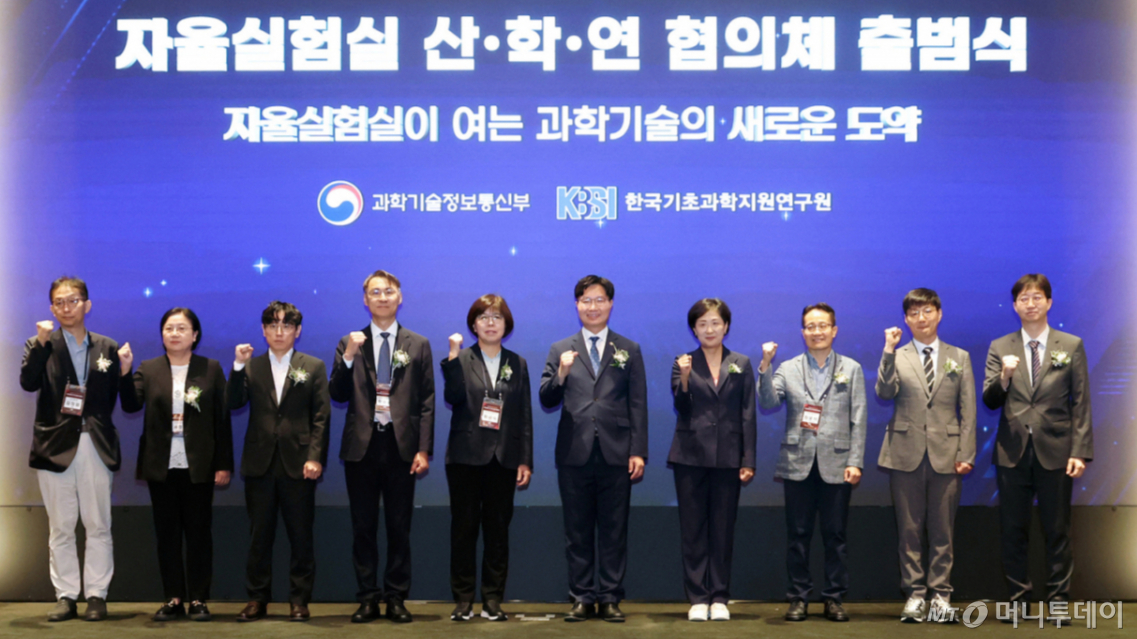
The nation's first 'Autonomous Laboratory' consortium, which will serve as the foundation for the government-wide R&D (Research and Development) project 'K-Shoot', held its launch ceremony on the 11th at El Tower in Yangjae, Seoul, marking the beginning of its operations.
An Autonomous Laboratory (Self-Driving Lab·SDL) is a research platform that connects experimental equipment, robots, and AI into a single system to automatically repeat experiments without human intervention. It is essentially a '24-hour full-capacity' laboratory. AI simultaneously explores vast experimental conditions to provide hypotheses. Significant investments are being made globally, including the U.S. Department of Energy's (DOE) major R&D project, the Genesis Mission. If realized, research timelines could be shortened from years to months.
In Korea, demand for autonomous laboratories is rapidly increasing, particularly in advanced fields such as biotechnology and materials science. It also serves as a core foundation for the government-wide project 'K-Shoot'. K-Shoot aims to double research productivity by 2030 by deploying AI in strategic technology R&D. However, infrastructure to support the establishment of autonomous laboratories is insufficient. The most significant issue is that equipment, data, and operational standards vary across institutional investors. If autonomous laboratories created by each institutional investor cannot be connected, achieving major results will be difficult, and resource waste may occur.
The consortium will focus on developing autonomous laboratory technologies, jointly utilizing infrastructure, accumulating data, and establishing standards and interfaces. Professor Jung Yu-seong of Seoul National University serves as chairman, with the National Center for Science AI Research and Korea Basic Science Institute (KBSI) serving as co-secretaries. Fifty demand-side companies, including Samsung Advanced Institute of Technology and SK Hynix, along with supply-side companies such as Park Systems and H-B Solution, and over 30 universities and research institutional investors are participating.
Director Heo Hwan stated, "To enable AI to handle hypothesis setting, experimental design, and result analysis in laboratories, bridging this gap through 'mutual specifications' is crucial." He added, "Through the consortium, we will create a data standard platform that serves as the basic condition for interoperability."
Jeong (Chairman) emphasized, "Connecting multiple autonomous laboratories to solve problems that cannot be resolved by a single laboratory is an important task at this point," and noted, "When researchers, demand-side companies, equipment suppliers, software-data companies, and operational standard institutional investors come together, each can contribute and benefit."
The consortium plans to hold monthly regular meetings and annual conferences to identify policy agendas.

 in TECH
