

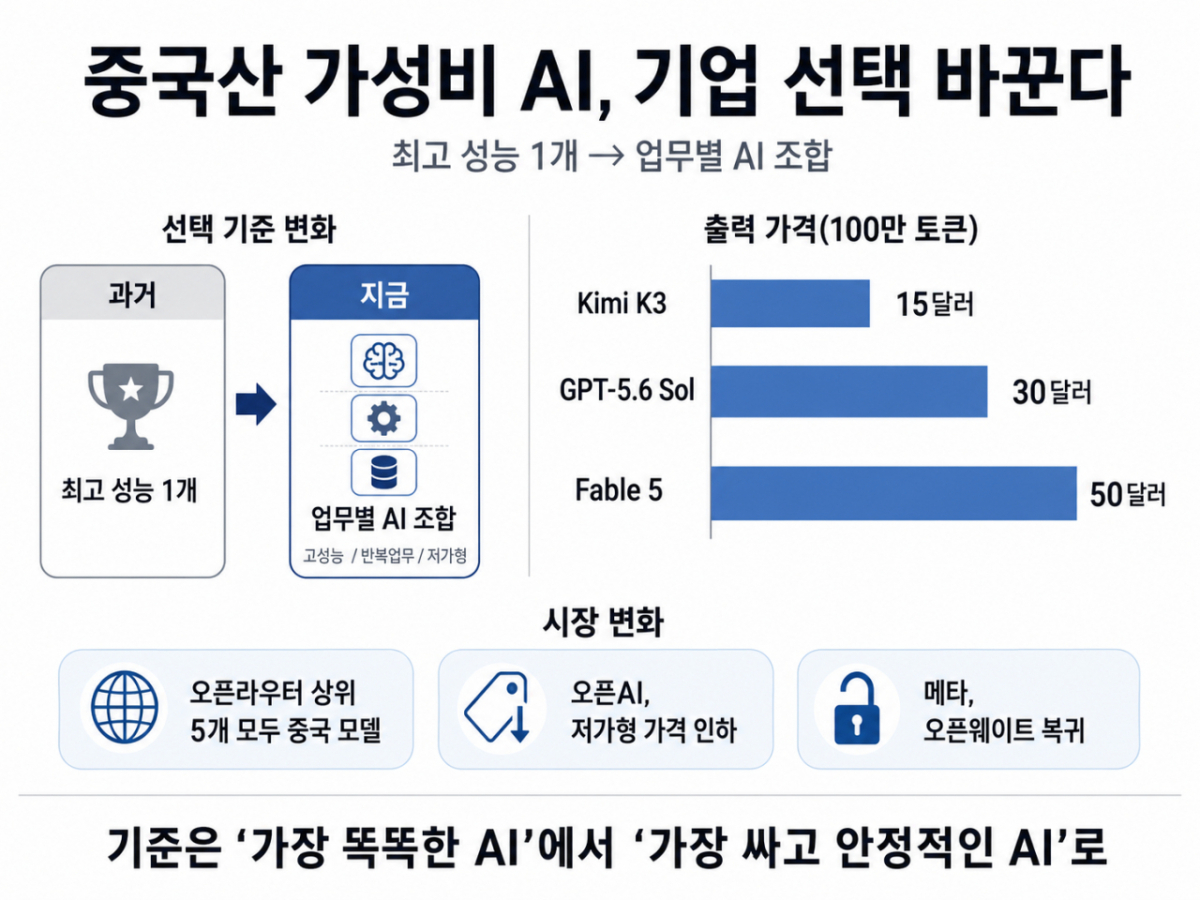
Companies' criteria for choosing AI are changing. Instead of using a single smartest AI for all tasks, they use high-performance models for difficult jobs and cheaper models for simple ones. Chinese open-weight AI that boosts performance while lowering prices is accelerating this shift.
According to the AI industry on the 15th, open-weight models from China's WenShai AI, including 'Kimi K3' released last month, as well as Z.ai, Alibaba, and DeepSeek, are gaining presence in the global market. Open-weight refers to models that release the 'weights' containing the results of AI training. Unlike the method of accessing developer servers like ChatGPT to rent usage, companies can download the model and run it directly on their own servers.
In fact, on the actual AI model brokerage platform OpenRouter, the top five models by usage last month were filled entirely with Chinese models for the first time in history. Reuters analyzed that companies are no longer just seeking the most expensive and high-performance AI but are starting to look for models that can handle necessary tasks sufficiently while also lowering costs.
Kimi K3 is a representative case showing this trend. With a total of 2.8 trillion parameters, it is the largest-scale open-weight model in history, yet it does not use all parameters to process a single question. It applies the 'MoE (Mixture of Experts)' method that activates only about 104 billion parameters selected as needed. This is similar to calling upon only a few experts suited to the question rather than running the entire massive AI every time. Through this, it lowered computational costs while maintaining performance.
In WenShai AI's own evaluation, Kimi K3 did not quite match top-tier closed models like OpenAI's GPT-5.6 Sol and Anthropic's Claude Fable 5 but recorded comparable performance in various fields. However, the price difference is significant. Kimi K3 costs $3 for input and $15 for output per 1 million tokens. This is half of GPT-5.6 Sol ($30) based on output and 30% of Fable 5 ($50).
The judgment that there is no need to entrust all tasks to top-tier AI is spreading. High-performance models are used for important analysis or difficult coding, while cheaper models are assigned to repetitive tasks like customer inquiry classification or document summarization. This is similar to choosing between passenger cars and trucks depending on the purpose rather than solving everything with a single car.
OpenAI is also moving in the same direction. Last month, it launched GPT-5.6 in three tiers: top-tier Sol, mid-tier Terra, and low-cost Luna. Within just three weeks thereafter, Terra prices were cut by 20% and Luna by 80%. It has begun to match prices with Chinese companies not only in the competition for top performance but also in the market for affordable AI.
Another reason open-weight is attractive to companies is 'control.' Installing models on their own servers allows companies to process data that is burdensome to send outside, such as corporate secrets or customer information, within the company. It is also easy to further train models according to specific tasks or modify functions.
However, companies cannot immediately switch to Chinese AI just because it is cheap and high-performing. Since they handle corporate secrets and customer information, they must also examine what data the model was trained on and how the developer manages the model. In the United States, some state governments and government institutional investors have restricted or banned the use of Chinese AI models for security reasons.
The utilization of Chinese open-weight is already underway domestically, such as SK Telecom developing its Korean-specialized model 'A.X 4.0' based on Alibaba's Qwen. In the future, it is highly likely that US AI like ChatGPT and Claude, Chinese open-weight models, and domestic AI will be compared together in the same market regarding price, performance, security, and technical support.
The questions companies ask are also changing from 'Which AI is the smartest?' to 'What is the AI that can handle this task most cheaply and stably?'

 in TECH
